




Forget Apple: Why Microsoft Is a Far Better Value Today
Key Points
The market has turned against Microsoft over the past six months.
Apple still holds its premium despite posting results similar to Microsoft's.
- 10 stocks we like better than Microsoft ›
Apple (NASDAQ: AAPL) continues to maintain its status as one of the three most valuable companies in the world (behind Nvidia and trading No.2 and No. 3 positions regularly with Alphabet). Investors are paying less attention to Apple in the age of AI, but it has still been a strong stock pick over the past year, although it hasn't escaped the recent tech sell-off. However, I'm not convinced that all of this rally is driven by business gains, and I think there are far better values out there.
One of the biggest (if not the biggest) bargains I can think of right now is the fourth-largest company in the world: Microsoft (NASDAQ: MSFT). If you're deciding between the two, I think Microsoft makes for a far better value, and I've got a few metrics to back that up.
Where to invest $1,000 right now? Our analyst team just revealed what they believe are the 10 best stocks to buy right now, when you join Stock Advisor. See the stocks »

Image source: Getty Images.
Microsoft's stock is cheap compared to Apple and its own average
Valuing a stock can be done in numerous ways. Given two mature businesses that generate mountains of profits, the price-to-earnings (P/E) ratio is a commonly used valuation metric. From this standpoint, Microsoft is trading at a low valuation compared to historical levels and is about 50% cheaper than Apple.
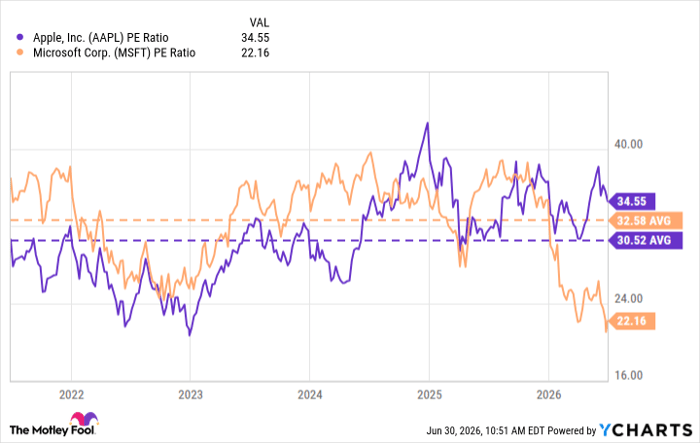
Data by YCharts.
That's a huge delta between the two, but that's not the only way these companies are valued. Investors also like to account for growth in their valuations, so they'll also utilize the forward P/E ratio to get an idea of where the stock is heading. Both Apple and Microsoft operate on non-traditional fiscal years; Microsoft's wraps up at the end of June, and Apple's is complete in September. Because we're nearing the end of both fiscal years, I'll use fiscal year 2027 projections for each of them.
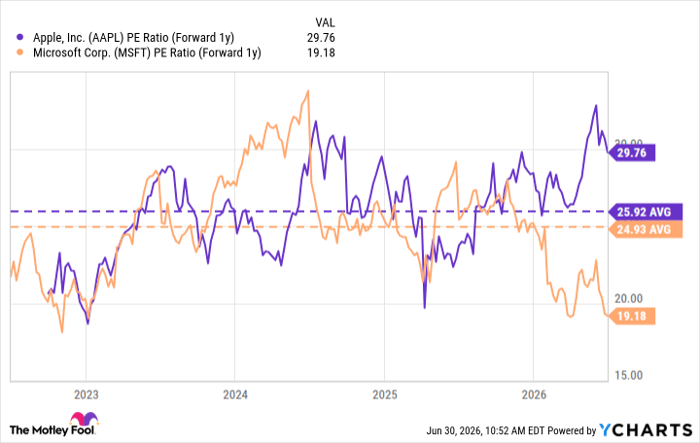
Data by YCharts.
The same gap exists in the forward earnings valuation as in the trailing earnings valuation, suggesting that their future growth rates are likely to be similar. So, if that's the case, then why would you want to own Apple stock versus Microsoft's? Well, some good reasons would be fear of overspending on AI on Microsoft's part, AI replacing some of Microsoft's staple software applications, or Microsoft's overreliance on its partnership with OpenAI. Those are some bearish arguments against Microsoft's stock, but I think they carry roughly the same weight as those against Apple. Apple hasn't spent much on AI, hasn't released a major iPhone revision for years, and hasn't launched a major new product recently, either.
There are valid arguments against both companies, but I still think each is holding its own in the current market. As a result, Microsoft looks like the better buy because its stock is far cheaper and could easily enter a multiple expansion phase, leading to major gains as the market values it higher. That could drive large returns in a short time frame, making it a time-sensitive buy as well.
Should you buy stock in Microsoft right now?
Before you buy stock in Microsoft, consider this:
The Motley Fool Stock Advisor analyst team just identified what they believe are the 10 best stocks for investors to buy now… and Microsoft wasn’t one of them. The 10 stocks that made the cut could produce monster returns in the coming years.
Consider when Netflix made this list on December 17, 2004... if you invested $1,000 at the time of our recommendation, you’d have $385,055!* Or when Nvidia made this list on April 15, 2005... if you invested $1,000 at the time of our recommendation, you’d have $1,228,089!*
Now, it’s worth noting Stock Advisor’s total average return is 902% — a market-crushing outperformance compared to 209% for the S&P 500. Don't miss the latest top 10 list, available with Stock Advisor, and join an investing community built by individual investors for individual investors.
See the 10 stocks »
*Stock Advisor returns as of July 1, 2026.
Keithen Drury has positions in Microsoft. The Motley Fool has positions in and recommends Apple and Microsoft. The Motley Fool has a disclosure policy.
Recommended Articles


