




Pfizer vs Verizon Communications: Which High-Yielding Dividend Stock Is the Better Buy?
Key Points
Pfizer and Verizon Communications are extremely high-yielding dividend stocks that trade at low valuations.
They have been raising their payouts for many years.
The companies, however, face very different risks and paths forward.
- 10 stocks we like better than Pfizer ›
Picking a good dividend stock for your portfolio can be challenging, especially when there are many attractive high-yielding options to choose from. And there's much more to consider than just the yield itself.
Below, I'll compare a couple of top dividend stocks: Pfizer (NYSE: PFE) and Verizon Communications (NYSE: VZ). While they're in different sectors, they both may be alluring options for dividend investors because they are blue chip stocks that have been known for generating plenty of dividend income over the years. Pfizer yields around 7.1% while Verizon's payout is closer to 6.7%. They also trade at less than nine times their expected future earnings (based on analyst expectations), making them attractive value buys.
Missed Nvidia in 2009? This Rare Signal Is Flashing Again. In 2009, a "Double Down" signal flashed for a little-known chipmaker called Nvidia. For the first time in years, that same "Total Conviction" signal is flashing for a company 1/100th the size of Nvidia. Continue »
But which one is the better buy? Let's take a look at which one is superior when evaluating multiple criteria.

Image source: Getty Images.
Which dividend is safer?
This is the crucial, first qualifying question to ask when evaluating dividend stocks. If the payout isn't safe, then nothing else really matters, because if it's in danger of being cut, the yield, track record, and dividend growth won't be of much comfort at that point.
Verizon's payout ratio based on earnings is around 67%. It's a good, healthy rate that you want to see from a quality dividend stock. Pfizer is a bit more complicated. Its payout ratio is more than 100%, but the reality is that its earnings are worse than they look due to acquisition-related expenses and non-cash items. This is where just looking at the payout ratio falls short.
In terms of cash flow, the story looks a bit better for Pfizer as its free cash flow has been more than the cash dividends the company has paid out in two of the past three quarters. It can fluctuate, but generally, the payout looks well-supported. Over the trailing 12 months, Pfizer's free cash has been a bit lower than the dividends it has paid out, but with the company in the midst of cutting costs, that should improve.
Pfizer's dividend looks reasonably safe, but it's clear that the edge here goes to Verizon, which has generated a massive $20 billion in free cash over the past four quarters, well above the $11.5 billion it has paid in dividends.
Which dividend has been growing at a faster rate?
Having plenty of room to pay dividends is one thing, but some companies hoard the cash or use it for other purposes rather than paying dividends. For dividend investors, it's important to consider which company actively rewards its shareholders and is generous with the dividend. Both of these stocks have been raising their payouts over the years, but one has been increasing them at a far higher rate than the other.
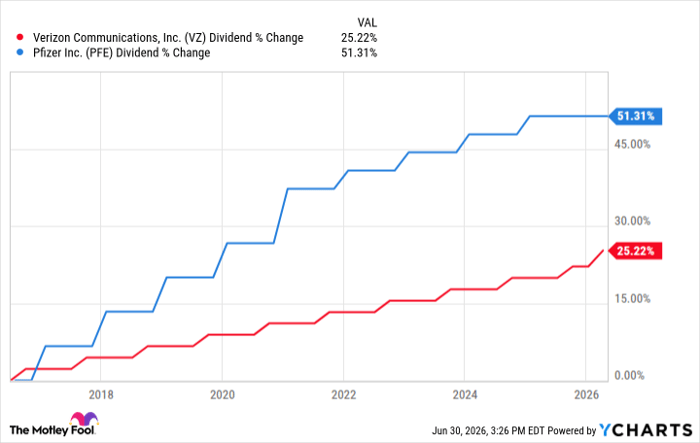
VZ Dividend data by YCharts
The edge clearly goes to Pfizer here. But it's worth noting the big spike around 2021 when Pfizer generated a boatload of revenue from its COVID vaccine and pill, and the slowing down of its dividend growth rate recently. When taking that into account, plus the restructuring it's undertaking right now, it's not as overwhelming an advantage for Pfizer anymore; its rate of increases may be much more modest in the years ahead.
Which company may be in better shape in the future?
This is an important question to ask because when looking at dividend stocks, it's crucial to also consider where a business is headed. While the payout ratio and dividend growth rate may tell you about past results, that doesn't tell you anything about the future.
For Pfizer, the big risk is that the healthcare company is investing heavily in its future growth to offset losses in exclusivity. It might need to free up some cash to pursue acquisitions and invest in more growth opportunities. Investors haven't been encouraged thus far as the stock continues to trade at a low valuation; it's down close to 40% in five years.
For Verizon, its big unknown is related to SpaceX and how competitive its Starlink business may prove to be. It's a tough question to answer right now, but Verizon may face greater adversity and competition, leading to more aggressive pricing, margin pressure, and lower earnings and free cash flow.
Verizon, however, doesn't have to drastically alter its growth strategy and likely spend as heavily as Pfizer might; thus, it gets the edge based on their criteria.
Verizon is the better-looking dividend stock right now
The only metric that might make Pfizer look better than Verizon is dividend growth. But even then, when predicting future dividend growth, I think Verizon may be better positioned to increase its dividend faster, given its stronger financials.
While both of these stocks can be compelling dividend options for investors, I think Verizon is the far better and safer buy today.
Should you buy stock in Pfizer right now?
Before you buy stock in Pfizer, consider this:
The Motley Fool Stock Advisor analyst team just identified what they believe are the 10 best stocks for investors to buy now… and Pfizer wasn’t one of them. The 10 stocks that made the cut could produce monster returns in the coming years.
Consider when Netflix made this list on December 17, 2004... if you invested $1,000 at the time of our recommendation, you’d have $385,055!* Or when Nvidia made this list on April 15, 2005... if you invested $1,000 at the time of our recommendation, you’d have $1,228,089!*
Now, it’s worth noting Stock Advisor’s total average return is 902% — a market-crushing outperformance compared to 209% for the S&P 500. Don't miss the latest top 10 list, available with Stock Advisor, and join an investing community built by individual investors for individual investors.
See the 10 stocks »
*Stock Advisor returns as of July 1, 2026.
David Jagielski, CPA has no position in any of the stocks mentioned. The Motley Fool has positions in and recommends Pfizer. The Motley Fool recommends Verizon Communications. The Motley Fool has a disclosure policy.
Recommended Articles


