




In Just 6 Words, Fed Chair Kevin Warsh Took Away Wall Street's Radar -- and Now Investors Are Flying Blind
Key Points
It's been a history-packed year for Wall Street, headlined by Kevin Warsh taking the reins at the Federal Reserve on May 22.
Warsh wants to lead a reform-oriented central bank, which became abundantly clear during his first Federal Open Market Committee (FOMC) meeting in June.
The Fed chair's removal of forward guidance introduces uncertainty that hasn't existed for Wall Street or the bond market in decades.
- 10 stocks we like better than S&P 500 Index ›
It's been a memorable year for Wall Street, with all three major indexes -- the Dow Jones Industrial Average (DJINDICES: ^DJI), S&P 500 (SNPINDEX: ^GSPC), and Nasdaq Composite (NASDAQINDEX: ^IXIC) -- rocketing to record highs, and the largest initial public offering in history taking shape.
But the most transformative moment is, arguably, the transfer of power at America's foremost financial institution, the Federal Reserve. May 15 marked Jerome Powell's final day as Fed chair, while May 22 was Kevin Warsh's swearing-in ceremony at the White House.
Missed Nvidia in 2009? This Rare Signal Is Flashing Again. In 2009, a "Double Down" signal flashed for a little-known chipmaker called Nvidia. For the first time in years, that same "Total Conviction" signal is flashing for a company 1/100th the size of Nvidia. Continue »
Jerome Powell's successor has wasted little time making his presence felt. Warsh promised to lead a reform-oriented Fed, and he held firm to that promise by taking away something that Wall Street and investors have held near and dear for more than two decades.
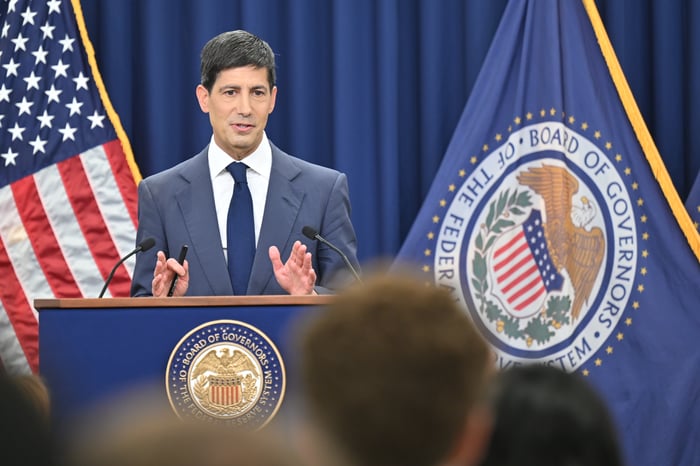
Fed Chair Kevin Warsh wants to lead a reform-oriented central bank. Image source: Official Federal Reserve Photo.
Kevin Warsh bids adieu to forward guidance
Before taking over as head of the Fed, Warsh outlined several changes he wanted to oversee. This includes adjusting how policymakers think about inflation, and deleveraging the central bank's bloated balance sheet, which grew tenfold between August 2008 and March 2022.
But the new Fed chair's most impactful move may be what he's no longer saying. In speaking with the press following the June Federal Open Market Committee (FOMC) meeting two weeks ago, Warsh proclaimed:
You might have already noticed something: a difference in today's policy statement. It's a bit shorter, a bit simpler -- and it dispenses with some older language. That statement just gives you the facts, as best we can judge it. Absent, also, is so-called forward guidance.
Since 2003, it's been customary for the FOMC to include forward guidance in its meeting statements, which Wall Street and investors have used to determine the central bank's next move. In six words, "absent, also, is so-called forward guidance," Kevin Warsh has abruptly ended this tradition and left investors to fly blind.
In theory, this is going to make it considerably more challenging for Wall Street and the bond market to figure out what, if any, changes the FOMC will make to monetary policy. Volatility in the bond market could be particularly consequential, with higher yields (and therefore higher lending rates) being the result.
Very hawkish dot plot.
-- Nick Timiraos (@NickTimiraos) June 17, 2026
Nine out of 18 officials have at least one hike this year (and six of those 9 have *multiple hikes*).
Only one person has a cut this year, and one participant (presumably Warsh) didn't submit an SEP
The statement gets a complete writethru from top to... pic.twitter.com/KRwatpTFOP
The lone silver lining for Wall Street and investors is that Warsh's first meeting coincided with the quarterly release of the Summary of Economic Projections (SEP), which is commonly known as the dot plot. The dot plot is a graph that anonymously outlines the interest rate projections of FOMC members.
Though Warsh didn't participate in the SEP, nine of 18 FOMC members (not all of whom vote) project that the federal funds target rate will rise before years end. Despite the lack of forward guidance, the dot plot paints a clear picture of the Committee's current view on inflation and interest rates.
But with the dot plot only released quarterly and Warsh unwilling to participate, at least half of the annual FOMC meetings could introduce a level of uncertainty that Wall Street and its major stock indexes haven't contended with in more than two decades. The transparency and predictability that have historically gone hand in hand with FOMC meetings are now gone.
Should you buy stock in S&P 500 Index right now?
Before you buy stock in S&P 500 Index, consider this:
The Motley Fool Stock Advisor analyst team just identified what they believe are the 10 best stocks for investors to buy now… and S&P 500 Index wasn’t one of them. The 10 stocks that made the cut could produce monster returns in the coming years.
Consider when Netflix made this list on December 17, 2004... if you invested $1,000 at the time of our recommendation, you’d have $397,890!* Or when Nvidia made this list on April 15, 2005... if you invested $1,000 at the time of our recommendation, you’d have $1,196,664!*
Now, it’s worth noting Stock Advisor’s total average return is 902% — a market-crushing outperformance compared to 207% for the S&P 500. Don't miss the latest top 10 list, available with Stock Advisor, and join an investing community built by individual investors for individual investors.
See the 10 stocks »
*Stock Advisor returns as of July 1, 2026.
Sean Williams has no position in any of the stocks mentioned. The Motley Fool has no position in any of the stocks mentioned. The Motley Fool has a disclosure policy.
Recommended Articles


