




Super Micro Stock Outlook: Is SMCI a Value Trap or a Buy After the Taiwan Raid?
TradingKey - Super Micro Computer (NASDAQ: SMCI) now trades at $28.66, forming a potential double bottom after slipping from $42.31 earlier this year and dropping nearly 40.8% in the last 12 months. The stock tanked 8.1% on June 29 after Bloomberg said that Taiwan investigators raided Super Micro Computer Taiwan offices as part of a widening probe into alleged smuggling of Nvidia AI chips to China.
That adds to a messy picture that already has Super Micro reporting fiscal Q3 2026 revenue of $10.2 billion, up 123% from the year-earlier period but missing a $12.33 billion Street estimate by about 17.7%. Earnings per share were 35% ahead of estimates. It has a $39 billion AI server backlog, and Super Micro raised more than $7 billion in June through a stock offering to fund that demand.
Are investors assuming the legal and governance risk in Super Micro’s share price? If so, what is the value gap? GuruFocus calculates SMCI’s fair value to be $87.03, which is the divergence analysts refer to as a potential value trap.
The Taiwan Raid and the DOJ Indictment — What Is Actually Alleged
The Taiwan raid reported June 29 stems from a larger saga. In March 2026, a federal court unsealed a DOJ grand jury indictment accusing Super Micro Computer co-founder and senior vice president Yih-Shyan “Wally” Liaw and two others of conspiring to ship high-performance servers to China. The scheme was said to have brought in an estimated $2.5 billion in sales from fake “dummy” servers, phony leasing arrangements and obstruction of Super Micro’s own compliance audits. The indictment does not name Super Micro as a defendant. A company itself is not a party to the indictment, though the company is a defendant in shareholder class action litigation from shareholders.
Super Micro’s stock has dropped heavily after previous disclosures. Ernst & Young resigned as Super Micro’s auditor over concerns involving 11 export transactions in October 2024 and Super Micro shares fell 32.6% that day, before dropping another 33% on the March 2026 unsealing of the indictment. The Taiwan raid is a new development, though not all the same new allegations have been confirmed to exist beyond the existing indictment. Any law enforcement activity is adding to investor concerns.
$10.2 Billion in Revenue, a $39 Billion Backlog, and a $7 Billion Dilution Event
Aside from the overhang, Super Micro’s AI servers business is booming. Super Micro said fiscal Q3 2026 revenue of $10.2 billion, up from $4.6 billion a year earlier. That was still below consensus estimates by $2-2.7 billion, or 17.7%. Super Micro Computer CEO Charles Liang said that was because customers had delayed their sites, and that many of these customers still needed more power and other networking capabilities to deploy in cloud centers and also industry-wide component availability.
Non-GAAP EPS of $0.84 beat the $0.62 estimate by 35.48% thanks to a gross margin expansion to 10.1% from 6.3% the prior quarter following improvements in customer and product mix and lower tariff, expedite, and inventory reserve charges. The enterprise channel generated $2.8 billion, up 46% year-over-year, and the OEM and large data center channel brought in $7.4 billion, up 183% year-over-year. Both reported strong results, yet overall top-line performance missed consensus.
Super Micro’s $39 billion AI server order backlog, spanning more than 20 customers, prompted the announcement on June 9 of a $7 billion capital raise, comprised of $5 billion in common stock and convertible preferred shares publicly underwritten and an at-the-market equity program to procure needed components to complete orders.
Shares sank 9.5% on June 9 and fell another 18% on June 10, with $12 billion in market value lost in the two-day slump as investors priced in an issuance representing a dilution in the ballpark of 35% of the pre-announcement market capitalization while simultaneously assessing the bullish impact from $39 billion of tangible, binding demand. Implied trailing twelve-month enterprise-value-to-sales stands just 0.76x, one of the lowest ratios in AI server infrastructure, while the stock’s NTM P/E of 10.7x is notably below Dell’s 15 to 16x P/E for a like AI server business, the valuation dislocation represents an explicit market penalty for concerns around governance and execution.
SMCI Technical Setup — Double Bottom at $27.72–$28.66, RSI 42.65, Target $33.30
Technical analysis indicates SMCI is consolidating as a double bottom at the $27.72 to $28.66 level, with the RSI at 42.65, suggesting a $33.30 target: 4H: SMCI tested a double bottom after dropping from $42.31; the lower end of the double bottom $27.72 to $28.66 defended via long lower wicks, with recently formed green candles absorbing sell orders. RSI at 42.65 is neutral and has room to run before it hits overbought territory and no bearish divergence has developed.
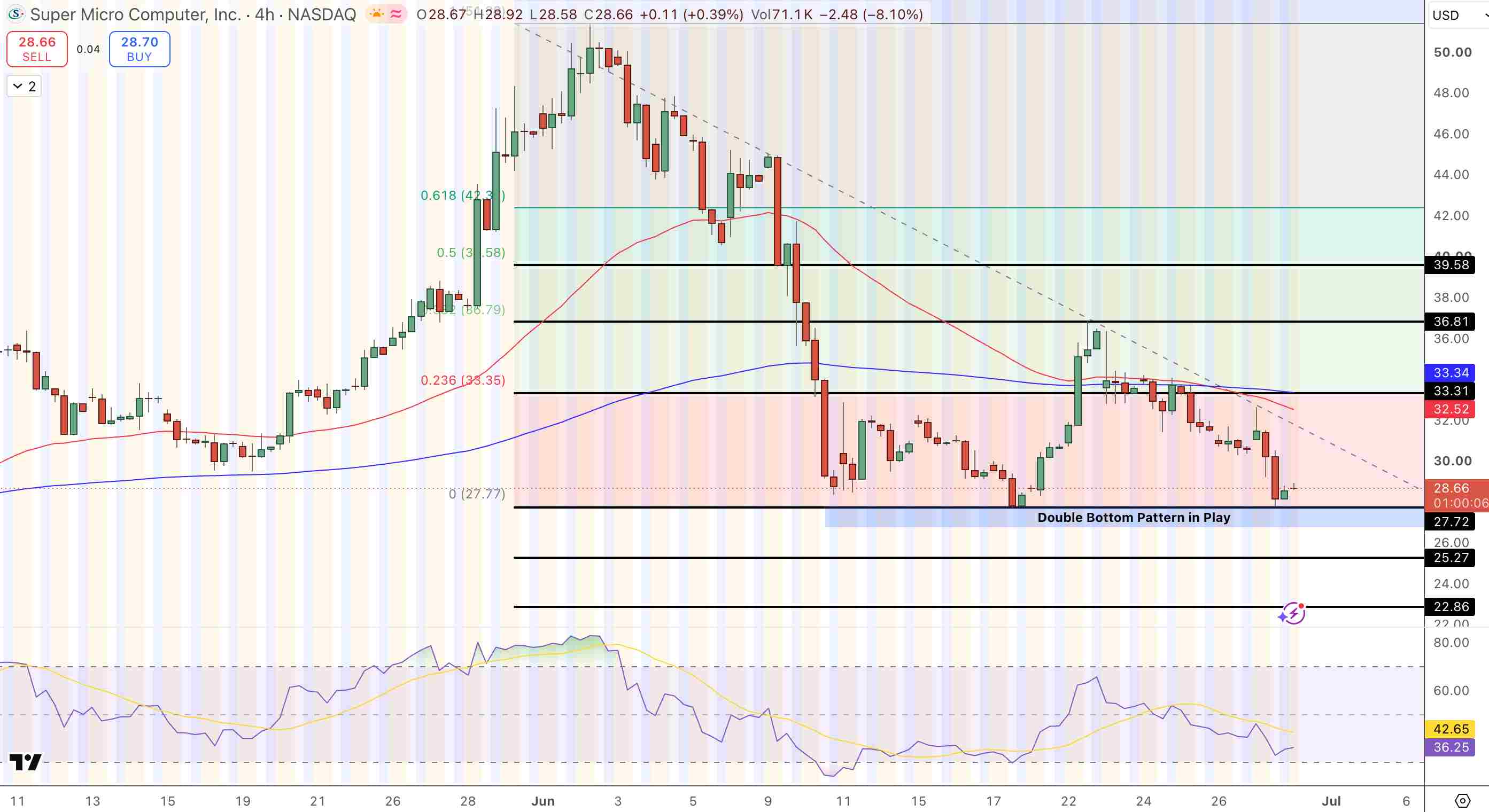
Super Micro Stock Price Chart - Source: Tradingview
Fibonacci levels off the $42.31 high place resistance at 0.236 ($36.35) and 0.5 ($38.58), with a full recovery target at the 0.618 level ($42.31). The double bottom has a measured target of $33 to $36 on continuation. A close above $30.00 sets a double bottom bounce target of $33.30.
- Entry: Long above $30.00 — double bottom upper boundary cleared
- Target: $33.30 — double bottom measured move
- Stop Loss: Close below $27.70 — double bottom lower boundary fails
- FY2026 guidance: $38.9–40.4B revenue. Q4: $11–12.5B, EPS $0.65–0.79
- AI backlog: $39B from 20+ customers, funded by June $7B capital raise
- Next earnings: August 3–4, 2026
Bottom Line
Super Micro at $28.66 remains a challenging stock to categorize: on one hand it has a $39B AI server backlog in hand and revenue growth of 123% YoY, on the other it has a DOJ indictment of named (but not the company) individuals, a June 29 Taiwan office raid linked to allegations of chip smuggling, and $7B of shareholder dilution that came with a capital raise to help fund the very backlog mentioned above. Its 0.76x EV/Sales and 10.7x NTM P/E, both below Dell's comparable ratios, suggest the market is explicitly pricing in a risk premium for Super Micro's overhang, but not mispricing its demand story.
Its double bottom from $27.72-$28.66 with RSI 42.65 neutral could be an opportunity to initiate a long, with an entry above $30.00 targeting $33.30 and stop loss of $27.70. The Aug. fiscal Q4 2026 earnings report should be the next checkpoint to see if Super Micro can convert this backlog at a pace to beat out the legal and governance risk.
Recommended Articles


