




A Social Security Benefits Cut Seems Inevitable. Here Is When It Could Possibly Happen.
Key Points
The Social Security program is paying out more in benefits than it's receiving in tax revenue.
Social Security benefits may need to be cut by late 2032 at the current rate of depletion.
Current projections say that benefits may need to be cut by more than one-fifth.
- The $23,760 Social Security bonus most retirees completely overlook ›
For decades, Social Security has been one of America's most relied-upon social programs. There are over 54.4 million people currently receiving Social Security retirement benefits, with many of them relying on the program for most or all of their retirement income.
Where to invest $1,000 right now? Our analyst team just revealed what they believe are the 10 best stocks to buy right now, when you join Stock Advisor. See the stocks »
Unfortunately, the Social Security program has once again found itself in a familiar position: facing potential benefit cuts to keep it properly funded. The cuts aren't guaranteed, but they're becoming a much more real possibility as time goes on. Here's what you should know.
Image source: Getty Images.
How Social Security is funded
The Social Security program is primarily funded through Social Security payroll taxes. Right now, the tax rate is 12.4%, with employees and employers each paying 6.2% (self-employed folks pay the full amount). The revenue goes into the Old-Age and Survivors Insurance (OASI) Trust Fund, where it is immediately used to pay benefits.
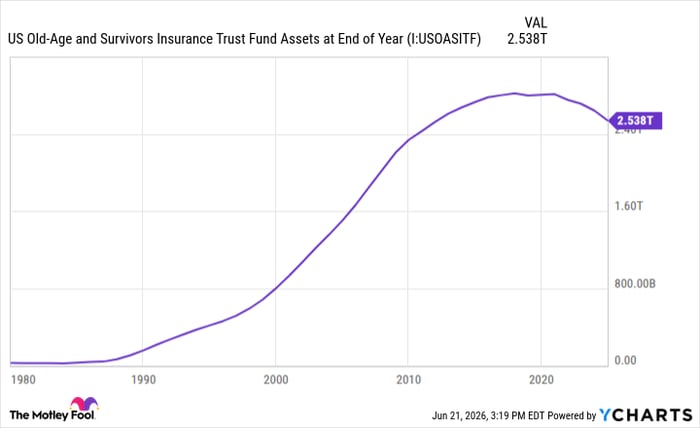
Unfortunately, the amount of benefits paid out has outpaced the revenue Social Security brings in for at least 16 years. Just last year, the OASI and Disability Insurance (DI) Trust Funds declined by $160 billion to $2.56 trillion, and the OASI fund is down over 9.7% since 2021.
US Old-Age and Survivors Insurance Trust Fund Assets at End of Year data by YCharts
For over a decade, the saving grace in the revenue-payout gap has been earning interest on the money in the trust fund. That hasn't been the case since 2021, and chances are it won't be for quite some time.
When can recipients expect a potential cut in benefits?
At its current depletion rate, the SSA expects the OASI Trust Fund to be depleted by the fourth quarter of 2032, at which point, only 78% of benefits would be payable. If your benefits were $2,000, a 22% cut would mean only receiving $1,560. If you were receiving $1,000, you could expect $780.
Given that millions of people rely on Social Security for most or all of their retirement income, a cut to benefits could be detrimental, inevitably leaving some retirees unable to cover all their expenses. Ideally, Social Security would be supplemental income alongside other retirement income (like a 401(k) or IRA), but that's simply not the reality for many people.
What can be done?
The current fixes likely won't be popular, such as increasing the Social Security payroll tax or applying higher taxes to investment income. It increases the tax burden on current workers, with no guarantee that the program will be fully funded and operational when it's their turn to receive benefits.
This isn't the first time that Social Security has faced this problem, though. It also occurred in 1983, before a deal was eventually reached that raised the retirement age and taxed more income of high earners.
There doesn't need to be a resolution in the coming months, but the sooner Congress can figure one out, the less dramatic a "fix" the program is likely to need.
The $23,760 Social Security bonus most retirees completely overlook
If you're like most Americans, you're a few years (or more) behind on your retirement savings. But a handful of little-known "Social Security secrets" could help ensure a boost in your retirement income.
One easy trick could pay you as much as $23,760 more... each year! Once you learn how to maximize your Social Security benefits, we think you could retire confidently with the peace of mind we're all after. Join Stock Advisor to learn more about these strategies.
View the "Social Security secrets" »
The Motley Fool has a disclosure policy.
Recommended Articles


