




Is This Asset the Secret to SpaceX's Success? (Hint: It Has Nothing To Do With Space or Starlink)
Key Points
SpaceX's Colossus supercomputers are set to be its biggest source of revenue.
The massive data centers will bring in more than $25 billion run rate revenue by the end of the year.
Elon Musk sees the deals as short-term, but they underscore the value that Colossus brings to SpaceX.
- 10 stocks we like better than Space Exploration Technologies ›
There's never been a company like Space Exploration Technologies (NASDAQ: SPCX) before.
While investors might refer to SpaceX as a space stock, it's really three businesses rolled into one.
Where to invest $1,000 right now? Our analyst team just revealed what they believe are the 10 best stocks to buy right now, when you join Stock Advisor. See the stocks »
There's the core space business, which includes the reusable Falcon 9 rocket booster, the first rocket to ever land itself, and Starship, the biggest launch vehicle ever made, designed to carry more than 100 metric tons and eventually more than 100 people to the moon and Mars. Starship is currently being used for test flights, rather than full missions.
The current driver of the business is the connectivity segment, or Starlink, the satellite internet business SpaceX developed in-house. Starlink currently generates the majority of the company's revenue and is profitable on a stand-alone basis.
Finally, there's the AI business, which came to the company through its merger with xAI, Elon Musk's AI company that owns the X social media platform and the Grok AI chatbot, earlier this year. Due to the large infrastructure expense to power the AI engine, including building data centers, investing in R&D, and acquiring GPUs, xAi is losing billions of dollars a year.
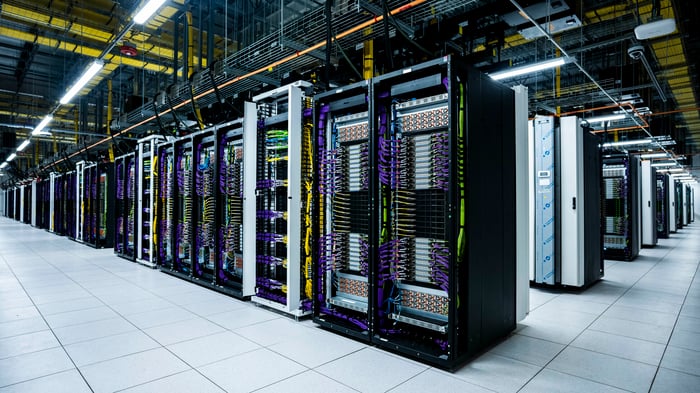
Image source: SpaceX.
Why SpaceX could be turning a corner
SpaceX's most recent quarterly result wasn't encouraging. In the first quarter of 2026, revenue growth slowed to just 15.4%, reaching $4.7 billion in revenue, and it reported an operating loss of $1.9 billion, compared to a profit of $27 million in the quarter a year ago, which reflects the addition of xAI.
However, SpaceX's revenue is set to soar. Since the quarter ended, the company has announced two deals to rent computing infrastructure, which will significantly boost its revenue.
First, the company signed a deal with Anthropic, allowing it to use all of the computing capacity at its Colossus 1 data center, which is equivalent to more than 300 megawatts or 220,000 Nvidia GPUs.
As a result, Anthropic will pay approximately $1.25 billion a month, or about $15 billion a year, through May 2029, making it one of the largest AI cloud infrastructure deals to date. Shortly after that, SpaceX announced a similar agreement with Alphabet, renting computing capacity to Google for $920 million per month for 32 months through October 2029, with access to 110,000 Nvidia GPUs. Alphabet is also a major investor in SpaceX as well. Those agreements alone will bring in about $26 billlion in new revenue, more than double from the $18.7 billion it brought in in 2024. On Monday, The Wall Street Journal reported that Reflection AI would pay SpaceX $150 million a month for compute capacity.
Those moves create a much-needed revenue stream to monetize SpaceX's AI assets and are likely to pave the way to similar deals.
Is Colossus a competitive advantage?
Colossus 1 and 2 are the company's massive, gigawatt-scale AI supercomputers, and SpaceX is monetizing its existing infrastructure capacity by converting it into inference-for-lease assets, such as for companies like Anthropic and Google, while using its newer Colossus 2 clusters to power Grok and the X social media platform.
Because SpaceX is renting out existing infrastructure, the deals should be highly profitable. It's expected to bring in more than a $2.5 billion in cash profit from the Anthropic contract, according to an estimate from New Street Research.
Based on the runway from the three deals above, Colossus is establishing itself as a massive competitive advantage for SpaceX, effectively making it a "neocloud" company without the risks of pure plays like CoreWeave and Nebius, which are unprofitable and heavily indebted.
Elon Musk has said the deal with Anthropic is short-term, implying that he doesn't see SpaceX's primary future as a neocloud company. However, the size of the deals demonstrates the value of Colossus's computing capacity. It's a unique asset for SpaceX, and it will help improve its profitability and drive top-line growth.
It also shows that SpaceX's valuation may not be as rich as it seems, given the billions in new revenue that's about to come online.
Regardless of whether SpaceX chooses to use Colossus's capacity itself or rent it out, investors should be mindful of the value it adds. The deals above help explain why xAI was valued at $250 billion when the two companies merged in February.
While Colossus alone doesn't justify SpaceX's current $2 trillion valuation, the new deals it's producing should help put a floor on the stock price as it searches for equilibrium.
Should you buy stock in Space Exploration Technologies right now?
Before you buy stock in Space Exploration Technologies, consider this:
The Motley Fool Stock Advisor analyst team just identified what they believe are the 10 best stocks for investors to buy now… and Space Exploration Technologies wasn’t one of them. The 10 stocks that made the cut could produce monster returns in the coming years.
Consider when Netflix made this list on December 17, 2004... if you invested $1,000 at the time of our recommendation, you’d have $393,037!* Or when Nvidia made this list on April 15, 2005... if you invested $1,000 at the time of our recommendation, you’d have $1,280,627!*
Now, it’s worth noting Stock Advisor’s total average return is 913% — a market-crushing outperformance compared to 208% for the S&P 500. Don't miss the latest top 10 list, available with Stock Advisor, and join an investing community built by individual investors for individual investors.
See the 10 stocks »
*Stock Advisor returns as of June 23, 2026.
Jeremy Bowman has positions in CoreWeave and Nvidia. The Motley Fool has positions in and recommends Alphabet and Nvidia. The Motley Fool has a disclosure policy.
Recommended Articles


