




Buy the Dip on This Stock for Its Monthly Dividend and 5.4% Yield
Key Points
Realty Income is a top-notch REIT with a track record of paying and increasing its dividend.
At just over 14 times its 2026 FFO guidance, the stock now trades at an appealing price.
Realty Income can deliver tremendous total returns when investors buy, hold, and reinvest dividends.
- 10 stocks we like better than Realty Income ›
Realty Income (NYSE: O) has slipped over the past few months from nearly $70 per share to around $60. Almost nobody enjoys watching stock prices fall, but for dividend-focused investors, a dip can be a blessing in disguise. Lower share prices mean higher dividend yields and more bang for your buck when it comes to dividend income. At this wrirting, the stock's dividend yield is 5.4%.
Of course, stocks can sometimes drop because of major problems with the underlying companies. Fortunately, that doesn't seem to be the case with Realty Income. The company generates strong cash profits to support its monthly dividend, and the stock's decline strengthens the case for buying shares today.
Will AI create the world's first trillionaire? Our team just released a report on the one little-known company, called an "Indispensable Monopoly" providing the critical technology Nvidia and Intel both need. Continue »
Here's a closer look.

Image source: The Motley Fool.
Dependable dividends at a very fair price
Realty Income is one of the world's most prominent real estate investment trusts (REITs). As a net lease REIT, Realty Income acquires properties and leases them to tenants, who are responsible for expenses such as maintenance, taxes, and insurance.
REITs report their profits as funds from operations, a non-GAAP (adjusted) metric that represents the company's distributable profits -- money it can pay to shareholders as dividends. The fact that Realty Income pays a monthly dividend and has raised it for more than 31 consecutive years speaks to the resilience of its business through COVID-19, recessions, and other challenges.
Realty Income currently expects adjusted FFO per share of $4.41 to $4.44 this year, up from $4.28 last year and $4.19 in 2024. At roughly $60 per share, Realty Income trades at just over 14 times its guided 2026 FFO. If you think of that like a price-to-earnings ratio, it's a very attractive valuation for a dependable business with 4% to 5% annualized dividend growth.
Why Realty Income is a sneaky good total returns stock
If you buy Realty Income, enjoy the dividends! But if you want to get the most out of the stock, you'll want to hold it for a long time and reinvest all dividends. When you reinvest a growing dividend, it adds another compounding effect that can become quite effective over a decade or two.
Realty Income has grown its business, measured as long-term dividend growth, by 4.2% annually over its long history. Yet, you can see that the stock has thrashed the S&P 500 index, which historically generates approximately 9% to 10% annualized total returns.
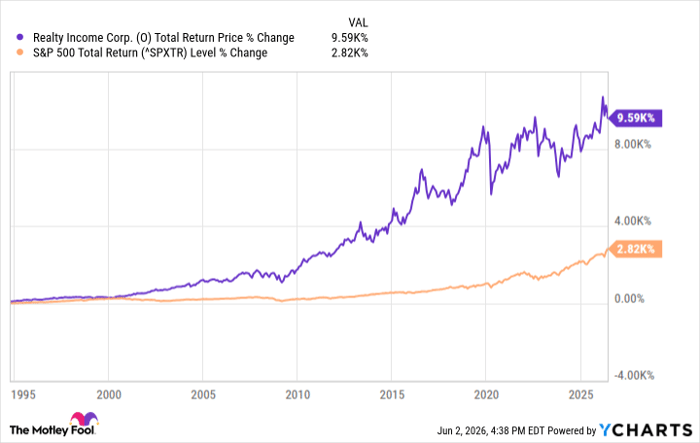
O Total Return Price data by YCharts
Investors who skip over Realty Income because they assume that a steady dividend stock can't generate strong total returns have been missing out. The stock's recent dip is a fantastic opportunity to hop aboard this monthly dividend train.
Should you buy stock in Realty Income right now?
Before you buy stock in Realty Income, consider this:
The Motley Fool Stock Advisor analyst team just identified what they believe are the 10 best stocks for investors to buy now… and Realty Income wasn’t one of them. The 10 stocks that made the cut could produce monster returns in the coming years.
Consider when Netflix made this list on December 17, 2004... if you invested $1,000 at the time of our recommendation, you’d have $439,632!* Or when Nvidia made this list on April 15, 2005... if you invested $1,000 at the time of our recommendation, you’d have $1,316,532!*
Now, it’s worth noting Stock Advisor’s total average return is 959% — a market-crushing outperformance compared to 210% for the S&P 500. Don't miss the latest top 10 list, available with Stock Advisor, and join an investing community built by individual investors for individual investors.
See the 10 stocks »
*Stock Advisor returns as of June 5, 2026.
Justin Pope has no position in any of the stocks mentioned. The Motley Fool has positions in and recommends Realty Income. The Motley Fool has a disclosure policy.
Recommended Articles


