




S&P 500 and Nasdaq Investors: SpaceX's IPO Could Come With a Hidden Risk to Your ETFs
Key Points
SpaceX is set to go public this month as the largest IPO in market history.
Major market indexes are relaxing their rules around including new stocks, which could pose a risk for ETF investors.
If you're nervous about SpaceX volatility affecting your S&P 500 ETF, you have other options.
- 10 stocks we like better than Invesco S&P 500 Equal Weight ETF ›
From now until June 12, all eyes are on SpaceX as investors await the company's heavily anticipated initial public offering (IPO). With a valuation of nearly $2 trillion, it's likely to be the largest IPO in market history.
But SpaceX will leave its mark on many areas of the market, and you may end up owning shares whether you intend to or not. This situation is especially true for investors who own broad-market funds that track major indexes, such as the S&P 500 (SNPINDEX: ^GSPC) and Nasdaq Composite (NASDAQINDEX: ^IXIC). Here's why investors should be paying attention.
Will AI create the world's first trillionaire? Our team just released a report on the one little-known company, called an "Indispensable Monopoly" providing the critical technology Nvidia and Intel both need. Continue »
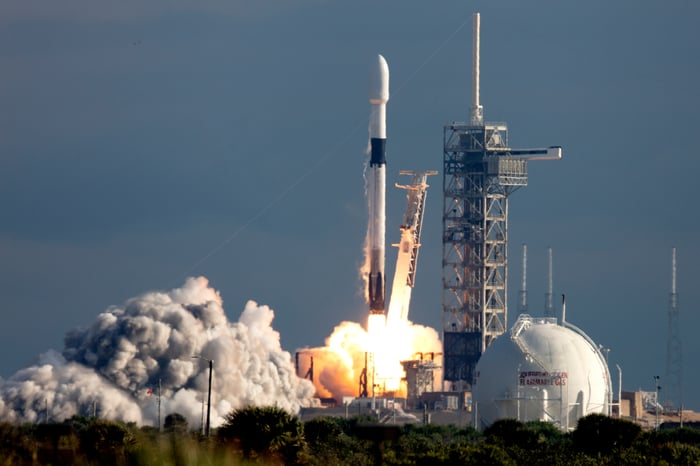
Image source: Getty Images.
SpaceX could soon make its way to ETFs and index funds
SpaceX's target valuation of around $1.8 trillion could position it within the top 10 largest stocks in the U.S., and it could be included in the S&P 500 and Nasdaq-100 relatively soon after going public. Investors who own funds tracking those indexes could own a stake in SpaceX whether they want to or not.
Exactly when SpaceX might join these indexes is still unclear, but it will probably be soon. The Nasdaq's "Fast Entry" rule, which went into effect on May 1, could allow SpaceX to enter the Nasdaq-100 within 15 trading days. The S&P has proposed a similar plan, which could fast-track SpaceX's inclusion in the benchmark index.
Previously, new IPOs would have to wait at least a few months to join a major index. This approach not only allowed time for the stock prices to settle after the IPO, but it also ensured the companies were profitable before joining popular index funds and ETFs.
Furthermore, with OpenAI and Anthropic planning public offerings later this year, SpaceX's IPO -- and indexes' willingness to relax the rules -- could shape the future of the S&P 500 and Nasdaq.
Two alternative options for investors
Most ETFs and index funds are market-cap-weighted, meaning larger companies make up a larger share of the fund. At SpaceX's projected market cap, it could rank among the S&P 500's top 10 holdings. That isn't a bad thing on the surface, but because there are still so many unknowns surrounding SpaceX, it could introduce more volatility to the index.
An alternative option is to invest in an equal-weight ETF -- such as the Invesco S&P 500 Equal Weight ETF (NYSEMKT: RSP). This type of ETF still holds all the companies in the S&P 500, but each stock accounts for roughly the same percentage of the portfolio.
When SpaceX joins the major indexes, it will still be included in an equal-weight ETF. However, it won't have as much influence on the fund's performance as it might with a market-cap-weighted ETF. The downside, of course, is that if SpaceX outperforms, it will be harder to capitalize on those returns with an equal-weight fund.
The other alternative is to build a portfolio of individual stocks. This approach requires more time and research than buying index funds or ETFs, but it's also the best way to tailor your portfolio to your needs and invest only in the stocks you want to own.
Regardless of your choice, it's wise to at least consider your options before SpaceX's IPO later this month.
Should you buy stock in Invesco S&P 500 Equal Weight ETF right now?
Before you buy stock in Invesco S&P 500 Equal Weight ETF, consider this:
The Motley Fool Stock Advisor analyst team just identified what they believe are the 10 best stocks for investors to buy now… and Invesco S&P 500 Equal Weight ETF wasn’t one of them. The 10 stocks that made the cut could produce monster returns in the coming years.
Consider when Netflix made this list on December 17, 2004... if you invested $1,000 at the time of our recommendation, you’d have $439,632!* Or when Nvidia made this list on April 15, 2005... if you invested $1,000 at the time of our recommendation, you’d have $1,316,532!*
Now, it’s worth noting Stock Advisor’s total average return is 959% — a market-crushing outperformance compared to 210% for the S&P 500. Don't miss the latest top 10 list, available with Stock Advisor, and join an investing community built by individual investors for individual investors.
See the 10 stocks »
*Stock Advisor returns as of June 5, 2026.
Katie Brockman has no position in any of the stocks mentioned. The Motley Fool has no position in any of the stocks mentioned. The Motley Fool has a disclosure policy.
Recommended Articles


