




New Fed Chairman Kevin Warsh Is Now in a Position Where Rate Cuts Are Virtually Impossible, and the Stock Market Could Pay the Price
Key Points
Kevin Warsh has been adamant about the risks of allowing inflation to climb once again.
Warsh wants to reduce the Fed's balance sheet, which would allow interest rates to climb higher.
Investors need to weigh the potential of Treasury bonds when considering how much a stock is worth paying for right now.
- These 10 stocks could mint the next wave of millionaires ›
When President Donald Trump nominated Kevin Warsh as Federal Reserve Chair at the start of the year, the market was primed for Warsh to push for lower interest rates. Just a few months later, that looks virtually impossible. In fact, investors currently put the odds of at least one rate hike by the end of 2026 at about 60%. Virtually nobody actually expects Warsh to push through a rate cut this year.
That has yet to affect equity prices. The S&P 500 and Nasdaq Composite have soared to new all-time highs as Warsh takes control of the central bank. But the Fed policies under Warsh could lead to a substantial stock market downturn if rates continue to creep higher.
Will AI create the world's first trillionaire? Our team just released a report on the one little-known company, called an "Indispensable Monopoly" providing the critical technology Nvidia and Intel both need. Continue »
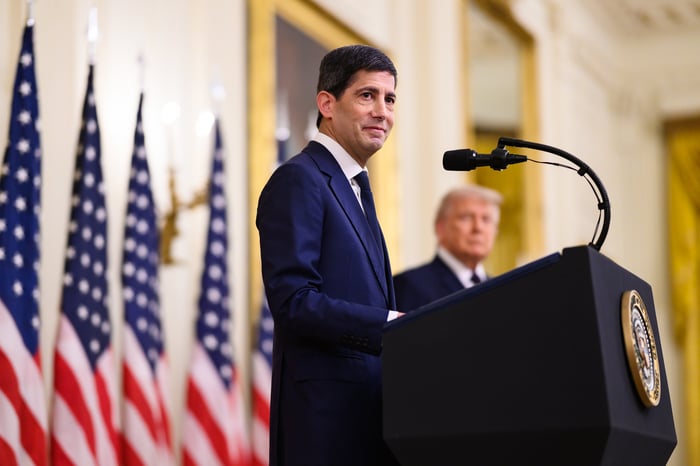
Fed Chair Kevin Warsh. Image source: Official White House Photo by Daniel Torok.
Will Kevin Warsh end up raising rates?
This isn't Warsh's first rodeo at the Fed. He served on the Board of Governors, acting as a voting member of the FOMC, between 2006 and 2011. During his tenure, he opposed maintaining low interest rates and quantitative easing amid the financial crisis, warning that they could lead to high inflation.
It seems he hasn't changed his attitude since. Warsh criticized his predecessors in his Senate confirmation hearing, saying that they made a terrible policy error in 2021 and 2022 by waiting too long to raise rates. "Once you let inflation take hold in the economy, it's more expensive and harder to bring it down," he said.
The best tools the Fed has to keep inflation at bay are to raise the target federal funds rate and sell long-term bonds on its balance sheet. The former will increase short-term rates, while the latter will increase long-term Treasury Bond rates.
Warsh joins the Fed as inflation is spiking. The war in Iran, which led to the closure of the Strait of Hormuz, has sent commodity prices soaring, affecting all sorts of goods and services. The Consumer Price Index reached 3.8% in April, and it could climb to 4.2% for May, according to the Cleveland Fed's estimate.
The longer the war continues, the worse the problem will get, and the slower prices will recover. It's just one more in a string of near-constant supply shocks that the U.S. economy has had to absorb over the last six years, putting pressure on the Fed to manage volatile inflation.
Warsh's bent is toward reducing the Fed's bond market participation and shrinking its balance sheet. That would allow long-term interest rates to rise. He could offset that with a cut in the target fed funds rate, but that's not a reasonable course with inflation running hot. Indeed, an interest rate hike is more likely to fit with Warsh's major concerns with previous policy decisions.
What could higher interest rates mean for the stock market?
There are three ways higher interest rates could ultimately affect stocks.
First and foremost, higher yields on government bonds increase the discount rate investors use to value businesses. That means future earnings are worth less today than they would be if interest rates were lower. As a result, the intrinsic value of businesses declines (and, theoretically, so does the stock price.)
Another way of thinking about that is that the price-to-earnings (P/E) ratio that investors are willing to pay for stocks will go down. The earnings yield (the inverse of the P/E ratio) needs to remain competitive with bond yields while offering a risk premium due to the uncertainty of future earnings and the economy.
That said, stock prices can continue rising if earnings expectations rise even faster (resulting in a lower P/E). So far, earnings results have proven extremely resilient, especially among large-cap stocks. Small-cap stocks have struggled, and higher interest rates could weigh further on their results, as many are more susceptible to interest rate changes. Smaller companies often use floating-rate interest instruments instead of issuing bonds.
Lastly, higher interest rates could weigh on consumers. If higher interest rates push down consumer spending, it could lead to lower earnings results for many consumer-facing businesses. That said, the risk of a consumer spending slowdown could be worse if inflation remains elevated. Former Fed Chair Jerome Powell warned that higher gas prices could lead to a lower gross domestic product before he stepped down.
Kevin Warsh's primary concern as Federal Reserve chair is fulfilling the central bank's dual mandate: stable pricing and full employment. In all likelihood, that means allowing interest rates to rise by reducing the balance sheet, if not raising them outright with a target rate change. While that will help Warsh fulfill his goal, it could come with a high cost for stock investors.
Where to invest $1,000 right now
When our analyst team has a stock tip, it can pay to listen. After all, Stock Advisor’s total average return is 959%* — a market-crushing outperformance compared to 210% for the S&P 500.
They just revealed what they believe are the 10 best stocks for investors to buy right now, available when you join Stock Advisor.
See the stocks »
*Stock Advisor returns as of June 5, 2026.
Adam Levy has no position in any of the stocks mentioned. The Motley Fool has no position in any of the stocks mentioned. The Motley Fool has a disclosure policy.
Recommended Articles


