




Sandisk Is Up More Than 4,900%. Is Now a Good Time to Invest or Did You Miss the Train?
Key Points
Sandisk has used the NAND supply shortage to raise prices and greatly improve its margins.
Sandisk's gross margins have increased by 54.7 percentage points over the past year.
Investors in this memory specialist should be prepared for the inevitable volatility.
- 10 stocks we like better than Sandisk ›
Imagine investing $1,000 into a stock and one year later, that position is worth over $50,000. That's exactly what has happened with Sandisk (NASDAQ: SNDK): In the past 12 months, the stock has risen by more than 4,900%.
Being in the right place to capitalize on gains like those is often a matter of luck, and with the ongoing AI boom and the data center infrastructure build-out, memory giant Sandisk has undoubtedly found itself at the right business at the right time. But curious investors who haven't yet added it to their portfolios will no doubt be wondering: Is all the magic gone, or does this stock still have room to run?
Will AI create the world's first trillionaire? Our team just released a report on the one little-known company, called an "Indispensable Monopoly" providing the critical technology Nvidia and Intel both need. Continue »
Image source: The Motley Fool.
Why has Sandisk become so popular?
Sandisk makes an assortment of memory storage products. You might be used to seeing its microSD memory cards in devices like digital cameras, but the real appeal now lies in its NAND flash memory chips.
These NAND chips are heavily used in data centers, and demand for them has skyrocketed over the past year or so. The problem (for customers, at least) is that supply now far exceeds demand. But this has worked out in Sandisk's favor because it and its peers have been able to use the shortage to dramatically increase their prices.
In its fiscal third quarter (which ended April 3), Sandisk's revenue increased by 251% year over year to $5.95 billion. That was also 97% more than its sales in the previous quarter. Yet the most impressive piece of the financial picture may be its gross margin, which rose from 22.7% a year ago to 78.4%.
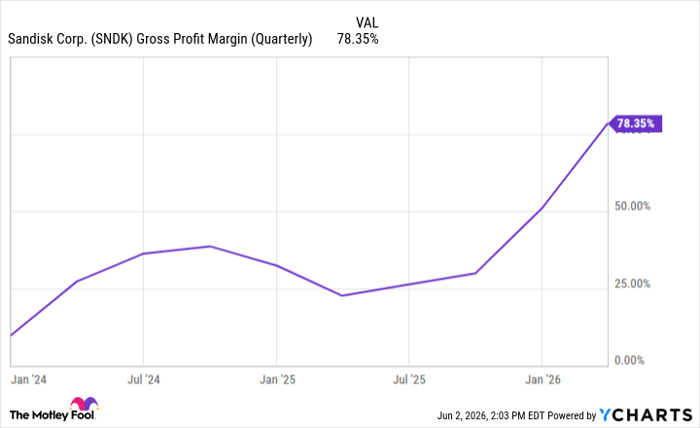
SNDK Gross Profit Margin (Quarterly) data by YCharts.
As often happens when a company rapidly starts to make lots of money, there's investor interest. In this case, that interest has turned Sandisk into a $271 billion company (as of the close of trading on Wednesday).
Did you miss the Sandisk train?
If you're considering investing in Sandisk, don't do so expecting similar returns to those it has produced over the past year. Much of the easy money has already been made, and now it's about risk management. That isn't to say Sandisk's stock won't continue to grow over time, but at its current valuation, it's much more subject to higher volatility.
If you like Sandisk as a company and aren't in it with get-rich-quick hopes, I'd recommend building a position gradually through dollar-cost averaging. This will help cushion you from any sudden drops or corrections.
The memory chip industry has a history of being highly cyclical, as manufacturers respond to shortages by building new foundries, which eventually leads to an oversupply of chips and crashing prices.
Right now, the industry is in the midst of a nice boom phase as the chipmakers have pricing power. We can't say how long this (lucrative) part of the cycle will last, but eventually the tides will change. If you can stomach the stock's inevitable volatility, it's worth investing in, but I would wait for at least a 10% pullback. It has already experienced a handful of those this year, so I wouldn't be surprised to see another one.
Should you buy stock in Sandisk right now?
Before you buy stock in Sandisk, consider this:
The Motley Fool Stock Advisor analyst team just identified what they believe are the 10 best stocks for investors to buy now… and Sandisk wasn’t one of them. The 10 stocks that made the cut could produce monster returns in the coming years.
Consider when Netflix made this list on December 17, 2004... if you invested $1,000 at the time of our recommendation, you’d have $439,632!* Or when Nvidia made this list on April 15, 2005... if you invested $1,000 at the time of our recommendation, you’d have $1,316,532!*
Now, it’s worth noting Stock Advisor’s total average return is 960% — a market-crushing outperformance compared to 211% for the S&P 500. Don't miss the latest top 10 list, available with Stock Advisor, and join an investing community built by individual investors for individual investors.
See the 10 stocks »
*Stock Advisor returns as of June 4, 2026.
Stefon Walters has no position in any of the stocks mentioned. The Motley Fool has no position in any of the stocks mentioned. The Motley Fool has a disclosure policy.
Recommended Articles


