




Broadcom Stock Forecast: Why Did AVGO Drop 17% and Is Wall Street Missing the AI Story?
TradingKey - Broadcom (NASDAQ: AVGO) has fallen back to $414, a roughly 17% pullback from its peak of $498.96 on the $13.70 session loss accompanied with high volume, indicating profit-taking. On the 4H, price is testing the main 0 retracement Fib of $405.42 which also represents the previous swing low support for this move. RSI on 34.37 has entered oversold levels, the first time since this rally commenced and suggests selling is nearing its conclusion. There were no company news catalysts to explain the fall, and we're looking at a macro-driven pullback of profits following the parabolic move in optimism around AI infrastructure investment. At $405 to $414, we're seeing if this is where we see accumulation to bounce off, or if RSI oversold alone is insufficient to halt the drop.
Why the Pullback Is Macro-Driven, Not Fundamental Deterioration
The timing and character of the AVGO pullback fits what we would expect from a correction driven by macro factors, rather than a problem specific to the company itself. With the April CPI report at 3.8% headline and 4.1% core inflation has reasserted the Fed Chair Kevin Warsh "higher for longer" rates outlook, real rates have moved higher and multiple compression on the premium tech names has increased. Broadcom, which trades at a significant premium to the broader semiconductor industry due to its AI infrastructure positioning plus the VMware software component, has higher-than-average multiple sensitivity to this pressure. The volume on this red session reflects investors buying the AI infrastructure rally selling off, rather than any sell order coming from a negative Broadcom story.
Nothing has changed in terms of the fundamentals of the name.
Broadcom's custom ASIC business, i.e., the specific AI chips designed and built at the request of hyperscalers like Google and Meta for their own workloads, has management giving us design win visibility out to 2027. The Tomahawk and Jericho families of the Ethernet switches continue to be the top of the AI cluster networking market at large scale, which has seen all of the largest GPU training clusters in the world use it.
Meanwhile, the 2023 VMware acquisition and integration has now turned into significant high-margin recurring infrastructure software revenue that will help diversify Broadcom away from semis cyclical. The combination of custom silicon, merchant networking chips and software recurring revenue are the key drivers that make Broadcom unique compared to an alternative pure-play semiconductor company during the downturn.
Broadcom’s Position in the AI Stack — Custom ASICs vs Nvidia and Why Both Win
One of the more prevalent misunderstandings of where Broadcom sits in the world of AI infrastructure is to think Broadcom competes with Nvidia. Instead the two are playing different parts of the AI stack. Nvidia H100 and Blackwell GPUs are general purpose AI accelerators that any organization can use to run any AI application or research. Custom ASIC chips from Broadcom are designed in accordance to the needs of one hyperscaler, for example Google TPU's for its custom chips for the cloud services company. Broadcom's custom ASIC business is not limited to one hyperscaler, but it builds chips for various hyperscalers to meet their needs with chips that are designed for different workloads including inference, recommendation systems etc., where a dedicated chip would give higher performance per watt and/or lower TCO than a more generalized GPU.
In this framework, Broadcom wins as AI scales as all those hyperscalers that can afford it go out and build out their own custom chips for themselves to reduce their reliance on Nvidia, and Broadcom is the custom ASIC design partner to do all of it with its talent, tools and fab partnerships. Its Ethernet networking business will be the second leg, as no matter which way any hyperscaler builds their infrastructure with Nvidia GPUs or Broadcom ASICs, they still need to use Broadcom switches to connect it all together in the data center. Broadcom is making money on both the custom silicon leg and networking regardless of which one wins.
AVGO Technical Setup — RSI 34 at 0 Fib $405 Support, Bounce Targets $441 and $452
AVGO technicals, at $414, are now retesting the major 0 retracement Fib level of $405.42 after a breach below the 0.236 level of $427.49. RSI is at 34.37 on the oversold side as this is its first oversold since this rally started, hinting that sellers are running out of steam. Moving averages 50 and 100 will act as dynamic resistance above near the 0.382 Fib of $441.15 and 0.5 Fib of $452.19, respectively.
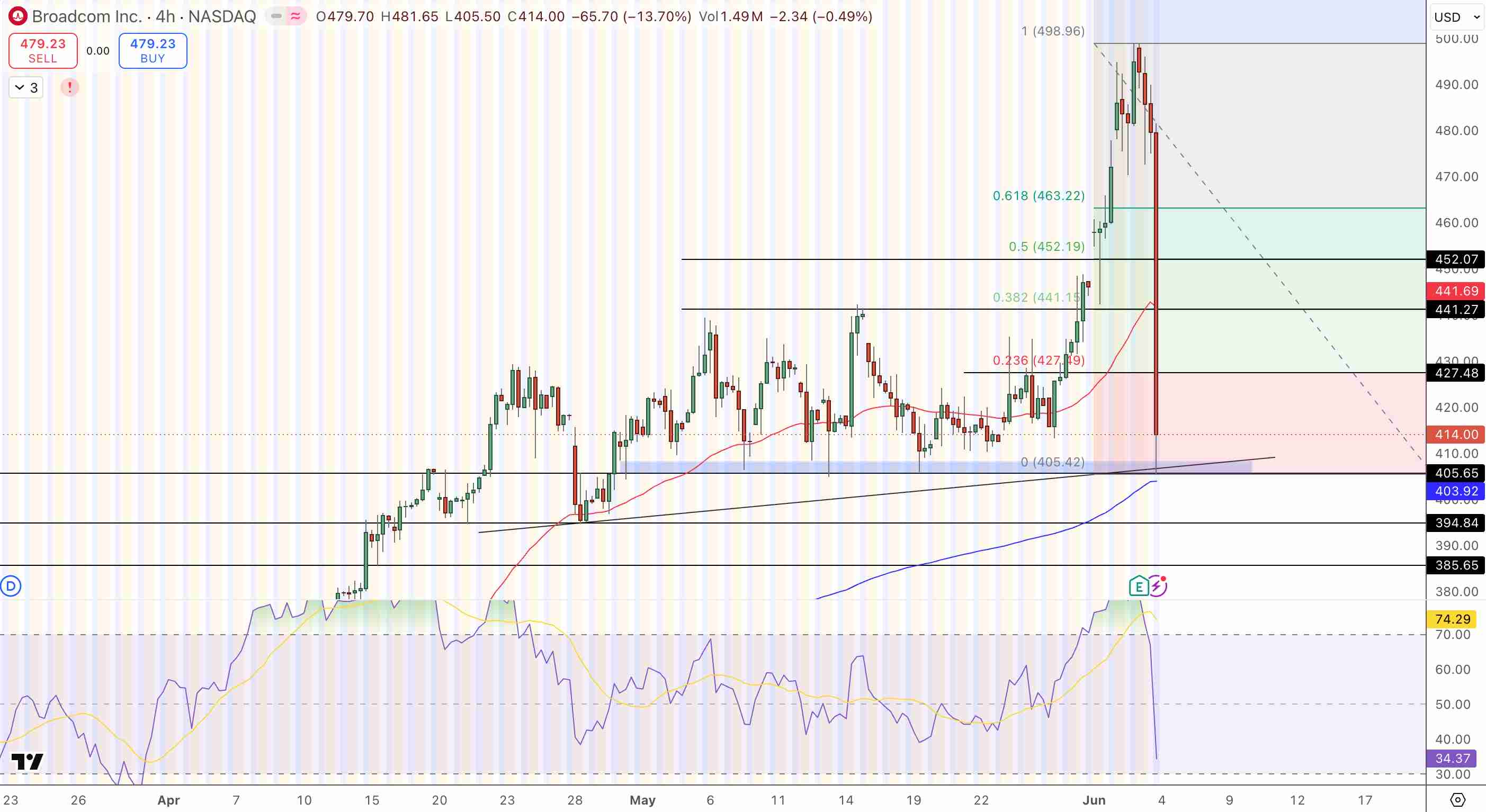
This decline with high volume is an indication that those taking profits, not fundamental sellers, are driving this move. The $499 high forms a descending channel in the near term which may provide a headwind, but the big picture bullish trend is intact as long as prices remain above $405. Any rebound off of the oversold RSI should see us retest first the 0.382 at $441.15, then 0.5 at $452.19 next.
TRADE SETUP
- Entry: Long on breakout above $427.50, as the 0.236 Fib is reclaimed and bounce begins
- Target 1: $441.15, the 0.382 Fib resistance
- Target 2: $452.19, the 0.5 Fib resistance
- Target 3: $463.22, the 0.618 Fib on complete retest
- Stop Loss: Daily close under $405.40, as 0 Fib support is broken and deeper pullback is ahead
Why Did Broadcom Fall 17% From Its Peak?
Broadcom has fallen from $498.96 to around $414, representing a 17% drop. This correction reflects profit taking in a parabolic move in AI infrastructure, not bad news on the company. In April, 2026 CPI print came in at 3.8% headlinve and 4.1% core, which reaffirmed the Warsh Fed’s higher-for-longer stance. That higher rate environment increased real yields, thereby compressing premium multiples in tech high-valuation growth stocks. The decline occurred on elevated volume, showing that the drop represents institutional selling, not retail panic. Broadcom’s custom ASIC design win backlog, its Ethernet networking leadership, and its VMware software business are all still intact.
What Does Broadcom's AI Business Offer That Nvidia Does Not?
Nvidia offers general-purpose AI accelerators (such as the H100 and Blackwell GPUs) that enterprises can purchase for their own use in a variety of applications. Broadcom builds custom ASICs for particular hyperscalers that build a tailored chip to serve just one customer's exact need to run a particular AI model's inference, recommendations, and/or training. Google's TPU, for example, is an ASIC for running Google's own model. Broadcom also sells Tomahawk and Jericho Ethernet switches, the networking switches that build the fabric of the AI data center regardless of the underlying computational chip architecture that it may be built upon.
Is AVGO A Buy At $414 After This Pullback?
RSI stands at 34.37 below 50 in oversold territory right as price at the 0 Fib level of $405.42 (which is the first oversold reading for the current bounce). A long above $427.50 (0.236 Fib reclaimed) targets $441.15 and $452.19 with a stop at $405.40. Broadly there have been no fundamental developments that change the investment thesis. Custom ASIC design win backlog extends out to 2027, Broadcom remains the dominant player in Ethernet switches for AI data centers, and VMware is an add-on recurring software business. The risk is that multiple compression, caused by the macro backdrop, will continue to extend longer than anticipated, meaning price may extend beyond the $405.40 level prior to any oversold bounce.
Bottom Line
The Broadcom correction from $499 to $414 represents institutional profit taking and not a change in fundamentals. RSI at 34 and oversold at the 0 Fib is the first oversold, actionable setup in this correction. Longs above $427.50 target $441.15 and $452.19. Broadcom's custom ASIC pipeline into 2027, continued dominance in Ethernet switches for AI data centers, and recurring revenue from VMware keeps the three-legged fundamental picture intact.
The stop is $405.40, because a drop below that level will suggest this is a deeper correction than a standard Fib retracement and positions should be exited. Q3 FY2026 earnings (late August) are the next event that can change the fundamental thesis.
Recommended Articles


