




Costco Stock Has Been Pulling Back Again. Time to Buy?
Key Points
Costco shares hit a record high last week before falling more than 8%.
The wholesale retailer's adjusted comparable sales growth has been accelerating, not slowing.
Even after the pullback, the stock trades at about 52 times earnings -- well above its long-term average.
- 10 stocks we like better than Costco Wholesale ›
Shares of Costco Wholesale (NASDAQ: COST) climbed to a record high near $1,096.50 last week, only to slide back to about $1,003 as of this writing -- a drop of more than 8% in just a handful of trading days. Even after the pullback, however, the membership-based wholesale retailer's stock is up sharply in 2026 and remains well ahead of the S&P 500's gain during this period.
So, is this latest retreat a chance to buy one of retail's most dependable compounders?
Will AI create the world's first trillionaire? Our team just released a report on the one little-known company, called an "Indispensable Monopoly" providing the critical technology Nvidia and Intel both need. Continue »
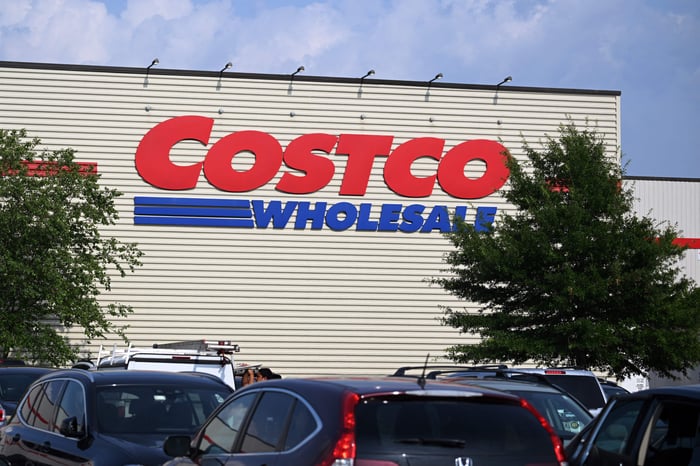
Image source: Getty Images.
The business is speeding up
Starting with the headline numbers from the company's fiscal second quarter of 2026 (the 12 weeks ended Feb. 15, 2026), Costco's net sales rose 9.1% to $68.24 billion, and net income climbed nearly 14% to $2.04 billion, or $4.58 per share.
More telling, however, is the acceleration seen in Costco's business.
Stripping out swings in gasoline prices and foreign exchange, Costco's adjusted comparable sales -- a measure of sales at warehouses open at least a year -- grew 6.7% in the quarter. That marks a step up from 6.4% in the prior quarter (the period ended Nov. 23, 2025).
And the company's most recent monthly sales update shows similar momentum. Net sales jumped 13% in April (the four weeks ended May 3). With that said, a change in the timing of Easter benefited the month. But still, the acceleration is notable. Further, digitally enabled comparable sales (online and app-based orders) jumped more than 22% in the latest quarter -- far outpacing the warehouses and easing worries investors may have about Costco's ability to compete with Amazon's e-commerce business.
Of course, one of the best parts of Costco's business is the reliability of its membership-based model. To this end, Costco's membership fee income rose 13.6% in the fiscal second quarter to $1.36 billion. And even after excluding the impact of a 2024 fee increase and currency effects on this growth rate, the underlying growth in membership fee income was about 7.5%. Further, renewal rates remain stellar, at 92.1% in the U.S. and Canada and 89.7% worldwide.
That loyalty is rooted in price, and price is where Costco's scale shows up most. The warehouse club deliberately stocks only a few thousand items -- a fraction of what a typical supermarket carries -- which concentrates its buying power.
Why the price still calls for patience
The harder question is valuation. As of this writing, Costco trades at roughly 52 times earnings, with a forward price-to-earnings ratio near 47.
Those are rich valuation multiples for any retailer, and they even sit well above the stock's own 10-year average price-to-earnings ratio of about 37.
In other words, the stock looks expensive, despite the recent pullback. A price like this arguably assumes the company keeps compounding sales and profits at a healthy clip for years on end -- essentially the performance we're seeing now, extended well into the future. Should growth cool, or should a prolonged consumer pullback or a sharper push from Amazon or Walmart's Sam's Club take hold, the stock could have a long way to fall before reaching a more forgiving level.
So, does the recent dip make shares a buy?
For investors who plan to hold for the long haul, starting a small position here could make sense, since trying to perfectly time an entry point into the stock of a company this consistent is extremely difficult. But given how much optimism is already priced in, I'd personally wait for a deeper pullback before building Costco into a full position. The business is performing about as well as it ever has. But at today's valuation, I'd still rather wait for a better price.
Should you buy stock in Costco Wholesale right now?
Before you buy stock in Costco Wholesale, consider this:
The Motley Fool Stock Advisor analyst team just identified what they believe are the 10 best stocks for investors to buy now… and Costco Wholesale wasn’t one of them. The 10 stocks that made the cut could produce monster returns in the coming years.
Consider when Netflix made this list on December 17, 2004... if you invested $1,000 at the time of our recommendation, you’d have $477,813!* Or when Nvidia made this list on April 15, 2005... if you invested $1,000 at the time of our recommendation, you’d have $1,320,088!*
Now, it’s worth noting Stock Advisor’s total average return is 986% — a market-crushing outperformance compared to 208% for the S&P 500. Don't miss the latest top 10 list, available with Stock Advisor, and join an investing community built by individual investors for individual investors.
See the 10 stocks »
*Stock Advisor returns as of May 27, 2026.
Daniel Sparks and his clients have no position in any of the stocks mentioned. The Motley Fool has positions in and recommends Amazon, Costco Wholesale, and Walmart. The Motley Fool has a disclosure policy.
Recommended Articles


