




The U.S. Government Just Bet $2 Billion on 9 Quantum Computing Companies. Here's What It Means for Investors.
Key Points
The Commerce Department signed letters of intent to provide about $2 billion in CHIPS Act funding to nine quantum companies, taking a minority equity stake in each.
IBM is in line for the biggest share -- $1 billion toward a new U.S. quantum chip foundry -- and its stock jumped double digits.
Smaller pure-plays D-Wave Quantum, Rigetti Computing, and Infleqtion each soared more than 30%, despite minuscule revenue and steep losses.
- 10 stocks we like better than International Business Machines ›
Shares of quantum computing companies erupted this past week after Washington revealed an unusually direct bet on the industry. On Thursday, the Department of Commerce said it had signed letters of intent to provide about $2.01 billion in funding from the 2022 CHIPS and Science Act to nine quantum companies. In exchange for the cash, the government will take a minority, non-controlling equity stake in each.
The market wasted no time. Tech veteran International Business Machines (NYSE: IBM), the largest recipient, climbed about 12% on Thursday. And the smaller, more speculative quantum names did far better still.
Will AI create the world's first trillionaire? Our team just released a report on the one little-known company, called an "Indispensable Monopoly" providing the critical technology Nvidia and Intel both need. Continue »
So what does all this federal money actually mean for investors? The answer depends a great deal on which of these stocks you're discussing.
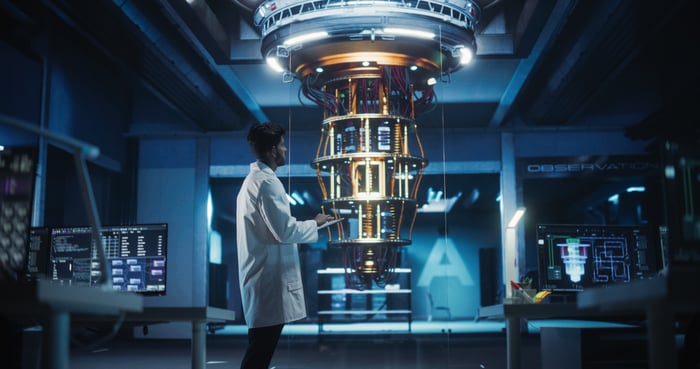
Image source: Getty Images.
IBM is the steadiest way to play it
Start with the company that grabbed the headlines. IBM is in line to receive $1 billion to launch Anderon, a new subsidiary that will build a quantum chip foundry in Albany, New York. The tech giant plans to match that with $1 billion of its own cash, putting the project's total price tag near $2 billion. Note that a second foundry award, $375 million, is slated to go to chipmaker GlobalFoundries (NASDAQ: GFS).
That is a meaningful vote of confidence in IBM's long-running quantum program.
But quantum barely registers in IBM's financial results today. The company generated $67.5 billion in revenue in 2025 and produced $14.7 billion in free cash flow -- its highest in over a decade. A $1 billion proposed award simply won't move numbers like those anytime soon.
What the money may do is accelerate a roadmap IBM has been chasing for years. On the company's fourth-quarter earnings call in January, CEO Arvind Krishna reiterated that IBM remains on pace to deliver its first large-scale, fault-tolerant quantum computer by 2029.
For now, though, anyone buying IBM is buying a profitable, diversified software and hardware business that happens to hold an early lead in quantum -- not a wager on quantum alone. Further, it's worth noting that the stock trades at a price-to-earnings ratio of about 22 and offers investors a dividend yield of 2.7%, a profile that looks nothing like the rest of this group.
The smaller names are a different animal
The pure-play quantum stocks are where the speculation -- and the risk -- lives.
D-Wave Quantum (NYSE: QBTS), Rigetti Computing (NASDAQ: RGTI), and Infleqtion (NYSE: INFQ), which only went public in February through a SPAC merger, each is in line for up to $100 million in proposed funding, and each soared more than 30% on Thursday. Together, those three names tacked on close to $5 billion in market value in a single session -- more than 15 times the $300 million in proposed awards they collectively stand to receive.
And the businesses underneath those valuations remain tiny. D-Wave, which calls itself the only company building both annealing and gate-model systems, took in just $2.9 million in revenue in the first quarter of 2026 and lost $18.4 million. Rigetti, maker of a recently launched 108-qubit machine, generated only $7.1 million in revenue for all of 2025 -- down from the prior year -- while posting a net loss of $216 million. To be fair, D-Wave's quarterly revenue was held back by the absence of a one-time system sale that had inflated the year-ago period, and its bookings recently hit a record. Even so, Rigetti carries a market capitalization above $8 billion as of this writing, on about $7 million of 2025 sales.
D-Wave, for its part, shared some optimistic comments about the news.
"We see this as a transformative moment for not just D-Wave, but also for quantum computing and the United States," said CEO Alan Baratz in a press release about the U.S. government's plan to obtain an equity stake in D-Wave and other quantum companies. That may well prove true over time.
But the rally may have gone too far. For starters, these are letters of intent, not finalized deals -- the awards still have to be completed.
Of course, Washington's planned funding is substantial -- and the long-term promise of quantum computing could be enormous. But for now, this remains a high-risk, fast-changing corner of the market, built far more on potential than on profits. Investors drawn in by the surge would be wise to tread carefully -- and to keep any position small.
Should you buy stock in International Business Machines right now?
Before you buy stock in International Business Machines, consider this:
The Motley Fool Stock Advisor analyst team just identified what they believe are the 10 best stocks for investors to buy now… and International Business Machines wasn’t one of them. The 10 stocks that made the cut could produce monster returns in the coming years.
Consider when Netflix made this list on December 17, 2004... if you invested $1,000 at the time of our recommendation, you’d have $477,813!* Or when Nvidia made this list on April 15, 2005... if you invested $1,000 at the time of our recommendation, you’d have $1,320,088!*
Now, it’s worth noting Stock Advisor’s total average return is 986% — a market-crushing outperformance compared to 208% for the S&P 500. Don't miss the latest top 10 list, available with Stock Advisor, and join an investing community built by individual investors for individual investors.
See the 10 stocks »
*Stock Advisor returns as of May 26, 2026.
Daniel Sparks and his clients have no position in any of the stocks mentioned. The Motley Fool has positions in and recommends GlobalFoundries and International Business Machines. The Motley Fool has a disclosure policy.
Recommended Articles


