




3 Ways to Become a Millionaire by Retirement
Key Points
Investing in the market consistently over time can lead to millionaire status.
You can supercharge your investments and minimize your risk by diversifying your ETFs.
A curated investment portfolio offers the greatest chances of gains.
- 10 stocks we like better than Vanguard S&P 500 ETF ›
The earlier you invest in the stock market, the more time you have for your funds to grow and reach $1 million by the time you retire. But even if you start late, investing consistently can help you reach your retirement goals.
Here are three general paths to millionaire status that can be customized to meet your specific needs and background.
Will AI create the world's first trillionaire? Our team just released a report on the one little-known company, called an "Indispensable Monopoly" providing the critical technology Nvidia and Intel both need. Continue »
1. Invest in the market
The easiest way to become a millionaire by retirement is to invest in the market. There are multiple ways to do that, but the most popular is the Warren Buffett-approved S&P 500 exchange-traded fund (ETF). Berkshire Hathaway has had positions in two ETFs that track the S&P 500: the original State Street SPDR ETF (NYSEMKT: SPY), which was the first ETF created, and the Vanguard S&P 500 ETF (NYSEMKT: VOO), the largest ETF in the world, with more than $1.6 trillion in assets.

Image source: Getty Images.
The theory is that by investing in a fund that tracks the market, you benefit from market gains without having to do the work of picking stocks and sweating over their performance. It's also cheap, since ETFs that track the market generally have low expense ratios. The S&P 500 has gained an annualized average of around 11% for the past 40 years. Theoretically, you could have invested only in such an ETF (although that's only in theory, since these ETFs didn't exist 40 years ago) and already be a millionaire, depending on how much you invested monthly or annually.
Here's an example. If you started your investment with $10,000 and added only $100 monthly, you'd have more than $1.3 million after 40 years. So if you started when you were 25, you could easily retire at 65 as a millionaire with no other investments.
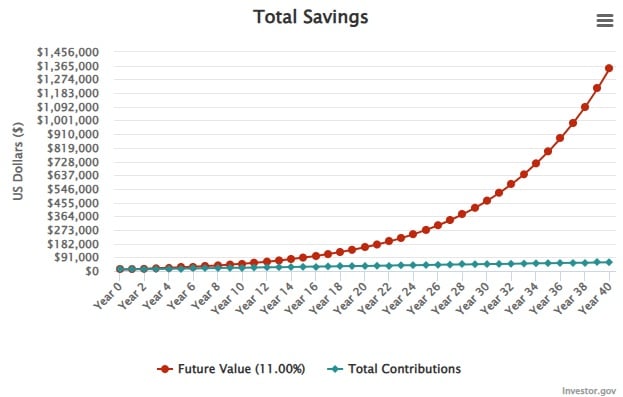
Image source: Investor.gov.
2. Diversify through ETFs
If you don't have 40 years to wait and you want to be a bit more aggressive in your investments, you can invest in growth ETFs that come with some more risk, but are still quite low-risk. Although many of them aren't as heavily diversified as those that track the S&P 500, if you invest in a few of them, you still get diversification, minimizing some of the extra risk.
Because these kinds of ETFs are relatively new, there isn't 40 years' worth of data about their performance, so I'm going to extrapolate a bit.
Let's take two popular ETFs that have different focuses: the Schwab U.S. Dividend Equity ETF (NYSEMKT: SCHD) and the Vanguard S&P Growth ETF (NYSEMKT: VOOG). The Schwab ETF tracks the Dow Jones U.S. Dividend 100 Index, and the Vanguard ETF tracks the S&P 500 Growth index, featuring 144 stocks. The average annualized return for the Schwab ETF since its inception in 2011 is 13.3%, and for the Vanguard ETF it's 16.7% since its inception in 2010. The midpoint is 15%.
If you took your $10,000 and split it between the two, and did the same with your monthly contributions, you would be a millionaire within 30 years.
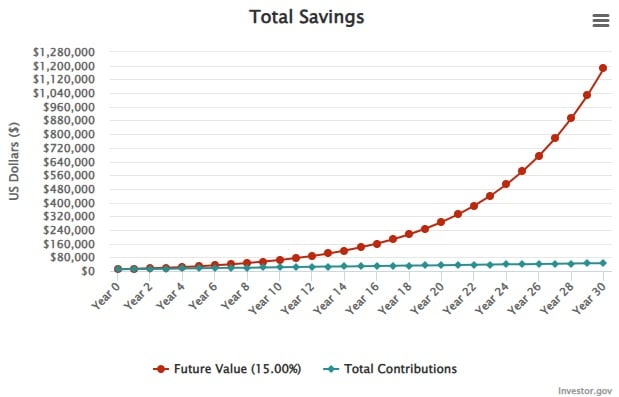
Image source: Investor.gov.
If you do have 40 years and employ this method, you'd end up with nearly $5 million. There are no guarantees that these ETFs will deliver the same kinds of gains going forward, but it's certainly possible.
3. Create a custom portfolio
The chance for the highest gains is through curating your own portfolio or working with an investment professional. This comes with the highest risks, but you can choose a portfolio of any risk type to meet your goals. An excellent portfolio is typically diversified with high-value stocks as well as strong growth stocks. The growth portion can supercharge your returns while the value stocks, especially dividend stocks, provide safety and passive income, shielding your money under challenging conditions. A portfolio of 25 to 30 stocks works well for most individual investors and can help you reach $1 million status in much less time. Continuing with the examples above, if you can raise the annualized return by another 4 percentage points to 19%, you'd be a millionaire within 24 years.
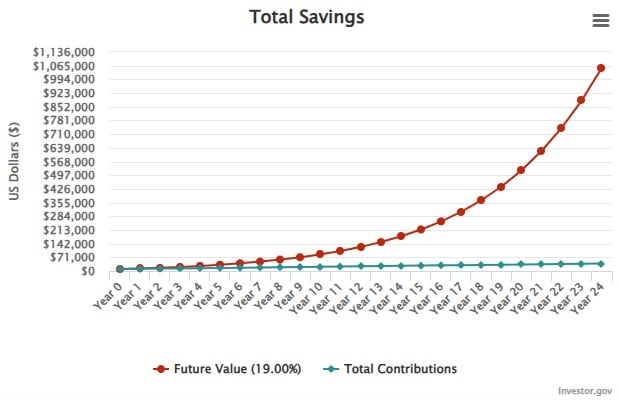
Image source: Investor.gov.
These are all theoretical scenarios to see how investing in the stock market can help you accumulate wealth over time. The key is consistency. Within any of these scenarios, the more you invest, the quicker you'll reach your goals.
Should you buy stock in Vanguard S&P 500 ETF right now?
Before you buy stock in Vanguard S&P 500 ETF, consider this:
The Motley Fool Stock Advisor analyst team just identified what they believe are the 10 best stocks for investors to buy now… and Vanguard S&P 500 ETF wasn’t one of them. The 10 stocks that made the cut could produce monster returns in the coming years.
Consider when Netflix made this list on December 17, 2004... if you invested $1,000 at the time of our recommendation, you’d have $481,589!* Or when Nvidia made this list on April 15, 2005... if you invested $1,000 at the time of our recommendation, you’d have $1,345,714!*
Now, it’s worth noting Stock Advisor’s total average return is 993% — a market-crushing outperformance compared to 208% for the S&P 500. Don't miss the latest top 10 list, available with Stock Advisor, and join an investing community built by individual investors for individual investors.
See the 10 stocks »
*Stock Advisor returns as of May 23, 2026.
Jennifer Saibil has positions in Vanguard Admiral Funds-Vanguard S&P 500 Growth ETF and Vanguard S&P 500 ETF. The Motley Fool has positions in and recommends Berkshire Hathaway and Vanguard S&P 500 ETF. The Motley Fool has a disclosure policy.
Recommended Articles


