




If You Think President Donald Trump and the Fed Are Feuding Now, Wait Until the Effects of the Iran War Hit the Inflation Report
Key Points
Although Donald Trump nominated Jerome Powell to succeed Janet Yellen as Fed chair during his first term, he's been a vocal critic of Powell and the Fed since the start of his second, non-consecutive term.
Trump has advocated for a federal funds target rate of 1% (or lower), while Powell has stated that economic data will guide the Federal Open Market Committee's monetary policy decisions.
Once the effects of the Iran war begin showing up in U.S. inflation reports, it'll likely exacerbate this feud, as well as expose a historically pricey stock market.
- 10 stocks we like better than S&P 500 Index ›
From an objective standpoint, the stock market has excelled with President Donald Trump in the White House. During his first, non-consecutive term (Jan. 20, 2017 – Jan. 20, 2021), the Dow Jones Industrial Average (DJINDICES: ^DJI), S&P 500 (SNPINDEX: ^GSPC), and Nasdaq Composite (NASDAQINDEX: ^IXIC) rallied 57%, 70%, and 142%, respectively. On an annualized basis, stock returns under Trump have been better than most presidents, dating back to the late 1890s.
But this doesn't mean equities have advanced in a straight line under Trump, or that Wall Street hasn't dealt with its fair share of uncertainty.
Will AI create the world's first trillionaire? Our team just released a report on the one little-known company, called an "Indispensable Monopoly" providing the critical technology Nvidia and Intel both need. Continue »
Although the Iran war is dominating headlines at the moment, it's President Trump's ongoing feud with the Federal Reserve -- more specifically, outgoing Fed Chair Jerome Powell -- that's been making waves on Wall Street over the last year. Rather than seeing this vocal disagreement on the future of interest rates die down, we're liable to see it escalate in a big way once the full effects of the Middle East conflict are reflected in U.S. economic data.
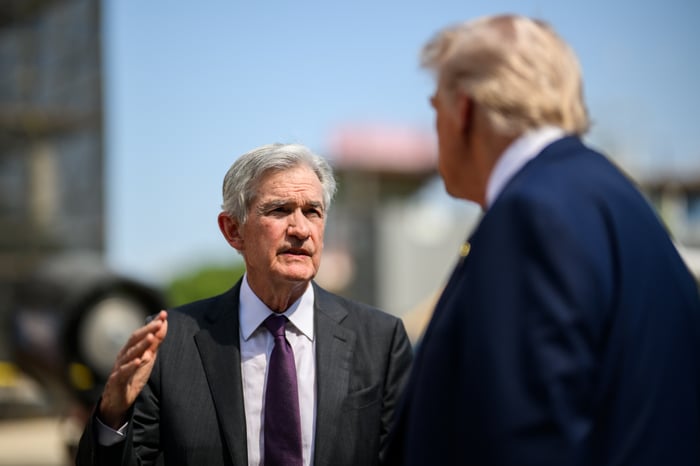
Fed Chair Jerome Powell speaking with President Donald Trump. Image source: Official White House Photo by Daniel Torok.
President Trump and Fed Chair Jerome Powell go head-to-head on Interest rates
Although Donald Trump nominated Powell to succeed Janet Yellen as Fed Chair during his first term, he and Powell have struggled to find common ground since the start of his second term on Jan. 20, 2025.
On several occasions, Trump has called for Powell and the Federal Open Market Committee (FOMC) -- the 12-person body responsible for setting the nation's monetary policy -- to significantly lower interest rates. He's specifically advocated for a 1% (or lower) federal funds target rate, which is the overnight lending rate between banks. For context, the current federal funds target rate ranges from 3.50% to 3.75%.
The president's desire to see interest rates slashed likely serves two purposes. Firstly, lower interest rates would be expected to encourage businesses to borrow, leading to an increase in hiring, acquisition activity, and spending on innovation. Lower borrowing costs can fuel economic growth and potentially lower the unemployment rate.
JUST IN: 🇺🇸 US national debt reaches new all-time high of $39 trillion. pic.twitter.com/85EQDetyd4
-- Watcher.Guru (@WatcherGuru) March 17, 2026
Secondly, Trump may be pushing for lower rates as a way to alleviate some pressure on U.S. debt-servicing costs. Last week, U.S. national debt surpassed $39 trillion. Lower interest rates would make it considerably easier for the U.S. to cover the interest payments on what it owes.
Despite the president's scathing criticisms of Jerome Powell's performance as Fed chair, the Fed has stuck to its dual mandate of maximizing employment and stabilizing prices. Powell has repeatedly stated that the FOMC will use economic data to guide its policymaking.
An inflation rate that's been persistently above the Fed's long-term target of 2% for nearly five years has squashed any hope of aggressive rate cuts. To add, Powell has noted that the inflationary effects of President Trump's tariffs are still working their way through the U.S. economy.

President Trump overseeing Operation Epic Fury. Image source: Official White House Photo by Daniel Torok.
The Iran war may lead to fireworks between Trump and the Federal Reserve
Although Jerome Powell's term as Fed chair is set to end on May 15, his departure is unlikely to end what's been a very open disagreement between Trump and America's foremost financial institution. Even if Trump's nominated successor to Powell, Kevin Warsh, is approved by the Senate Banking Committee and then U.S. Senate, we're liable to see an increase, not a decrease, in this ongoing feud.
On Feb. 28, U.S. and Israeli forces began military operations against Iran. While there's an incalculable and tragic human toll associated with war, there are also ancillary impacts that can extend well beyond where the fighting is taking place.
Shortly after this war commenced, Iran virtually closed the Strait of Hormuz to oil exports. Approximately 20% of the world's liquid petroleum travels through the Strait of Hormuz daily, according to the Energy Information Administration. The largest energy supply disruption in history has sent crude oil prices soaring.
Consumers are enduring the steepest one-month increase in fuel prices in three decades. But higher energy costs also impact the trucking, airline, and railroad industries.
The Cleveland Fed is now forecasting a 3% CPI Inflation reading for March, up from 2.4% in February.
-- Charlie Bilello (@charliebilello) March 19, 2026
There is now a higher probability of a Fed rate HIKE (8%) in April than a rate CUT (0%). pic.twitter.com/yoWBJBbDDN
Based on the latest estimate from the Federal Reserve Bank of Cleveland's Inflation Nowcasting tool, the trailing 12-month inflation rate is expected to jump from approximately 2.4% in February to an estimated 3.02% in March, with energy commodities likely doing much of this heavy lifting.
Additionally, the Federal Reserve Bank of Atlanta's Market Probability Tracker indicates only an 18.3% chance of a 25-basis-point rate cut for the April FOMC meeting and a 40.2% probability of a 25-basis-point rate hike!
The Iran war is expected to notably increase the prevailing inflation rate and could completely halt the Fed's current rate-easing cycle. If trailing 12-month inflation moves well above 3%, it may even prompt members of the FOMC to raise interest rates, which will undoubtedly draw the ire of President Trump.
It's also worth noting that Trump nominee Kevin Warsh was dubbed a "hawk" during his tenure with the FOMC (Feb. 24, 2006 – March 31, 2011). Warsh frequently prioritized inflation concerns over rising unemployment throughout the financial crisis. If the inflation rate meaningfully picks up, Warsh's track record suggests he'll advocate for higher rates to stabilize prices.
"If Trump wants someone easy on inflation, he got the wrong guy in Kevin Warsh."@AnnaEconomist pic.twitter.com/FGMfeSqHpU
-- Daily Chartbook (@dailychartbook) January 31, 2026
Perhaps the bigger issue at hand is how the Iran war dynamic will impact the stock market. According to the S&P 500's Shiller Price-to-Earnings Ratio, the stock market entered 2026 at its second-priciest valuation in history, dating back to January 1871. This premium valuation has been supported, in part, by the notion that the Fed will enact several rate cuts throughout the year, thereby spurring corporate borrowing. With these rate cuts potentially off the table, a historically expensive stock market suddenly finds itself highly vulnerable.
When the March inflation report hits the newswires on April 10, it may mark a shift in the Federal Reserve's monetary policy -- and that would be terrible news for Wall Street.
Should you buy stock in S&P 500 Index right now?
Before you buy stock in S&P 500 Index, consider this:
The Motley Fool Stock Advisor analyst team just identified what they believe are the 10 best stocks for investors to buy now… and S&P 500 Index wasn’t one of them. The 10 stocks that made the cut could produce monster returns in the coming years.
Consider when Netflix made this list on December 17, 2004... if you invested $1,000 at the time of our recommendation, you’d have $503,861!* Or when Nvidia made this list on April 15, 2005... if you invested $1,000 at the time of our recommendation, you’d have $1,026,987!*
Now, it’s worth noting Stock Advisor’s total average return is 884% — a market-crushing outperformance compared to 179% for the S&P 500. Don't miss the latest top 10 list, available with Stock Advisor, and join an investing community built by individual investors for individual investors.
See the 10 stocks »
*Stock Advisor returns as of March 29, 2026.
Sean Williams has no position in any of the stocks mentioned. The Motley Fool has no position in any of the stocks mentioned. The Motley Fool has a disclosure policy.
Recommended Articles


