




Is This ETF the Best Way to Invest in the S&P 500 Right Now?
Key Points
The tech sector makes up roughly a third of the S&P 500, which is much higher than in the past.
An equal-weight S&P 500 ETF divides your investment roughly evenly among S&P 500 companies.
The Invesco S&P 500 Equal Weight ETF has outperformed the S&P 500 since its inception.
- 10 stocks we like better than Invesco S&P 500 Equal Weight ETF ›
The S&P 500 is widely regarded as the stock market's most important index. It tracks around 500 of the largest public American companies, so its performance is often used to gauge the overall health of the U.S. stock market. Unfortunately, after three consecutive years of double-digit gains, the S&P 500 has been off to a slow start in 2026, down about 0.5% year to date (as of March 10).
There's plenty to like about the S&P 500, but one key characteristic could be the cause of its lackluster performance: tech industry concentration. In light of this issue, is there a better alternative for investing in the index? Let's take a look.
Will AI create the world's first trillionaire? Our team just released a report on the one little-known company, called an "Indispensable Monopoly" providing the critical technology Nvidia and Intel both need. Continue »
Image source: Getty Images.
The current state of the S&P 500
The S&P 500 is weighted by market capitalization, so larger companies account for more of the index than smaller ones. Historically, this hasn't typically been an issue, but as big tech stocks have surged in value over the past few years, the index has become highly concentrated.
Nvidia, Microsoft, and Apple alone account for almost 20% of the index, and the top 10 holdings account for over 38%. That's a high concentration for an index with diversification as a main selling point. The S&P 500 is still diversified, containing major companies from all 11 major sectors, but it has undoubtedly become tech-heavy (as tech stocks make up over a third of the index).
The concentration in big tech stocks works out in the S&P 500's favor when the sector is flourishing, but it's also a huge drag when the opposite is true (like we're currently witnessing).
An alternative way to invest in the S&P 500
If you're interested in investing in the S&P 500 but don't want the current concentration risk that comes with it, a good option is an equal-weight S&P 500 exchange-traded fund like the Invesco S&P 500 Equal Weight ETF (NYSEMKT: RSP). Instead of being split by company size, RSP allocates your investment relatively evenly across all companies in the S&P 500. Below are the S&P 500's top 10 holdings and their weight in the standard versus equal-weight indexes:
| Company | Percentage of the Standard S&P 500 | Percentage of RSP |
|---|---|---|
| Nvidia | 7.84% | 0.19% |
| Apple | 6.47% | 0.18% |
| Alphabet (Class A and C) |
5.98% | 0.18% |
| Microsoft | 5.40% | 0.17% |
| Amazon | 3.93% | 0.18% |
| Broadcom | 2.64% | 0.16% |
| Meta Platforms (Class A) | 2.63% | 0.19% |
| Tesla | 2.04% | 0.17% |
| Berkshire Hathaway (Class B) | 1.49% | 0.20% |
Data sources: Vanguard and Invesco. Vanguard percentages as of Jan. 31; Invesco percentages as of March 9.
There's a big difference between nine companies making up over 38% of an index and 1.6% of an ETF. The latter is much better during periods when certain sectors (in this case, tech) are lagging or otherwise seem riskier.
You don't have to sacrifice gains when investing in RSP
Despite its lackluster performance to start the year, the S&P 500 has been on an impressive run since its 19% drop in 2022. In the roughly three years since, it's up over 77%, and it's easy to see why when you look at the performance of its top holdings. The worst performer among its top 10 over that span is Microsoft, and it's gained nearly 70% in that time. Not too shabby.
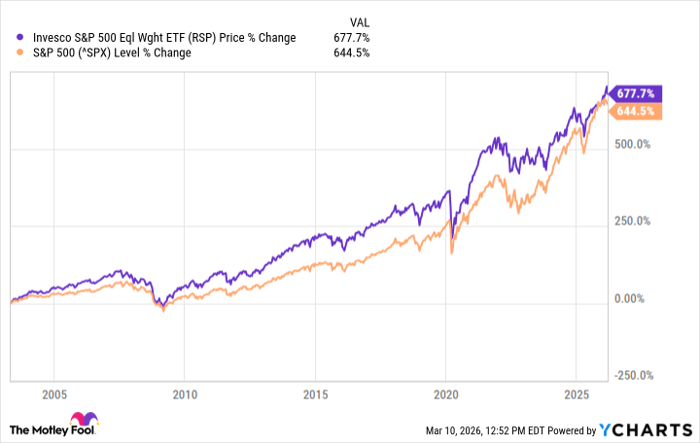
RSP has underperformed the S&P 500 over the past three years amid the recent artificial intelligence (AI) boom, but when you zoom out, RSP has outperformed the S&P 500 since it debuted on the stock market in April 2003.
RSP data by YCharts
The highs of the standard S&P 500 are typically higher than RSP's highs, but its lows are also typically much lower. I'm still a big fan of the S&P 500 (it's my largest holding), and believe it's a great long-term investment for the vast majority of investors. However, RSP can be a great supplemental piece that helps hedge against the high concentration of big tech stocks in the S&P 500 and any potential AI-induced bubble.
Should you buy stock in Invesco S&P 500 Equal Weight ETF right now?
Before you buy stock in Invesco S&P 500 Equal Weight ETF, consider this:
The Motley Fool Stock Advisor analyst team just identified what they believe are the 10 best stocks for investors to buy now… and Invesco S&P 500 Equal Weight ETF wasn’t one of them. The 10 stocks that made the cut could produce monster returns in the coming years.
Consider when Netflix made this list on December 17, 2004... if you invested $1,000 at the time of our recommendation, you’d have $508,607!* Or when Nvidia made this list on April 15, 2005... if you invested $1,000 at the time of our recommendation, you’d have $1,122,746!*
Now, it’s worth noting Stock Advisor’s total average return is 933% — a market-crushing outperformance compared to 188% for the S&P 500. Don't miss the latest top 10 list, available with Stock Advisor, and join an investing community built by individual investors for individual investors.
See the 10 stocks »
*Stock Advisor returns as of March 13, 2026.
Stefon Walters has positions in Apple and Microsoft. The Motley Fool has positions in and recommends Alphabet, Amazon, Apple, Berkshire Hathaway, Meta Platforms, Microsoft, Nvidia, and Tesla and is short shares of Apple. The Motley Fool recommends Broadcom. The Motley Fool has a disclosure policy.
Recommended Articles


