




Middle East Tensions Intensify Supply Disruptions, Wall Street Turns Bullish on Aluminum Prices
TradingKey - The war in Iran has once again drawn the world’s attention to the Strait of Hormuz — that narrow waterway connecting the Persian Gulf and the Arabian Sea, through which about one‑fifth of global oil trade passes. Yet what is now at stake goes far beyond crude. The fragile balance of global commodities depends, almost symbolically, on the calm of these waters. As fighting on both shores intensifies, freight rates have soared, insurance premiums have spiked, and the ripples have reached the metals market.
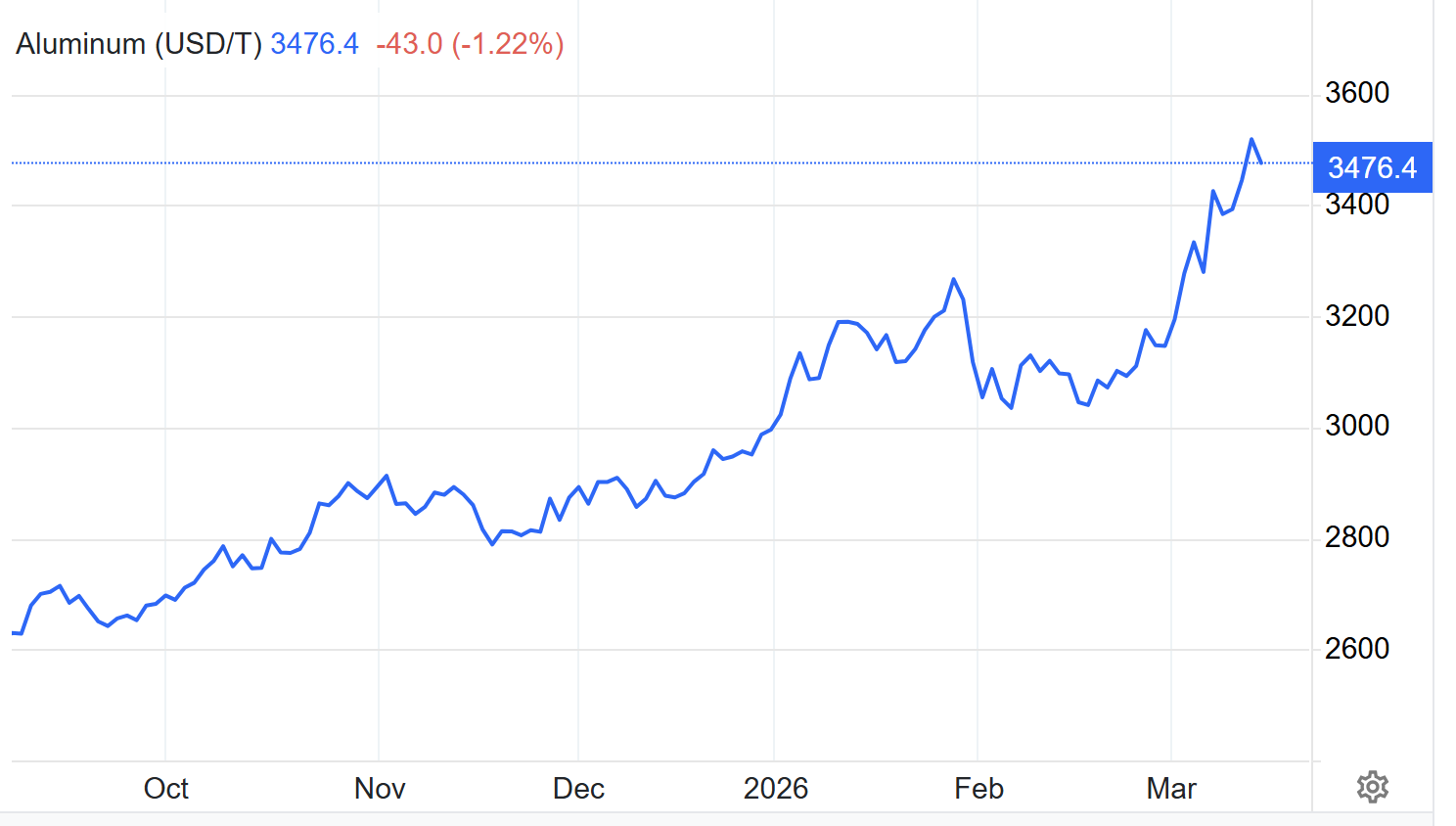
Aluminium, the quiet workhorse of modern industry, has suddenly found itself in the eye of the storm. On the London Metal Exchange, prices rose by more than ten percent in a single week — the strongest rally in three years.
According to data from Aladdin (ALD), the Middle East has long since outgrown its role as a mere energy exporter. Over the past decade, it has quietly become one of the world’s largest aluminium production hubs. By 2025, the six Gulf nations — Iran, Saudi Arabia, the UAE, Bahrain, Qatar and Oman — will together hold some 7.05 million tons of smelting capacity, accounting for roughly 9 percent of global output. Among them, the UAE, Bahrain and Saudi Arabia provide more than 90 percent of the total, forming one of the key pillars of the global aluminium trade. Yet the strength of this industrial pillar hides a structural weakness: a deep dependence on imported alumina, the pale ore from which aluminium is refined.
The Gulf’s self‑sufficiency rate is barely a third. The region faces an annual deficit of more than 4.5 million tons, with Iran sourcing over 80 percent of its alumina from abroad. Bahrain and Qatar depend entirely on cargoes shipped from far‑off producers in Australia and Guinea. Every tonne must pass through the Strait of Hormuz before reaching the smelters. Any meaningful disruption there would risk cutting the region’s aluminium industry off from its raw‑material lifeline.
This vulnerability is now redrawing the map of the global aluminium market from three directions at once. The first is sheer scarcity. If the Gulf’s 9 percent of global capacity were to shut down for lack of feedstock, inventories worldwide could sustain demand for scarcely more than a week. Under such a prospect of imbalance, a near‑term price spike toward 3,500 to 4,000 dollars a tonne no longer sounds implausible. Analysts at Goldman Sachs and elsewhere have already raised their 2026 average forecast to about 3,300 dollars.
The second is the shifting cost structure. Aluminium has always been described as “solid electricity”: each tonne demands roughly 14,000 kilowatt‑hours to produce. With energy prices surging after the oil and gas shock, electricity now accounts for over half of total production costs, up from about 35 percent in calmer times. Added to the surge in freight premiums, this has pushed high‑cost producers closer to the edge. By contrast, integrated Chinese smelters — controlling everything from alumina supply to power generation — are poised to benefit. Their margins, analysts estimate, could expand to somewhere between 4,000 and 5,000 yuan per tonne, the highest levels in recent memory.
The conflict may accelerate a gradual migration of aluminium production toward regions with fewer geopolitical flashpoints in the future. China, Indonesia and Iceland — each with stable energy sources and resilient policy environments — are emerging as likely destinations for new capacity. For the Middle East, however, this could mark the start of a long reconfiguration that might take five to ten years to complete. During that period, aluminium prices will probably abandon their old stability in favor of a new, higher plateau defined by volatility.
Recommended Articles


