




Boeing Sends Liquid Robots to Defend Japan
Key Points
Boeing subsidiary Liquid Robotics just won its first sizeable defense contract to supply USVs to Japan.
The company has nearly tripled the price of its Wave Glider robot vessel since getting acquired by Boeing.
- 10 stocks we like better than Boeing ›
Reviewing the Department of Defense's daily digest of contract awards (as one does), you tend to get a good idea of who "the usual suspects" are at the Pentagon. Big defense names like RTX, Lockheed Martin, and Northrop Grumman make regular appearances on the list; big tech names like Microsoft or Palantir or Amazon Web Services will also pop up from time to time, hired to do military IT work. And then, every so often, an entirely unfamiliar name will arrive that causes you to sit up and take notice.
That's what happened for me last week, when Liquid Robotics appeared on the list.
Will AI create the world's first trillionaire? Our team just released a report on the one little-known company, called an "Indispensable Monopoly" providing the critical technology Nvidia and Intel both need. Continue »
Searching through the archives for the past 10 years, it turns out last week was the first time ever Liquid Robotics won a contract big enough to show up on the Pentagon's list (which covers all contracts $7.5 million and up). So what exactly is Liquid Robotics, I wondered?
And what does it do?
And why is the Japanese navy buying drone ships from it?
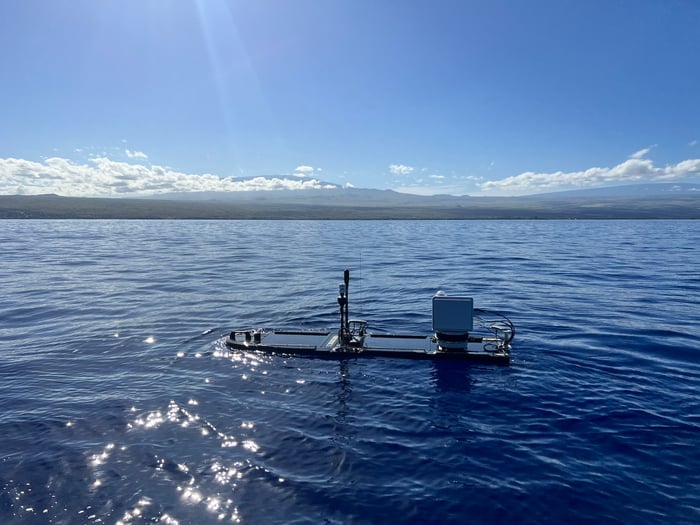
Image source: Liquid Robotics.
Japan loves robots
Because that's the substance of the contract I had stumbled upon. For $25 million, the U.S. Air Force had contracted to purchase 20 commercial unmanned surface vehicles (that's military-speak for drone warships) from Liquid Robotics, apparently for delivery to Japan as a Foreign Military Sale.
It took a bit of digging, but in short order, all was made clear.
Liquid Robotics, it turns out, is a subsidiary of Pentagon megacontractor Boeing (NYSE: BA), which bought the company back in December 2016 as "a market leader in autonomous maritime systems and developer of the Wave Glider ocean surface robot." It now resides within Boeing's Defense, Space & Security division.
Liquid Robotics makes only one product, the Wave Glider USV (which makes it pretty clear which "commercial unmanned surface vehicles" Japan is buying). Liquid Robotics describes the Wave Glider as a "low-observable, mobile platform that enables over-the-horizon surveillance with both surface and sub-surface payloads." Although even the largest Wave Glider (SV5) measures only 15 feet in length, it can tow sonar to detect threats underwater, even as it carries sensors and communications gear topside to detect surface and air threats -- and transmit this data back to base.
Powered by solar panels and wave energy, the vessels are capable of operating autonomously for as long as 12 months at a time and in any environment, including sailing through doldrums, hurricanes, typhoons, and even Arctic conditions. Wave Gliders aren't speedy, with a maximum speed of just two knots, but they have long endurance; at least one has successfully traveled in excess of 9,300 nautical miles on a single trip.
What does this contract mean for Boeing?
At just $25 million in value, the Japanese Wave Glider contract is just a very small fish swimming within Boeing's $89.5 billion annual revenue stream. It's still probably a nice, profitable little business for Boeing.
Back when Boeing bought the company, Liquid Robotics was selling Wave Gliders for just $300,000 apiece. The company's new Japanese contract, meanwhile, implies the per-unit cost has nearly tripled in 10 years, to more than $830,000.
Even at the new and improved price, the Navy -- both Japan's and our own -- can probably afford to buy quite a lot of them.
Should you buy stock in Boeing right now?
Before you buy stock in Boeing, consider this:
The Motley Fool Stock Advisor analyst team just identified what they believe are the 10 best stocks for investors to buy now… and Boeing wasn’t one of them. The 10 stocks that made the cut could produce monster returns in the coming years.
Consider when Netflix made this list on December 17, 2004... if you invested $1,000 at the time of our recommendation, you’d have $534,817!* Or when Nvidia made this list on April 15, 2005... if you invested $1,000 at the time of our recommendation, you’d have $1,123,912!*
Now, it’s worth noting Stock Advisor’s total average return is 964% — a market-crushing outperformance compared to 192% for the S&P 500. Don't miss the latest top 10 list, available with Stock Advisor, and join an investing community built by individual investors for individual investors.
See the 10 stocks »
*Stock Advisor returns as of March 7, 2026.
Rich Smith has no position in any of the stocks mentioned. The Motley Fool has positions in and recommends Amazon, Boeing, Microsoft, Palantir Technologies, and RTX. The Motley Fool recommends Lockheed Martin. The Motley Fool has a disclosure policy.
Recommended Articles


