




Another Credit Crash Coming? This Stress Indicator Is Hitting Financial Crisis Levels.
Key Points
The percentage of consumer credit card debt that's at least 90 days delinquent just hit its highest level since 2011.
Wage growth has been adequate, but affordability issues mean consumers are having trouble handling the stress.
With no immediate relief in sight, a crash in the credit market might be unavoidable.
- 10 stocks we like better than S&P 500 Index ›
We hear a lot nowadays about the K-shaped economy. In this model, those in higher income brackets are doing well, while lower income folks are struggling. The financial markets pay attention to things like GDP growth and corporate earnings, both of which are looking healthy at the moment and helping push the S&P 500 (SNPINDEX: ^GSPC) toward new highs.
The details, however, paint a different picture.
Will AI create the world's first trillionaire? Our team just released a report on the one little-known company, called an "Indispensable Monopoly" providing the critical technology Nvidia and Intel both need. Continue »
Overall personal spending has remained resilient throughout this current economic cycle. Over the past several months, it has averaged a 0.4% month-over-month gain -- enough to keep the economic engine churning.
But a lot of that spending appears to be built on the back of credit. And the data suggests that consumers are having a really hard time keeping their heads above water right now.

Image source: Getty Images.
Severe credit card delinquency rates are nearing record highs
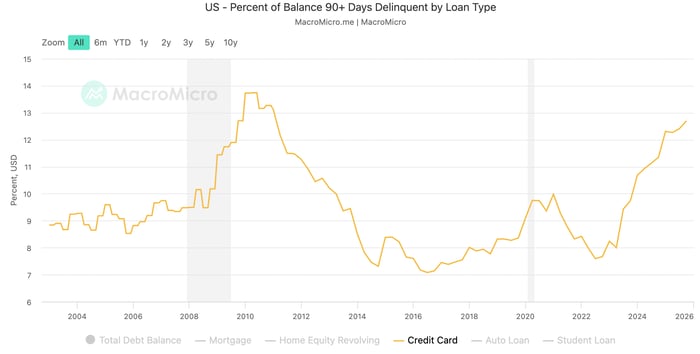
In Q4 2025, the percentage of credit card debt that was at least 90 days delinquent climbed to 12.7%. That's the highest level since 2011 Q1, when it was just over 13%.
Source: MacroMicro.
It's important to note that the current delinquency rate on credit card debt isn't that far off from its financial crisis peak in 2010. Given the current trajectory of that trend line (it's gone from around 8% to over 12% in just three years), it's not unreasonable to think that the credit market could be around 12 months away from a new all-time high.
The numbers that the stock market usually trades on are based on economic growth and corporate earnings. Those are driven largely by spending. The calculations don't care how the spending is being done. Only THAT it's being done.
Wage growth isn't keeping up with consumer spending
Ideally, you want to see increased spending supported by increased incomes. U.S. wage growth has slowed from its 2021 peak, but it's still well above 3% annually. That should be enough to support an increase in spending, but that doesn't appear to be the case.
That's because of ongoing affordability concerns. Inflation is still hovering around 3% annually, with many goods seeing even sharper price increases. To keep their heads above water, it looks like an increasing number of consumers are funding their spending by running up credit card debt.
That's a plan that's sustainable for a little while, but as we saw during the financial crisis, consumers eventually hit a wall, and the house of cards comes crashing down.
There isn't much relief in sight, and any attempts by Congress to fix the problem are likely to run into roadblocks. That might mean that the only plausible outcome is a major reset of the credit markets like we saw back in the late 2000s. It would be a painful path no doubt, but the government can't spend its way out of problems forever.
Should you buy stock in S&P 500 Index right now?
Before you buy stock in S&P 500 Index, consider this:
The Motley Fool Stock Advisor analyst team just identified what they believe are the 10 best stocks for investors to buy now… and S&P 500 Index wasn’t one of them. The 10 stocks that made the cut could produce monster returns in the coming years.
Consider when Netflix made this list on December 17, 2004... if you invested $1,000 at the time of our recommendation, you’d have $526,889!* Or when Nvidia made this list on April 15, 2005... if you invested $1,000 at the time of our recommendation, you’d have $1,103,743!*
Now, it’s worth noting Stock Advisor’s total average return is 947% — a market-crushing outperformance compared to 192% for the S&P 500. Don't miss the latest top 10 list, available with Stock Advisor, and join an investing community built by individual investors for individual investors.
See the 10 stocks »
*Stock Advisor returns as of March 4, 2026.
David Dierking has no position in any of the stocks mentioned. The Motley Fool has no position in any of the stocks mentioned. The Motley Fool has a disclosure policy.
Recommended Articles


