




Is It Time to Buy Energy Transfer as Growth Projects Ramp Up?
Key Points
Energy Transfer saw solid Q4 growth and upped its 2026 guidance.
The stock is one of the cheapest in the MLP midstream space.
- 10 stocks we like better than Energy Transfer ›
Energy Transfer (NYSE: ET) is off to a strong start in 2026, with its stock price up about 14% as of this writing. With the company just reporting its Q4 results, let's look at why it is one of the most intriguing master limited partnerships (MLPs) to own right now.
Solid growth ahead
While most investors are attracted to Energy Transfer's attractive forward yield of 7.2%, the company also has some of the best growth opportunities in the midstream space. The company is in the midst of two large-scale natural gas projects out of the Permian Basin, with the Hugh Brison Pipeline and Desert Southwest Pipeline. The former is 75% complete, with phase 1 expected to come online by the end of the year. Meanwhile, it just upsized the Desert Southwest project due to the strong demand from customers, with an in-service date of late 2029.
Where to invest $1,000 right now? Our analyst team just revealed what they believe are the 10 best stocks to buy right now, when you join Stock Advisor. See the stocks »

Image source: Getty Images.
The pipeline company will increase its capital expenditures (capex) this year to a range of $5 billion to $5.5 billion. That's up from the $4.5 billion it spent in 2025. It has said it expects a mid-teens return, or 6 times adjusted earnings before interest, taxes, depreciation, and amortization (EBITDA) build rate of these projects. That would be close to adding $90 million in incremental EBITDA once these projects come online and are fully ramped up.
Turning to its Q4 results, Energy Transfer's EBITDA in the quarter climbed by 8% year over year to $4.18 billion. It said that a favorable regulatory ruling around NGL (natural gas liquid) pipeline pricing led to a $56 million benefit in the quarter and that the ruling will have a small positive impact moving forward.
Distributable cash flow (DCF) to partners, which is operating cash flow minus maintenance capex, rose 3% to $2.04 billion, up from $1.98 billion a year ago. It paid out $1.15 billion in distributions in the quarter, good for a coverage ratio of nearly 1.8.
The company also slightly upped its full-year EBITDA forecast, taking it to a range of $17.45 billion and $17.85 billion, up from a prior guidance range of $17.3 billion to $17.7 billion. The increase was attributed to an acquisition made by its subsidiary, USA Compression. It continues to expect to raise its distribution by a 3% to 5% clip moving forward.
Is the stock a buy?
Energy Transfer is a great combination of a stock with a high yield that is well covered with solid growth opportunities ahead. Meanwhile, the stock is attractively valued, trading at an enterprise value-to-EBITDA (EV/EBITDA) multiple of just 8.6 times. That's one of the lowest valuations in the midstream MLP sector.
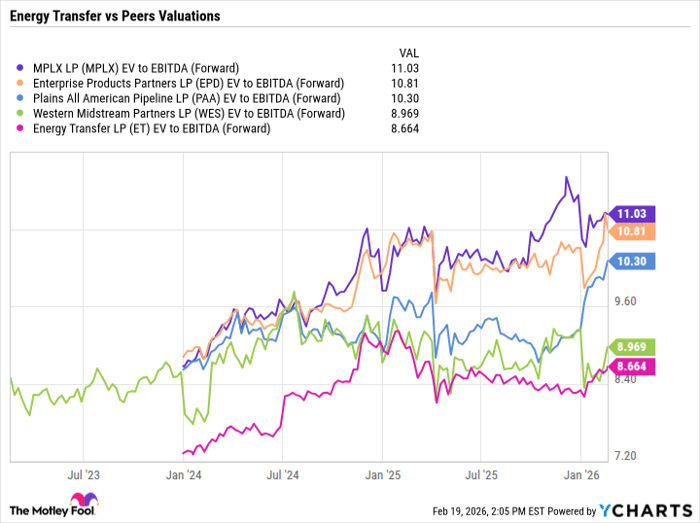
Data by YCharts.
In my view, Energy Transfer is the best stock in the midstream sector to buy right now.
Should you buy stock in Energy Transfer right now?
Before you buy stock in Energy Transfer, consider this:
The Motley Fool Stock Advisor analyst team just identified what they believe are the 10 best stocks for investors to buy now… and Energy Transfer wasn’t one of them. The 10 stocks that made the cut could produce monster returns in the coming years.
Consider when Netflix made this list on December 17, 2004... if you invested $1,000 at the time of our recommendation, you’d have $415,256!* Or when Nvidia made this list on April 15, 2005... if you invested $1,000 at the time of our recommendation, you’d have $1,151,865!*
Now, it’s worth noting Stock Advisor’s total average return is 892% — a market-crushing outperformance compared to 194% for the S&P 500. Don't miss the latest top 10 list, available with Stock Advisor, and join an investing community built by individual investors for individual investors.
See the 10 stocks »
*Stock Advisor returns as of February 20, 2026.
Geoffrey Seiler has positions in Energy Transfer, Enterprise Products Partners, and Western Midstream Partners. The Motley Fool recommends Enterprise Products Partners. The Motley Fool has a disclosure policy.
Recommended Articles


