




Prediction: Nvidia Will Have a Difficult Time Living Up to Investors' Lofty Expectations on Feb. 25
Key Points
Artificial intelligence (AI) is Wall Street's hottest trend, with the stock market's largest publicly traded company, Nvidia, leading the charge.
Demand for Nvidia's graphics processing units (GPUs) has been borderline insatiable, translating into superior pricing power and mouthwatering margins.
A myriad of factors suggest Nvidia's fiscal 2027 outlook won't satisfy investors.
- 10 stocks we like better than Nvidia ›
For much of the last three years, artificial intelligence (AI) has been the hottest trend on Wall Street. Providing software and systems with the tools to make accurate, split-second decisions without human oversight is a game changer that's expected to create trillions of dollars in global economic value.
Although a long list of publicly traded companies is benefiting from this artificial intelligence push, none exemplify this technological evolution quite like Nvidia (NASDAQ: NVDA). Since the end of 2022, Nvidia has added nearly $4.2 trillion in market cap and has become the most valuable company on Wall Street.
Where to invest $1,000 right now? Our analyst team just revealed what they believe are the 10 best stocks to buy right now, when you join Stock Advisor. See the stocks »

Image source: Nvidia.
Perhaps it's no surprise that Nvidia's operating results are the most anticipated of any public company. Though the bulk of earnings season is in the rearview mirror, the star of the show (Nvidia) is set to lift the hood on its fiscal 2026 fourth-quarter operating results (ended Jan. 25, 2026) following the closing bell on Feb. 25.
While Nvidia is expected to do what it does best -- decisively surpass the consensus sales and profit forecast of Wall Street analysts -- other factors suggest it'll have a difficult time living up to the lofty expectations of investors.
Demand for Nvidia's AI hardware has been borderline insatiable
When Nvidia reveals its fiscal fourth-quarter operating results in a little over a week, analysts will be looking for approximately $65.6 billion in sales (up 67% from the prior-year period) and $1.52 in earnings per share (EPS). Considering that Nvidia has topped the consensus EPS estimate by 3% to 8% in each of the last four quarters, there's a good chance Nvidia will clear the bar, yet again.
Nvidia's outperformance stems from the insatiable demand for its AI graphics processing units (GPUs). These are the brains that are powering split-second decision-making, generative AI solutions, and large language model training in AI-accelerated data centers.
Nvidia's three best-known generations of GPUs, Hopper (H100), Blackwell, and Blackwell Ultra, lack competitors that can match their compute capabilities. Businesses seeking an edge have wisely chosen Nvidia's AI GPUs for their data centers.
To build on this point, CEO Jensen Huang has been aggressively investing in research and development to ensure his company retains its compute superiority. Nvidia is on track to introduce an advanced GPU each year, with the Vera Rubin chip, powered by the brand-new Vera processor, set to make its debut later this year. External competitors are already struggling to keep pace with Nvidia's prior-generation chips, making it unlikely that Wall Street's most valuable company will face any real compute competition anytime soon.
Additionally, Nvidia continues to benefit from GPU scarcity. Even with world-leading chip fabricator Taiwan Semiconductor Manufacturing rapidly expanding its chip-on-wafer-on-substrate (CoWoS) capacity, enterprise demand for AI hardware is handily outstripping supply. This dynamic, coupled with Nvidia's superior compute capabilities, is enabling it to charge a premium price point for its GPUs. The result is a generally accepted accounting principles (GAAP) gross margin in the mid-70% range.
Lastly, give the CUDA software platform its due. This is the dynamic toolkit developers use to maximize the potential of their Nvidia GPUs, and it effectively keeps clients loyal to the company's products and services.

Image source: Getty Images.
Nvidia may struggle to live up to outsized investor expectations
While the above catalysts appear to suggest that Nvidia stock can soar on Feb. 25, we may see another example of "buy the rumor, sell the news" -- something we've observed following several earnings reports from the face of the AI revolution in recent years.
One of the challenges Nvidia faces is justifying its premium valuation amid a historically pricey stock market. On the one hand, it offers a near-monopoly in GPUs deployed in AI-accelerated data centers and is deserving of some level of valuation premium. However, backing up its current premium may prove impossible.
Based on what history tells us, companies at the forefront of a game-changing innovation that sport price-to-sales (P/S) ratios above 30 indicate the presence of a bubble. Nvidia's P/S ratio briefly topped 30 in early November and was even higher in previous years. Although its rapidly rising sales are lowering its P/S ratio over time, there's likely not a fiscal fourth-quarter earnings beat and guidance raise sufficient to satisfy investors' lofty expectations.
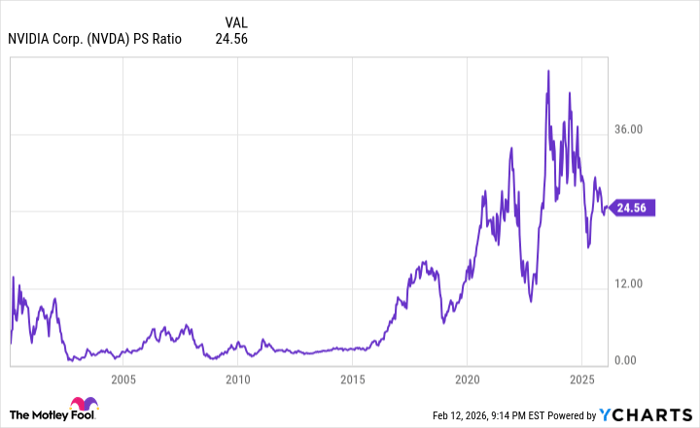
NVDA PS Ratio data by YCharts.
Nvidia's fiscal 2027 outlook also has the potential to disappoint investors. While Nvidia's guidance has a knack for surpassing the consensus of analysts, two factors threaten to weigh on the company's sales growth expectations for its upcoming fiscal year.
For one, internal competitive pressures are ramping up. Whereas most analysts are focused on external competition from the likes of Advanced Micro Devices or custom AI chip company Broadcom, arguably the biggest threat to Nvidia's margins is its top customers by net sales.
Most members of the "Magnificent Seven" have purchased Nvidia's GPUs for their AI-accelerated data centers – and many of these companies are also internally developing GPUs or AI solutions. Even though this in-house hardware can't match the compute capabilities of Nvidia's GPUs, it's markedly cheaper and not backlogged, as has been the case with Hopper, Blackwell, and Blackwell Ultra. There exists a real possibility that Nvidia will lose data center real estate as its top customers deploy their own chips.
The other factor that can derail investors' lofty expectations for Nvidia's fiscal 2027 is GPU scarcity. As noted, Taiwan Semiconductor has been expanding its monthly CoWoS capacity at a breakneck pace for Nvidia and its competition. As production expands, the aforementioned demand-supply imbalance should be minimized. As GPU scarcity wanes, so should some of Nvidia's pricing power and its premium GAAP gross margin.
Even a perfect quarter from Nvidia is unlikely to support the near-parabolic climb it's delivered over the last three years.
Should you buy stock in Nvidia right now?
Before you buy stock in Nvidia, consider this:
The Motley Fool Stock Advisor analyst team just identified what they believe are the 10 best stocks for investors to buy now… and Nvidia wasn’t one of them. The 10 stocks that made the cut could produce monster returns in the coming years.
Consider when Netflix made this list on December 17, 2004... if you invested $1,000 at the time of our recommendation, you’d have $414,554!* Or when Nvidia made this list on April 15, 2005... if you invested $1,000 at the time of our recommendation, you’d have $1,120,663!*
Now, it’s worth noting Stock Advisor’s total average return is 884% — a market-crushing outperformance compared to 193% for the S&P 500. Don't miss the latest top 10 list, available with Stock Advisor, and join an investing community built by individual investors for individual investors.
See the 10 stocks »
*Stock Advisor returns as of February 16, 2026.
Sean Williams has no position in any of the stocks mentioned. The Motley Fool has positions in and recommends Advanced Micro Devices, Nvidia, and Taiwan Semiconductor Manufacturing. The Motley Fool recommends Broadcom. The Motley Fool has a disclosure policy.
Recommended Articles


