



Iran unveils four-step US plan to end war and reopen Hormuz – Fars

Source Fxstreet

According to Fars, Saeed Ajorlou, a member of the Iranian negotiating team, outlined a four-stage proposal for a deal between Iran and the US

In the first phase, ending the war and halting military actions, followed by the second phase, which includes tangible measures and the mechanisms related to the Strait of Hormuz. This includes lifting the US Navy blockade, removing restrictions, Oil sanctions and unfreezing Iran’s assets and blocked financial resources.

The third phase would be dedicated to discussions on actions and the nuclear program, followed by the last phase, which involves establishing a supervisory committee to oversee the implementation of the understanding and monitor the commitments of all the involved.
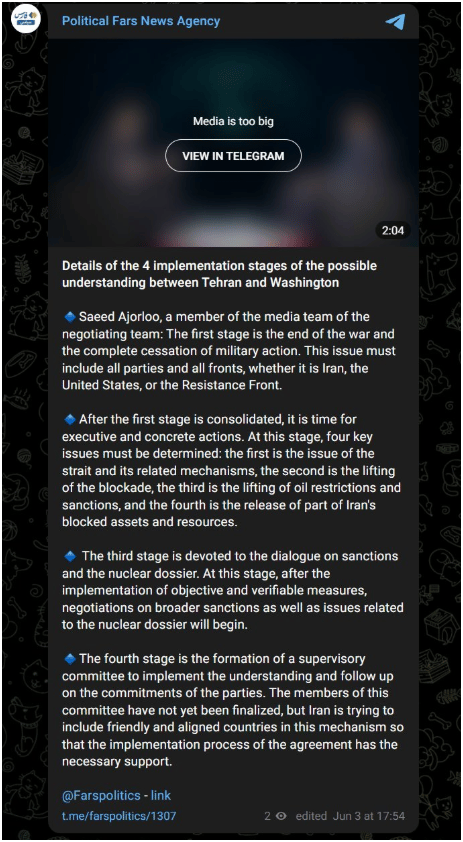
Source: Political Fars News Agency

Risk sentiment FAQs

In the world of financial jargon the two widely used terms “risk-on” and “risk off'' refer to the level of risk that investors are willing to stomach during the period referenced. In a “risk-on” market, investors are optimistic about the future and more willing to buy risky assets. In a “risk-off” market investors start to ‘play it safe’ because they are worried about the future, and therefore buy less risky assets that are more certain of bringing a return, even if it is relatively modest.

Typically, during periods of “risk-on”, stock markets will rise, most commodities – except Gold – will also gain in value, since they benefit from a positive growth outlook. The currencies of nations that are heavy commodity exporters strengthen because of increased demand, and Cryptocurrencies rise. In a “risk-off” market, Bonds go up – especially major government Bonds – Gold shines, and safe-haven currencies such as the Japanese Yen, Swiss Franc and US Dollar all benefit.

The Australian Dollar (AUD), the Canadian Dollar (CAD), the New Zealand Dollar (NZD) and minor FX like the Ruble (RUB) and the South African Rand (ZAR), all tend to rise in markets that are “risk-on”. This is because the economies of these currencies are heavily reliant on commodity exports for growth, and commodities tend to rise in price during risk-on periods. This is because investors foresee greater demand for raw materials in the future due to heightened economic activity.

The major currencies that tend to rise during periods of “risk-off” are the US Dollar (USD), the Japanese Yen (JPY) and the Swiss Franc (CHF). The US Dollar, because it is the world’s reserve currency, and because in times of crisis investors buy US government debt, which is seen as safe because the largest economy in the world is unlikely to default. The Yen, from increased demand for Japanese government bonds, because a high proportion are held by domestic investors who are unlikely to dump them – even in a crisis. The Swiss Franc, because strict Swiss banking laws offer investors enhanced capital protection.

Disclaimer: For information purposes only. Past performance is not indicative of future results.
placeholder
Bitcoin Price In Freefall As Panic Sweeps Through The MarketBitcoin price started a fresh decline below the $70,000 zone. BTC is consolidating and might continue to move down if it dips below $66,000. Bitcoin failed to stay above $70,500 and extended losses.
Author  NewsBTC
18 hours ago
Bitcoin price started a fresh decline below the $70,000 zone. BTC is consolidating and might continue to move down if it dips below $66,000. Bitcoin failed to stay above $70,500 and extended losses.
placeholder
Gold replaces US Treasuries as top global reserve asset, latest ECB report saysA recent report published by the European Central Bank today has stated that central banks globally now hold more gold than US government bonds and treasuries in their reserves for the very first time. Geopolitical tensions, concerns over a risk of sanctions, and a growing desire among some countries to lessen their exposure to dollar-denominated...
Author  Cryptopolitan
18 hours ago
A recent report published by the European Central Bank today has stated that central banks globally now hold more gold than US government bonds and treasuries in their reserves for the very first time. Geopolitical tensions, concerns over a risk of sanctions, and a growing desire among some countries to lessen their exposure to dollar-denominated...
placeholder
Crypto Crash Wipes Out 7% in 24 Hours: What’s Next?The total crypto market capitalization has fallen sharply to $2.32 trillion. The decline has wiped out roughly 17% of the market value in less than three weeks.Bitcoin (BTC) trades near $67,400, down
Author  Beincrypto
18 hours ago
The total crypto market capitalization has fallen sharply to $2.32 trillion. The decline has wiped out roughly 17% of the market value in less than three weeks.Bitcoin (BTC) trades near $67,400, down
placeholder
Google Shares Sink as AI Boom Forces Alphabet to Go Back on Strategy Critical to its StockGoogle stock fell after parent Alphabet (GOOGL) announced an $80 billion equity raise to fund artificial intelligence (AI) infrastructure. The move reverses years of buybacks that steadily shrunk its
Author  Beincrypto
18 hours ago
Google stock fell after parent Alphabet (GOOGL) announced an $80 billion equity raise to fund artificial intelligence (AI) infrastructure. The move reverses years of buybacks that steadily shrunk its
placeholder
Experts Warn Bitcoin Has a MicroStrategy Problem as BTC and MSTR Stock SinkBitcoin (BTC) and MicroStrategy (MSTR) stock plunged on Tuesday after the company disclosed its first BTC sale in 41 months. The move reignited debate over how much the asset depends on one corporate
Author  Beincrypto
18 hours ago
Bitcoin (BTC) and MicroStrategy (MSTR) stock plunged on Tuesday after the company disclosed its first BTC sale in 41 months. The move reignited debate over how much the asset depends on one corporate
goTop
quote