




OpenAI and Anthropic’s $200 AI plans can deliver thousands in API-equivalent usage
According to a study by the research company SemiAnalysis, it appears that two flat-rate AI subscriptions that charge $200 per month can provide more usage than what is suggested by the actual price.
For OpenAI and Anthropic, this forces the question: how long can subsidized access to technology last while there is pressure in the market to profit from AI?
According to SemiAnalysis, subscriptions from both companies were purchased and used to perform extensive coding work until the maximum amount of work allowed in the week was reached.
The cost of the services on Anthropic’s $200 Claude plan amounts to about $8,000 per month based on the standard API rates. In the case of OpenAI’s $200 plan, the cost reached about $14,000. The research has been conducted, and initial findings were released in June. Additional findings were released on August 23.
Why a $2,000 assumption turned into five figures
The figures are much higher than what several in the sector believed possible. As reported by SemiAnalysis, industry insiders assumed a subscription worth $200 could yield about $2,000 worth of tokens in a month. But people who fully utilize all weekly limits can reap three to seven times more than that.
Anthropic’s Max plans start at $100 monthly with access to either 5x or 20x usage of Claude Pro. OpenAI uses almost the exact pricing structure, with its $100 plan providing 5x usage of Plus and $200 plan providing 20x usage.
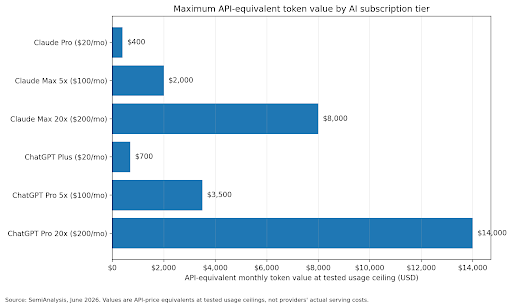
A majority of subscribers will most likely never attain those upper limits. SemiAnalysis did achieve this by utilizing an extremely long-term workload that was executed continuously instead of doing regular conversations.
The token bill behind agentic coding
This is significant as coding agents tend to be very demanding in the number of tokens. Research conducted with eight cutting-edge models on SWE-bench Verified has demonstrated that agentic coding may use around 1,000 times more tokens than a simple one-turn coding question, with input tokens leading the cost.
Estimating usage is proven to be very difficult. The same study discovered that tasks completed in the same way could have differences in use that reached 30 times in token consumption, not ensuring better results due to larger token spending.
There are several ways to cut down on costs. In another study by an independent firm, using a lot of prompt caching resulted in lowering the cost of the API to just about $0.57 for every million tokens, or even by 88.6%. However, users who get $8,000 and $14,000 worth of API usage out of a subscription plan that costs only $200 are still getting quite a sizable allowance.
Where this lands in the AI market
The pressure mounts as the rivalry among the top laboratories stiffens. Reports state that Anthropic’s revenue as of Q2 has exceeded $11.6 billion, more than double from the previous year while OpenAI reported an 18% increase in revenue to $6.7 billion, stated a report published by the Wall Street Journal as noted by Cryptopolitan. There has also been an increase in Anthropic’s annualized revenue run rate to over $65 billion.
Ramp’s August AI Index put Anthropic ahead in U.S. business adoption, at 43.5% of companies versus 39.7% for OpenAI. Yet Ramp lead economist Ara Kharazian has also pointed to limits on how much businesses are willing to spend: Anthropic’s most expensive model, Fable 5, accounted for just 6% of the tokens customers bought from the company in its first month.
Gartner has also anticipated that the emergence of agentic AI may lead to the increase of inference costs by more than five times by the year of 2028. The firm, as reported by Cryptopolitan, has defined this situation as an “inference paradox” in that falling token rates do not imply lower costs; this is due to the fact that agents will use significantly more tokens now.
That is what makes the SemiAnalysis numbers important. If power users can pull five figures of API-equivalent usage from a $200 plan, OpenAI and Anthropic eventually face a choice between absorbing the subsidy and tightening access. Either way, the pressure on AI margins is likely to grow as cheaper and increasingly capable open-source models give customers more alternatives.
The smartest crypto minds already read our newsletter. Want in? Join them.
Recommended Articles


