




Bitcoin Price Suppressed By Shadow Banking Rehypothecation, Saylor Says
Michael Saylor argued that Bitcoin’s inability to sustain the most aggressive upside forecasts is less about a broken long-term thesis and more about a credit-market bottleneck: a large share of Bitcoin wealth still can’t be financed cleanly inside the traditional banking system, pushing holders toward “shadow” venues where rehypothecation creates effective selling pressure.
In a Feb. 27 interview with Coin Stories host Nathalie Brunell, Saylor said the market has matured in ways that naturally damp both upside and downside volatility as derivatives migrate “from offshore to onshore” and regulated US markets grow. But he placed the sharper brake on price in the plumbing of credit. Banks, he argued, are moving slowly to recognize Bitcoin as collateral, and that delay matters when the asset base is large.
Saylor framed the current top-of-market structure as roughly “$2 trillion worth of Bitcoin,” with “probably $1.8 trillion held by retail investors or offshore investors” who “cannot access the traditional banking system.” The practical implication, he said, is that Bitcoin holders who want to unlock liquidity face a narrow menu compared with traditional equity portfolios.
“If I posted $10 million of Apple stock with JP Morgan or Morgan Stanley, I could take a $5 million loan at SOFR plus 50 basis points and I could spend it,” Saylor said. “But you can’t even post $10 million worth of Bitcoin with JP Morgan or Morgan Stanley right now. Therefore, you can’t take a loan. Therefore, you have to go to a shadow banking system. You have to go offshore.”
That constraint, he argued, forces holders into behavior that mechanically caps upside. The “safe way” to monetize is simply to sell, which “damps the upside.” The next option is borrowing from a small pool of crypto lenders that don’t rehypothecate collateral, but Saylor described that market as both expensive and shallow—“a few billion dollars probably”—with rates he characterized as closer to “SOFR plus 400” or “plus 500 basis points,” rather than traditional prime-style spreads.
He pointed to a newer channel, banks extending credit against spot Bitcoin ETFs like BlackRock’s iShares Bitcoin Trust (IBIT), but described it as early, limited, and still costly versus conventional secured lending.
The most controversial pathway, Saylor said, is where the cheapest funding appears: counterparties offering low-rate Bitcoin-backed credit in exchange for control of the collateral. “I’ve had people offer me Bitcoin-backed credit at 1% or 0%,” he said, before emphasizing the trade-off. “There’s always the catch […] they want me to transfer the Bitcoin to them so they can rehypothecate it.”
Saylor then tied rehypothecation directly to spot-market suppression, arguing that collateral handed to intermediaries can be effectively “sold” multiple times through reuse. “So, if you have $10 million […] you can get a 3 or 4% loan, but then it gets rehypothecated,” he said. “So, your $10 million of Bitcoin gets sold once, gets sold twice, gets sold three times […] You might actually create $30 or $40 million worth of selling because the Bitcoin that you posted […] rehypothecated it three times.”
Michael Saylor: Shadow banking “rehypothecation” suppresses Bitcoin price
On February 27, 2026, in an interview with Natalie Brunell, Michael Saylor discussed why Bitcoin failed to surpass $126,000.
He suggested that the exclusion of Bitcoin from traditional banks like JP… pic.twitter.com/ODpOEvhi2j
— Wu Blockchain (@WuBlockchain) March 4, 2026
In his view, the missing piece is a large, regulated, non-rehypothecating credit system for Bitcoin—one that looks more like mainstream securities financing. “What’s holding down the price? I think what holds down the price of the asset is the lack of a fully formed nonrehypothecating credit system,” he said, adding that rehypothecation “damps the vol” and can amplify moves on both sides through leveraged positioning.
Saylor’s bottom line was timing, not thesis: if banks take “four years, 5 years, 6 years” to “bank it” in the full sense, then Bitcoin’s price discovery will continue to be shaped by a shadow-credit workaround that can manufacture synthetic supply. If and when conventional credit rails mature around Bitcoin collateral without aggressive rehypothecation, he suggested, the market may rely less on forced selling and more on ordinary secured borrowing, potentially changing the ceiling on upside cycles.
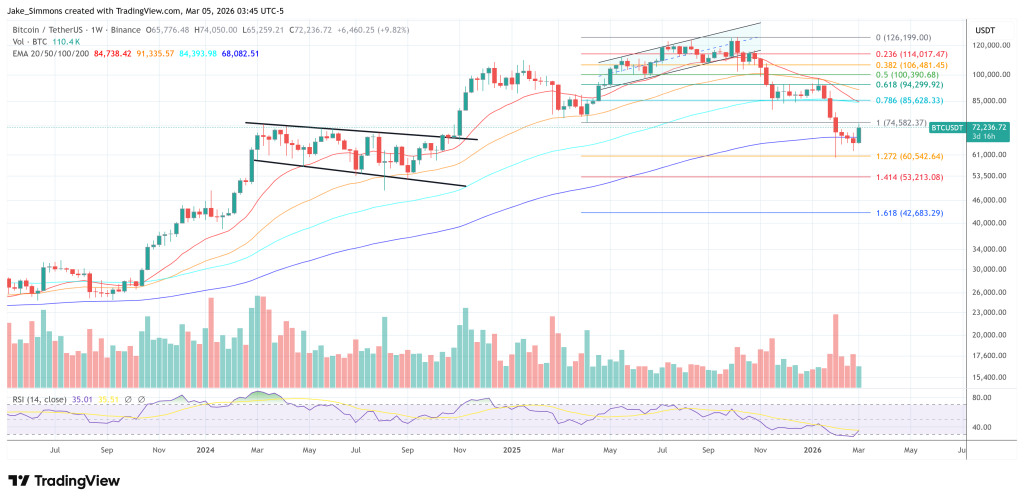
At press time, Bitcoin traded at $72,236.
Recommended Articles


