




Is Trump’s Friday Night Strike Pattern the Most Tradeable Signal for Crypto and Stocks?
Six major geopolitical and economic actions under President Donald Trump since mid-2025 have shared one precise tactical detail: they all happened on Friday nights, after equity markets closed and before futures liquidity fully developed.
This is not a coincidence. It is, according to pattern analysis, the single most consistent and operationally significant element of Trump’s conflict strategy — and arguably the most tradeable timing signal in macro markets today.
Trump’s Friday Night Strike Pattern Is the Most Tradeable Signal in Macro Right Now
Understanding why Trump uses Friday nights, and what happens to Bitcoin (BTC), equities, oil, and bonds in the 60 hours that follow, could give traders and investors a structural edge that most market participants are not pricing.
“Obviously, Trump chose weekends to carry out combat ops in Venezuela and Iran. Smart move to buy time before Wall Street opens and minimize market shocks. But here’s the structural shift: Markets used to rest on weekends. Now they don’t,” wrote Gracy Chen, CEO at Bitget.
Six Events Show A Singular Trump Playbook
The documented list by financial research firm The Kobeissi Letter is specific:
- On June 21, US and Israeli forces struck Iranian nuclear sites.
- On September 1, the US military targeted Caribbean drug boats.
- On October 10, a 100% tariff threat against China dropped after market close.
- On November 29, Trump closed Venezuelan airspace in its entirety.
- On December 25, military action commenced in Nigeria.
- On February 28, 2026, US forces struck Iran directly.
Every single one landed on a Friday night or early Saturday morning.
The pattern extends to Trump’s corporate pressure campaigns. On August 11, 2025, the Trump administration announced an Intel deal after weeks of public pressure on CEO Lip-Bu Tan, again, structured to land outside active trading hours.
That position returned over 80% in under two months for those who tracked the escalation sequence from the beginning.
The consistency across geopolitical strikes, tariff actions, and corporate confrontations is not accidental. It reflects a deliberate understanding of how financial markets process shock.
Why Friday Night? The Market Psychology Behind the Timing
When a major geopolitical event occurs during active market hours, price discovery breaks down. Liquidity thins immediately. Algorithms amplify every directional tick.
Intraday swings create panic that feeds on itself, producing disorderly markets that are difficult for any participant, including the administration, to read or control.
A Friday night announcement changes the dynamic entirely. Investors, institutions, and governments have a full weekend to process information, consult advisors, and model scenarios before a single share trades.
The shock is real, but the response is measured. Futures markets absorb the initial repricing on Sunday evening at 6 PM ET. This is a low-liquidity session where price moves are sharp but short-lived. Similarly, the gap between the emotional reaction and the rational reassessment becomes visible within hours.
This matters for Trump’s negotiation strategy in a specific way. Trump, by his own description and observable behavior, is highly responsive to financial market performance.
A disorderly market reaction during trading hours creates political and economic pressure, complicating his objectives.
A Friday night announcement gives markets time to digest, and gives Trump’s team time to read the reaction and calibrate the next message before Monday open.
The result: every Friday night event has been followed by:
- A Sunday evening futures shock
- A partial Monday recovery, and then
- A second, more sustained move in the same direction as the initial shock.
Is this three-phase sequence now repeatable enough to trade?
The 60-Hour Window: What Each Asset Does
The 60-hour window from Friday close to Monday open has produced near-identical cross-asset sequences across all six confirmed events.
At Sunday open, Bitcoin sells off 5–12% as it trades as a pure risk asset, with equity correlation spiking above 0.8. Ethereum (ETH) and altcoins fall by 15–25% from pre-event levels in the first 48 hours, as liquidity exits the most volatile assets first.
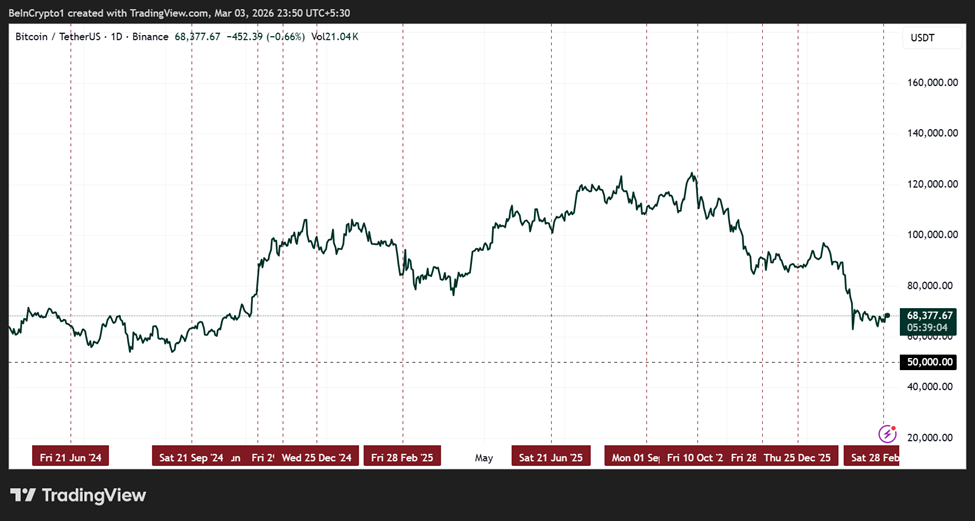 Bitcoin Price Performance. Source: TradingView
S&P 500 futures gap down 1.5–3%. Oil spikes 5–10% depending on proximity to energy infrastructure — Iran-related events have produced the sharpest initial moves.
The US dollar catches a strong safe-haven bid. Ten-year Treasury yields drop sharply as flight-to-quality demand floods the bond market.
By Monday morning, a partial reversal begins. Markets price a short engagement based on Trump’s well-documented preference for deals over prolonged conflicts.
BTC recovers 40–60% of its Sunday drawdown. Oil gives back 30–50% of its initial spike. Equity futures stabilize.
This Monday recovery is where most retail traders make their critical mistake.
The partial reversal appears to be a resolution signal. It is not. In every prior cycle, the Monday stabilization has failed. A second, more sustained leg in the original direction (lower equities, higher oil, weaker crypto) follows within 48–72 hours as the market acknowledges the conflict will not resolve quickly.
The correct trading behavior in the 60-hour window is not to react at Sunday open, because:
- Spreads are too wide
- Algorithms are front-running every move, and
- The liquidity is not there for clean execution.
The actionable entry for equities and BTC has historically arrived 48–72 hours after the initial shock, not at the shock itself.
The Bond Market Is the Real Signal
One element of the Friday night pattern that most crypto and equity traders overlook is the bond market’s role as a leading indicator of resolution.
In the April 9, 2025, tariff pause, the most significant de-escalation event of Trump’s second term, it was not equity market weakness that triggered the pivot. It was the bond market.
10 year Treasury yields surged sharply in the days leading up to April 9, signaling structural stress in fixed income that the administration could not ignore. When yields moved, Trump moved.
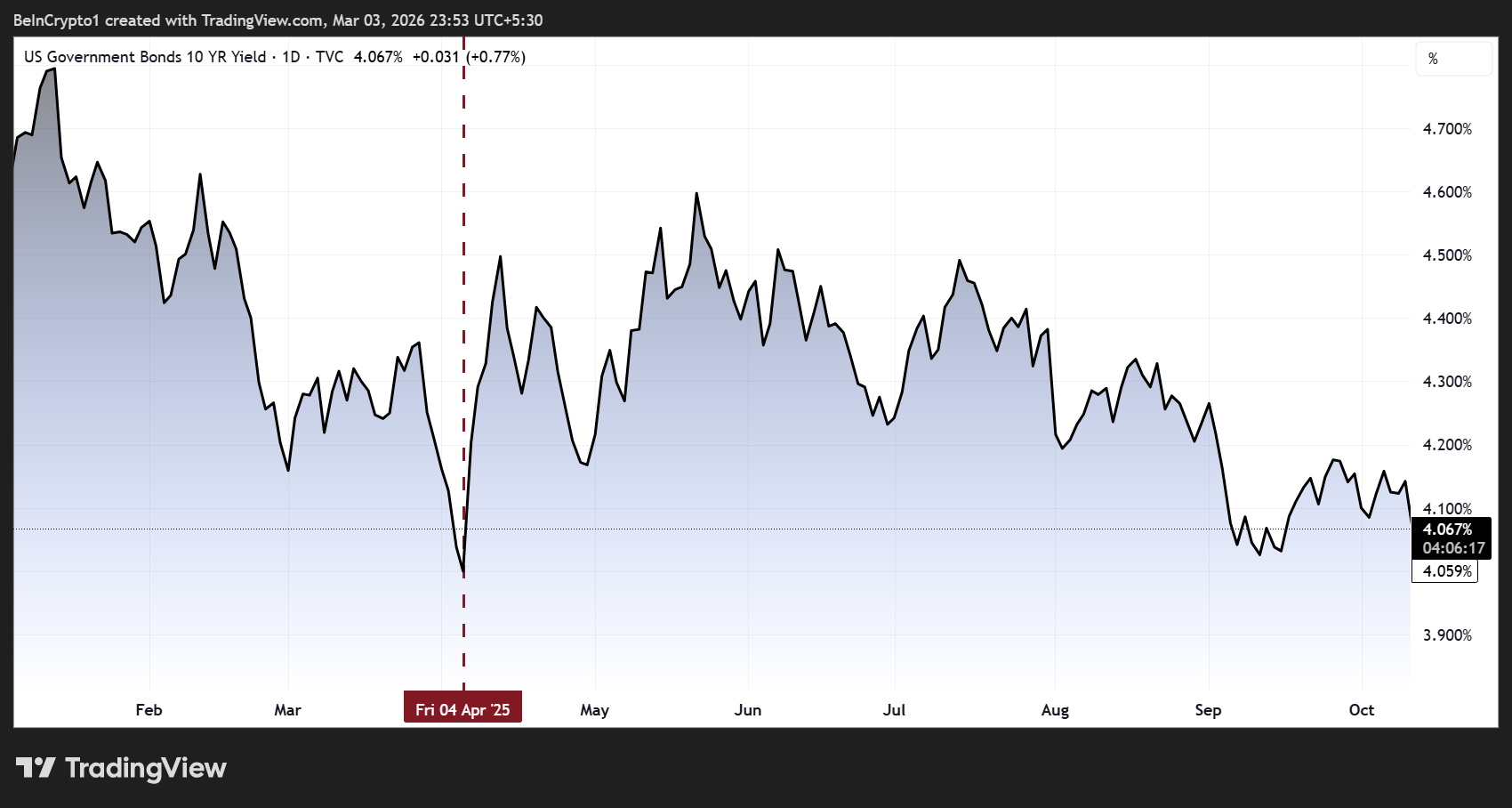 10-Year Treasury Yields Leading Up to April 9, 2025. Source: TradingView
This dynamic has repeated across multiple cycles. Equity weakness gets bought. Oil spikes get dismissed as temporary.
However, when bond market stress becomes acute (when the 10-year yield is moving in ways that imply credit market dysfunction rather than simple flight-to-quality) the probability of de-escalation language rises sharply.
Traders positioning around the Friday night pattern should therefore monitor the bond market as the leading indicator of Trump’s next pivot, not equity prices or crypto sentiment.
What Makes This Pattern Durable?
The Friday night strike pattern has survived six confirmed events across radically different conflict types: military, tariff, corporate, and geopolitical, without breaking.
That durability comes from the underlying logic being structural rather than tactical. Trump’s three core second-term policy objectives are:
- Lowering inflation
- Cutting gasoline prices to $2 per gallon, and
- Positioning as a peace president in a midterm election year.
Every Friday night event creates short-term upward pressure on oil and inflation expectations. The Friday night timing passes as the mechanism Trump may be using to contain that pressure.
If history is any guide, he gives the markets a weekend to absorb shock before consumer-facing data, like gasoline prices at the pump, can register the move politically.
The pattern will break when one of two things changes:
- Trump abandons the deal-making framework entirely in favor of a genuinely prolonged conflict, or
- The Friday night announcement loses its market-timing advantage as participants anticipate and front-run the window.
Neither has happened across 13 months of observation.
Until one of those conditions is met, the 60-hour post-strike sequence (Sunday shock, Monday partial recovery, Tuesday confirmation) remains the most consistently repeatable cross-asset trading pattern in current macro markets.
As of March 3, 2026, with Brent crude above $85 per barrel and the Dow Jones Industrial Average down roughly 1,100 points, markets are in the phase that has historically preceded Trump’s conditional de-escalation signals.
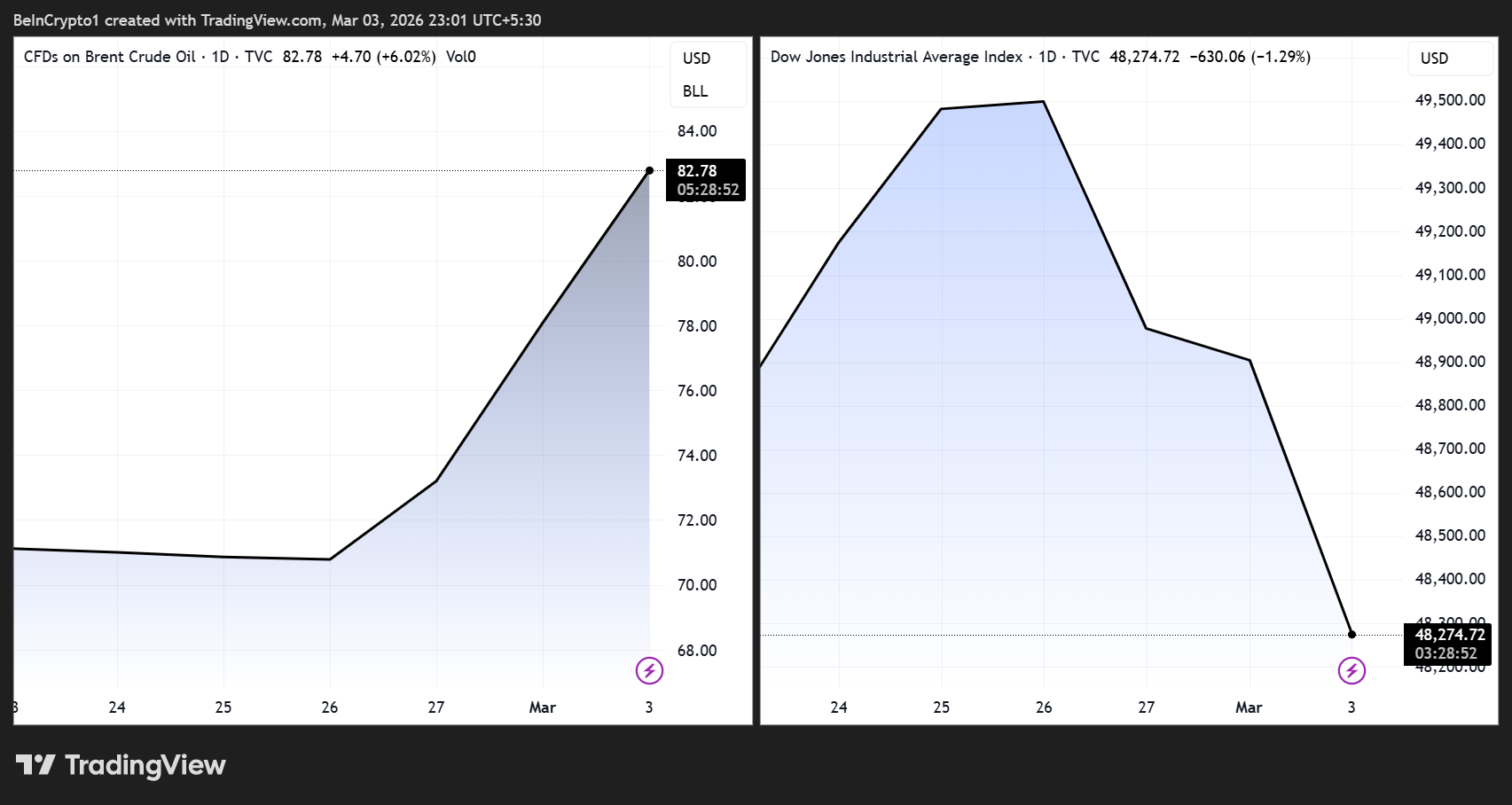 Brent Crude Oil (UKOIL) and Dow Jones Industrial Average (DJI) Price Performance. Source: TradingView
The Friday night that created this moment is already history. The question is whether traders are positioned for what the pattern says comes next.
This article is for informational purposes only and does not constitute financial or investment advice.
Follow us on X to get the latest news as it happensSubscribe to our YouTube channel to watch leaders and journalists provide expert insights
Recommended Articles


