




U.S.-Iran Talks Reach Breakthrough, Oil Prices Slump More Than 5%, But Market Still Faces Multiple Variables
TradingKey - International oil prices slumped during Monday's Asian trading session as U.S. President Trump stated that U.S.-Iran negotiations were "largely finalized," with both Brent crude July futures and U.S. WTI crude futures falling by more than 5%.
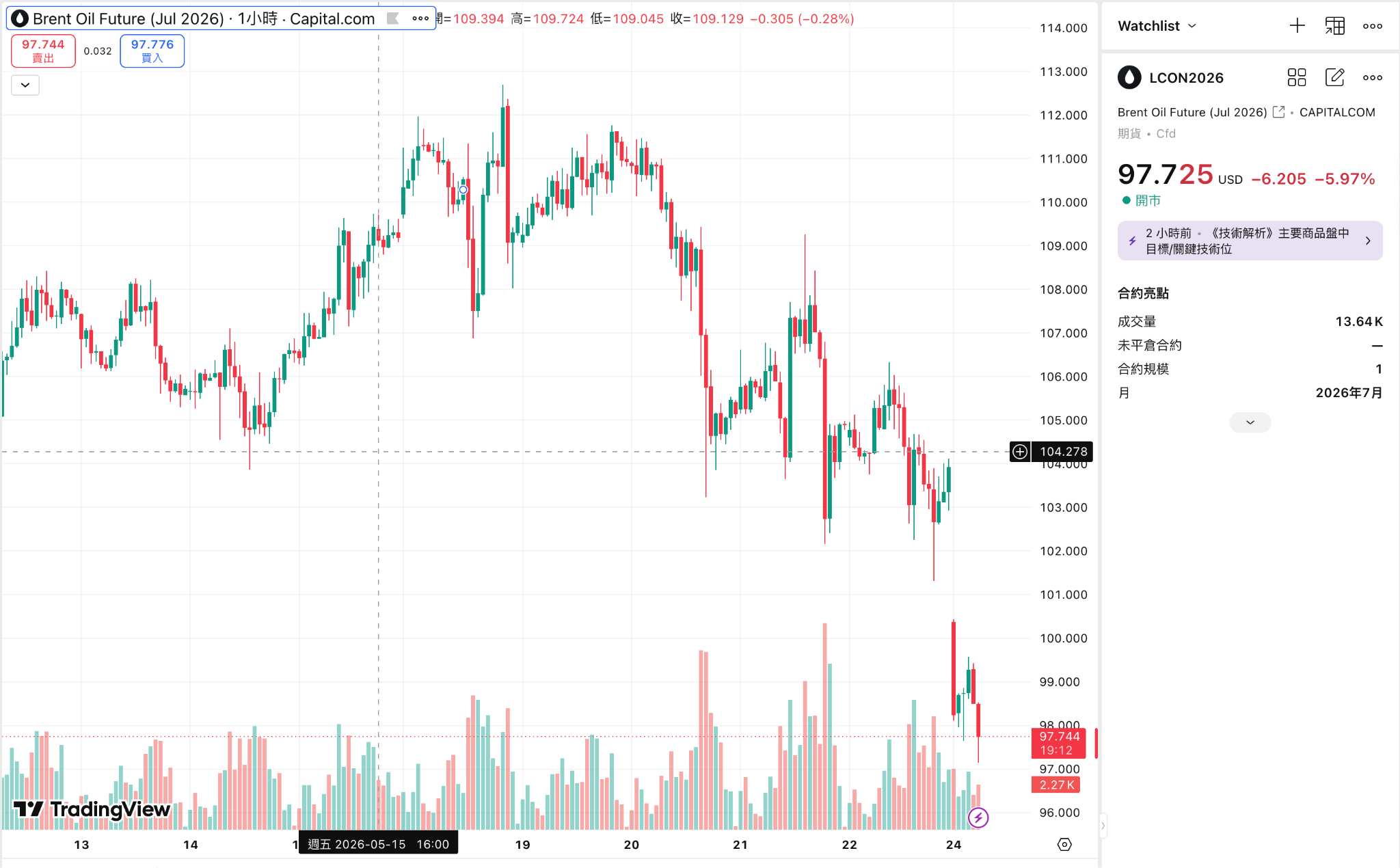
[Source: TradingView]
Negotiation Signals and Market Divergence
Trump stated last Friday that the U.S. and Iran have "effectively reached a deal" and the Strait of Hormuz will subsequently reopen, with the U.S. demanding that Iran hand over its highly enriched uranium. Iran, however, signaled caution, noting that while both sides are in the final stages of a memorandum, nuclear issues and sanction details are not part of current discussions, and Khamenei has ordered that no enriched uranium be shipped abroad.
Markets are divided on whether the decline in oil prices is sufficient. Carl Weinberg, founder of High Frequency Economics, pointed out that even if an agreement is reached between the U.S. and Iran, no one knows when normal shipping through the Strait of Hormuz will resume, but oil prices will certainly not fall anytime soon.
David Oxley, Chief Commodities Economist at Capital Economics, believes that oil prices will only move lower if oil market fundamentals improve significantly, a situation that looks set to persist until 2027. Max Layton, Head of Commodities Research at Citi, previously stated that until the agreement is clarified, oil prices will continue to be news-driven and fluctuate sharply.
Fundamental Pressures and Shifting OPEC+ Dynamics
Oil prices are also weighed down by fundamentals, as the global manufacturing PMI has remained in contraction territory for three consecutive months, recording 49.2 in May according to data released on May 6. U.S. gasoline inventories have accumulated for two consecutive weeks but remain approximately 2% below the five-year average.
Furthermore, oil prices had previously traded at elevated levels due to the blockade of the Strait of Hormuz, resulting in crowded long positions and building pressure for a technical correction.
On the supply side, the UAE officially withdrew from OPEC+ on May 1, primarily because its production capacity (exceeding 4.5 million bpd) far exceeds its quota (3.447 million bpd). The short-term impact is limited by the obstruction of the strait, but once navigation resumes, the UAE will gradually increase production without constraints, exerting upward pressure on mid-term oil prices.
Seven major OPEC+ oil producers decided on May 3 to increase daily production by 188,000 barrels in June, marking the first decision since the UAE's exit. The alliance will meet again on June 7, with the market expecting the remaining seven nations to maintain a moderate pace of production increases.
Core disagreements remain unresolved; implementation remains in doubt.
Key U.S.-Iran points of contention remain, specifically regarding the disposal of enriched uranium and control of the strait. Even if a memorandum is signed, it would take at least 6-9 months for Iranian crude oil exports to resume at over 2 million barrels per day, requiring IAEA verification and U.S. congressional cooperation. GOP hardliners have prepared legislation to mandate a 60-day congressional review period, meaning months could lapse between the "conclusion of an agreement" and the "lifting of sanctions."
In addition, the Netanyahu government has stated that any agreement allowing Iran to retain enriched uranium is "unacceptable." Market analysts believe that the risk of Israeli intervention is barely priced into oil prices; if military action is taken, oil prices could rebound rapidly.
Oil Price Outlook: Key Window and Implementation Details
Trump himself acknowledged that the likelihood of reaching a deal is "about fifty-fifty" and reserved the option to resume military action. Meanwhile, the Iranian side maintains that the Strait of Hormuz will continue to be "managed" by Iran.
The coming days will be a critical window. As the Iranian Foreign Ministry spokesperson stated: "We must wait and see, and closely observe what exactly happens over the next three to four days."
Overall, oil prices will continue to fluctuate in the coming week between negotiation progress, OPEC+ policy signals, and demand data. Any extreme one-sided bets may face two-way risks.
Recommended Articles


