




GBP/USD Price Forecast: 20-day EMA continues to cap upside
- GBP/USD drops to near 1.3446 as the US Dollar trades firmly due to renewed US-Iran tensions.
- US forces intercepted Iranian missiles and launched strikes in self-defense.
- BoE’s Greene expresses the need to hike interest rates sooner to counter the risk of high inflation.
The GBP/USD pair trades 0.16% lower to near 1.3446 during the European trading session on Wednesday. The pair faces selling pressure as the US Dollar (USD) strengthens due to increased uncertainty over the United States (US)-Iran deal.
US Dollar Price Today
The table below shows the percentage change of US Dollar (USD) against listed major currencies today. US Dollar was the strongest against the New Zealand Dollar.
| USD | EUR | GBP | JPY | CAD | AUD | NZD | CHF | |
|---|---|---|---|---|---|---|---|---|
| USD | 0.15% | 0.14% | 0.00% | 0.12% | 0.35% | 0.45% | 0.25% | |
| EUR | -0.15% | -0.02% | -0.17% | -0.03% | 0.19% | 0.29% | 0.10% | |
| GBP | -0.14% | 0.02% | -0.13% | -0.04% | 0.21% | 0.30% | 0.12% | |
| JPY | 0.00% | 0.17% | 0.13% | 0.10% | 0.33% | 0.39% | 0.23% | |
| CAD | -0.12% | 0.03% | 0.04% | -0.10% | 0.24% | 0.33% | 0.13% | |
| AUD | -0.35% | -0.19% | -0.21% | -0.33% | -0.24% | 0.09% | -0.16% | |
| NZD | -0.45% | -0.29% | -0.30% | -0.39% | -0.33% | -0.09% | -0.18% | |
| CHF | -0.25% | -0.10% | -0.12% | -0.23% | -0.13% | 0.16% | 0.18% |
The heat map shows percentage changes of major currencies against each other. The base currency is picked from the left column, while the quote currency is picked from the top row. For example, if you pick the US Dollar from the left column and move along the horizontal line to the Japanese Yen, the percentage change displayed in the box will represent USD (base)/JPY (quote).
During press time, the US Dollar Index (DXY), which tracks the Greenback’s value against six major currencies, trades 0.12% higher to near 99.35.
The US-Iran uncertainty has escalated, following the exchange of attacks on Tuesday. The US Central Command (CENTCOM) said that it had intercepted and defeated a series of Iranian missile and drone attacks targeting regional neighbors, including Kuwait and Bahrain, while also carrying out self-defence strikes on Iran’s Qeshm Island.
Meanwhile, the British Pound (GBP) trades lower despite Bank of England (BoE) officials expressing the need to tighten monetary conditions sooner to counter high inflation projections.
On Tuesday, BoE Monetary Policy Committee (MPC) member Megan Greene said, “The risk of acting against inflation, even if it proves less persistent, is less severe than the risk of failing to act.”
GBP/USD technical analysis
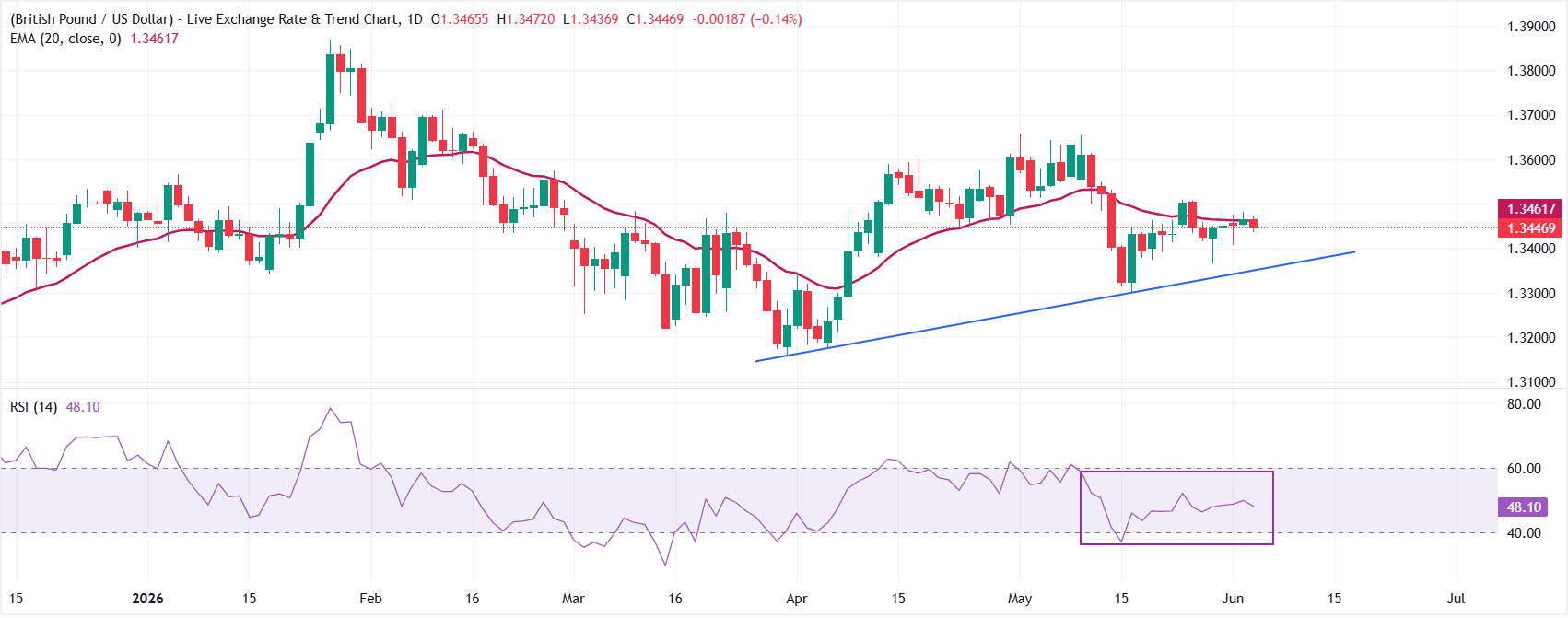
GBP/USD trades lower at around 1.3446 at press time. The pair hovers just under the 20-day Exponential Moving Average (EMA) at 1.3461, which now acts as immediate resistance.
The Relative Strength Index (RSI) at 47.6 sits slightly below the neutral 50 mark, hinting at subdued momentum and suggesting the pair lacks strong directional conviction while it consolidates between the reclaimed trend support and the nearby EMA barrier.
On the topside, initial resistance is defined by the 20-day EMA at 1.3461, and a daily close above this level would open the door for a recovery towards 1.3500. A decisive move above 1.3500 would open further upside towards the May 12 high at 1.3614. On the downside, the key structural floor emerges around the former break level of the ascending trend line near 1.3352; a decisive breakdown below that level would expose the pair to 1.3300.
(The technical analysis of this story was written with the help of an AI tool.)
Risk sentiment FAQs
In the world of financial jargon the two widely used terms “risk-on” and “risk off'' refer to the level of risk that investors are willing to stomach during the period referenced. In a “risk-on” market, investors are optimistic about the future and more willing to buy risky assets. In a “risk-off” market investors start to ‘play it safe’ because they are worried about the future, and therefore buy less risky assets that are more certain of bringing a return, even if it is relatively modest.
Typically, during periods of “risk-on”, stock markets will rise, most commodities – except Gold – will also gain in value, since they benefit from a positive growth outlook. The currencies of nations that are heavy commodity exporters strengthen because of increased demand, and Cryptocurrencies rise. In a “risk-off” market, Bonds go up – especially major government Bonds – Gold shines, and safe-haven currencies such as the Japanese Yen, Swiss Franc and US Dollar all benefit.
The Australian Dollar (AUD), the Canadian Dollar (CAD), the New Zealand Dollar (NZD) and minor FX like the Ruble (RUB) and the South African Rand (ZAR), all tend to rise in markets that are “risk-on”. This is because the economies of these currencies are heavily reliant on commodity exports for growth, and commodities tend to rise in price during risk-on periods. This is because investors foresee greater demand for raw materials in the future due to heightened economic activity.
The major currencies that tend to rise during periods of “risk-off” are the US Dollar (USD), the Japanese Yen (JPY) and the Swiss Franc (CHF). The US Dollar, because it is the world’s reserve currency, and because in times of crisis investors buy US government debt, which is seen as safe because the largest economy in the world is unlikely to default. The Yen, from increased demand for Japanese government bonds, because a high proportion are held by domestic investors who are unlikely to dump them – even in a crisis. The Swiss Franc, because strict Swiss banking laws offer investors enhanced capital protection.
Recommended Articles


