


SpaceX Softens the Nasdaq's Fall While the Dow Keeps Climbing
Key Points
The Dow rose 0.8% at midday while the Nasdaq Composite slipped 0.4%.
SpaceX jumped 9.9% after announcing a $60 billion buyout of AI coding startup Anysphere.
Elon Musk's space company is already in the Nasdaq Composite but not the Nasdaq-100, creating a gap between the indexes.
- 10 stocks we like better than NASDAQ Composite Index ›
Wall Street couldn't agree on a direction on Tuesday. The Dow went for a run while the Nasdaq sulked in a corner.
The Dow Jones Industrial Average (DJINDICES: ^DJI) rose 0.8% by noon ET, building on Monday's record-setting session. The S&P 500 (SNPINDEX: ^GSPC) slipped 0.2%, while the Nasdaq Composite (NASDAQINDEX: ^IXIC) fell 0.4%. The Invesco QQQ Trust (NASDAQ: QQQ), which tracks the Nasdaq-100 index, dropped 1.2%. One stock's absence from the stricter Nasdaq-100 list made a big difference.
Will AI create the world's first trillionaire? Our team just released a report on the one little-known company, called an "Indispensable Monopoly" providing the critical technology Nvidia and Intel both need. Continue »
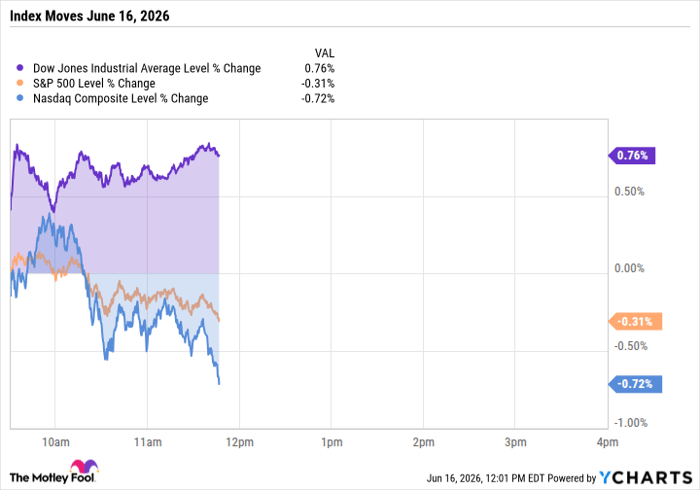
^DJI data by YCharts
Banks and bulldozers beat the chipmakers
As usual, the Dow's winners on Tuesday made up an old-school portfolio. Banks and bulldozers led the way. JPMorgan Chase (NYSE: JPM) jumped 3.2%, contributing 64 points to the index. Goldman Sachs (NYSE: GS) added 1.6% for another 104 points. When oil falls and geopolitical risk fades, banks tend to smile.
Caterpillar (NYSE: CAT) climbed 2.5%, adding 142 points and leading all Dow components. The construction equipment maker has now fully recovered from last Wednesday's 5.9% sell-off, when inflation fears and Iran tensions rattled markets.
It was a different story on the Nasdaq Composite. Semiconductor stocks tugged the index gently lower, with a 1.4% drop for Nvidia (NASDAQ: NVDA) and a 3.5% retreat in Broadcom (NASDAQ: AVGO) shares.
But Space Exploration Technologies (NASDAQ: SPCX) compensated for the tech-heavy index's mild downturn. SpaceX was up 9.9% at noon ET, outweighing the dented market caps seen further down the index. Elon Musk's space and AI business wasn't just coasting on its IPO momentum, either. The company announced a $60 billion buyout of AI coding start-up Anysphere, maker of the Cursor vibe-coding platform.

Image source: Getty Images.
If you follow the tech sector via the shorter stock list of the Nasdaq-100 index, you'll see how SpaceX is making a difference to the broader Nasdaq Composite index. The stock is still waiting for an invitation to the Nasdaq-100 (and the S&P won't accelerate its customary one-year waiting period), but the Nasdaq Composite index automatically adds any Nasdaq-listed stock daily. So one Nasdaq index is dipping deeper than the other today, and SpaceX made most of the difference.
The geopolitical picture looks promising at the moment, which explains the Dow's broad gains. The United States Oil Fund (NYSEMKT: USO) dropped 6.1%, with Brent crude slipping below $80 for the first time since March. That's a two-day decline of more than 10% as many traders expect the Strait of Hormuz to open by Friday.
Cheaper oil means less inflation pressure, which means less reason for the Fed to hike interest rates. The Fed concludes its policy meeting Wednesday, and futures markets indicate a 98% probability that rates remain unchanged. At the same time, the Fed seems likely to drop its "easing" ambitions from the final comments. In other words, it could take a while before interest rates drop any further.
The Fed and Geneva hold the cards now
Investors are rethinking what matters. When oil crashes and war fears fade, banks and bulldozers suddenly look more attractive than chipmakers. The Dow hasn't outpaced the Nasdaq like this in months.
The Fed's statement on Wednesday will set the tone for the rest of the week. Friday's deal-signing ceremony in Geneva remains the next major catalyst. SpaceX will keep surprising investors. So far, so good, but some of the shocks may be scary.
It's a weird moment, but weird moments have a way of clarifying what you actually own and why. For long-term investors, the signal through the noise remains: stay the course.
Should you buy stock in NASDAQ Composite Index right now?
Before you buy stock in NASDAQ Composite Index, consider this:
The Motley Fool Stock Advisor analyst team just identified what they believe are the 10 best stocks for investors to buy now… and NASDAQ Composite Index wasn’t one of them. The 10 stocks that made the cut could produce monster returns in the coming years.
Consider when Netflix made this list on December 17, 2004... if you invested $1,000 at the time of our recommendation, you’d have $440,440!* Or when Nvidia made this list on April 15, 2005... if you invested $1,000 at the time of our recommendation, you’d have $1,303,950!*
Now, it’s worth noting Stock Advisor’s total average return is 959% — a market-crushing outperformance compared to 211% for the S&P 500. Don't miss the latest top 10 list, available with Stock Advisor, and join an investing community built by individual investors for individual investors.
See the 10 stocks »
*Stock Advisor returns as of June 16, 2026.
JPMorgan Chase is an advertising partner of Motley Fool Money. Anders Bylund has positions in Nvidia. The Motley Fool has positions in and recommends Broadcom, Caterpillar, Goldman Sachs Group, JPMorgan Chase, and Nvidia. The Motley Fool has a disclosure policy.
Recommended Articles


