


European Central Bank set to hike interest rates for first time in nearly three years
- The European Central Bank is widely expected to raise interest rates by 25 basis points on Thursday.
- Investors will focus on whether the ECB signals that further tightening could follow in the coming months.
- The outlook remains clouded by the Middle East war, rising energy prices and weakening Eurozone growth.
The European Central Bank (ECB) is set to announce its monetary policy decision at 12:15 GMT following its June meeting. The Frankfurt-based institution is widely expected to raise its key interest rates by 25 basis points, taking the deposit facility rate to 2.25% from 2%. Such a move would mark the first rate hike since September 2023 and reflect policymakers’ growing concern about the inflationary impact of the energy shock caused by the war in Iran and the disruption of shipping routes in the Middle East.
ECB President Christine Lagarde will hold a press conference shortly after the announcement, at 12:45 GMT, where investors will seek guidance on whether June represents the start of a broader tightening cycle or merely a precautionary adjustment. The ECB is expected to publish updated staff projections alongside the decision, with economists anticipating higher inflation forecasts and weaker growth estimates compared with the March projections.
While a rate hike is largely priced in by financial markets, uncertainty remains elevated. Policymakers must balance the risk of inflation becoming more persistent against the danger of further weakening an already fragile Eurozone economy. As a result, communication regarding future policy steps is likely to be the key market driver.
What to expect from the ECB interest rate decision?
The ECB enters the June meeting facing a significantly different environment than it did only a few months ago. Eurozone inflation accelerated to 3.2% YoY in May from 3% in April, while core inflation rose to 2.5%, reflecting the gradual transmission of higher energy prices into broader price categories.
Several Governing Council members have openly supported a rate increase in recent weeks. ECB Chief Economist Philip Lane indicated that inflation projections would likely be revised higher, while Executive Board member Isabel Schnabel argued that the central bank could no longer simply “look through” the energy shock. Even traditionally dovish policymakers have acknowledged that a tightening of monetary policy may be necessary to prevent inflation expectations from becoming unanchored.
Updated ECB projections are expected to reinforce this view as several institutions forecast that inflation estimates for 2026 could be revised closer to 3%, up from 2.6% in March, while growth forecasts are likely to be downgraded as higher energy costs weigh on activity. Recent Purchasing Managers Index (PMI) surveys have already pointed to deteriorating business conditions, with Eurozone economic activity remaining in contraction territory.
Despite the expected hike, the ECB is unlikely to provide explicit forward guidance. Policymakers continue to emphasize a data-dependent and meeting-by-meeting approach, reflecting the exceptional uncertainty surrounding the geopolitical situation and future energy prices. Most analysts expect Christine Lagarde to maintain a cautiously hawkish tone, acknowledging upside risks to inflation while avoiding any commitment regarding the timing of additional moves.
The key debate within markets is whether June marks the beginning of a new tightening cycle or simply an insurance hike designed to preserve the ECB’s anti-inflation credibility. While some institutions foresee multiple hikes over the coming months, others argue that weakening growth, tighter financial conditions and limited evidence of wage-driven inflation should ultimately restrict the scope of further tightening.
How could the ECB meeting impact EUR/USD?
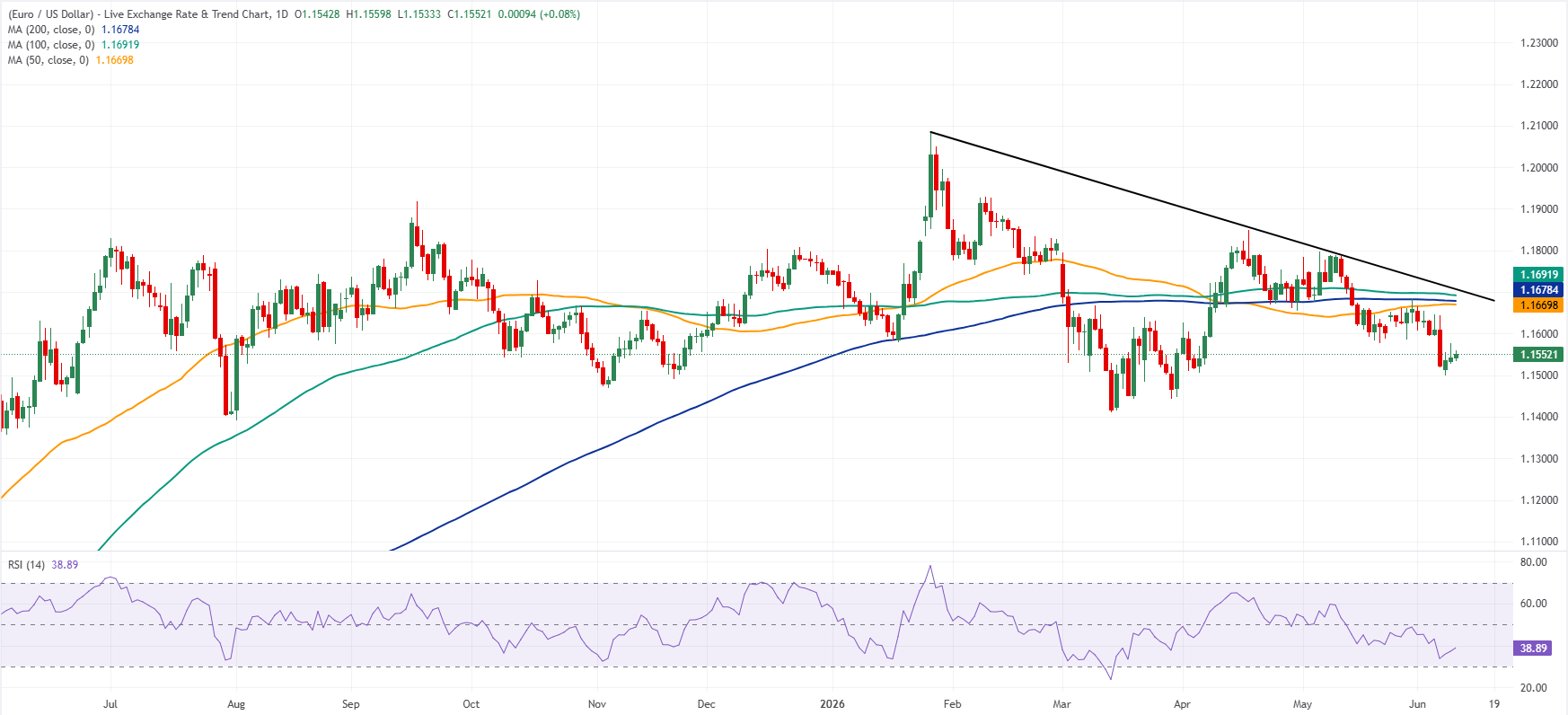
Ahead of the decision, markets have largely priced in a 25-basis-point rate increase, meaning the Euro’s immediate reaction may depend more on the ECB’s communication than on the decision itself.
A more hawkish-than-expected message from Christine Lagarde, particularly if she suggests that additional rate hikes could be warranted in July or September, would likely support the Euro (EUR) by pushing European rate expectations higher. An upward revision to inflation forecasts that highlights persistent price pressures could further reinforce this reaction.
Conversely, if the ECB emphasizes downside risks to growth and signals that June should not be interpreted as the start of an aggressive tightening cycle, the common currency could struggle to gain traction despite the rate increase. Traders would likely interpret such communication as confirmation that only limited additional tightening remains likely.
Interest rate differentials will remain a key driver for EUR/USD. While the ECB is expected to raise rates this week, the Federal Reserve (Fed) is widely expected to keep policy unchanged at its upcoming meeting, even as markets start to anticipate rate hikes later this year. This divergence could provide near-term support for the Euro if the ECB adopts a sufficiently hawkish tone.
Nevertheless, broader market themes remain highly influential, as developments in the Middle East conflict, energy markets and global risk sentiment could continue to dominate EUR/USD price action. As a result, unless the ECB substantially alters expectations regarding the future path of interest rates, the pair may remain driven as much by geopolitical developments as by monetary policy itself.
Since early June 2025, the EUR/USD pair has been trading within a broad horizontal range, with no clear trend. In the daily chart above, EUR/USD maintains a bearish near-term tone as spot remains anchored below the 50-day, 200-day and 100-day Simple Moving Averages (SMAs), clustered between roughly 1.1670 and 1.1692.
The downward resistance trend line, last intersected around 1.1704, continues to frame the broader downside bias. Meanwhile, the Relative Strength Index (RSI) at 38.9 indicates weak momentum but stops short of oversold territory, suggesting that sellers retain control, albeit with limited immediate exhaustion signals.
On the topside, initial resistance emerges at the 50-day SMA near 1.1670, followed closely by the 200-day SMA around 1.1678, creating a dense supply band just overhead. A move above these would then expose the 100-day SMA at 1.1692 ahead of the trend-line reference near 1.1704.
On the downside, the first support comes at the psychological 1.1500 level, close to Monday’s low. A break below this area could reinforce the bearish pressure and open the door for a move toward 1.1400, a key support zone located near the March 13 and August 1 lows. A sustained decline below 1.1400 would further strengthen the negative outlook and expose lower levels not seen since June 2025.
(The technical analysis of this story was written with the help of an AI tool.)
Economic Indicator
ECB Rate On Deposit Facility
One of the European Central Bank's three key interest rates, the rate on the deposit facility, is the rate at which banks earn interest when they deposit funds with the ECB. It is announced by the European Central Bank at each of its eight scheduled annual meetings.
Read more.Next release: Thu Jun 11, 2026 12:15
Frequency: Irregular
Consensus: 2.25%
Previous: 2%
Source: European Central Bank
ECB FAQs
The European Central Bank (ECB) in Frankfurt, Germany, is the reserve bank for the Eurozone. The ECB sets interest rates and manages monetary policy for the region. The ECB primary mandate is to maintain price stability, which means keeping inflation at around 2%. Its primary tool for achieving this is by raising or lowering interest rates. Relatively high interest rates will usually result in a stronger Euro and vice versa. The ECB Governing Council makes monetary policy decisions at meetings held eight times a year. Decisions are made by heads of the Eurozone national banks and six permanent members, including the President of the ECB, Christine Lagarde.
In extreme situations, the European Central Bank can enact a policy tool called Quantitative Easing. QE is the process by which the ECB prints Euros and uses them to buy assets – usually government or corporate bonds – from banks and other financial institutions. QE usually results in a weaker Euro. QE is a last resort when simply lowering interest rates is unlikely to achieve the objective of price stability. The ECB used it during the Great Financial Crisis in 2009-11, in 2015 when inflation remained stubbornly low, as well as during the covid pandemic.
Quantitative tightening (QT) is the reverse of QE. It is undertaken after QE when an economic recovery is underway and inflation starts rising. Whilst in QE the European Central Bank (ECB) purchases government and corporate bonds from financial institutions to provide them with liquidity, in QT the ECB stops buying more bonds, and stops reinvesting the principal maturing on the bonds it already holds. It is usually positive (or bullish) for the Euro.
Recommended Articles


