


Did OpenAI use the work of mathematicians to solve a Millennium Prize Problem?
OpenAI claimed that it has cracked the Navier-Stokes existence and smoothness question, one of the seven Millennium Prize Problems declared by the Scientific Advisory Board of the Clay Mathematics Institute of Cambridge, Massachusetts (CMI). However, the harder problem to solve might be convincing a public gallery that has grown more skeptical of the giant AI lab’s methods.
OpenAI walked straight from solving one of the hardest unsolved mathematics problems of our lifetime to fielding questions from two mathematicians asking whether their unpublished work somehow helped the lab arrive at its answer.
However, as this drama plays out publicly, OpenAI is a few legs behind in the perception lane, as expected when a trillion-dollar AI lab implicated in a rogue agent security hack and an internal “safety reckoning” over risk handling goes up against two relatable academics.
Which math problem did OpenAI just solve?
The Sam Altman-led AI lab said it has written proof and a machine-checkable version in the Lean proof language that a smooth, initially calm fluid can, under a smooth force, speed up without limit and break down in finite time.
The work, which OpenAI claims was done by an internal model more capable than its recently released GPT-6 Astra model, solves one of seven million-dollar problems the Clay Mathematics Institute listed in 2000.
OpenAI said it spent more on compute bill than the $1 million prize that the CMI is offering, according to head of research Mark Chen. Sebastien Bubeck, a researcher at the lab, said about 10,000 agents were working on the problem at one point.
The Clay Institute has not recognized the OpenAI proof yet. The institute requires solutions be published on a qualifying outlet, be available to the public for two years, and receive broad acceptance from mathematicians before consideration for the prize.
Notably, OpenAI has already said it will not seek the prize money.
Did OpenAI use the work of mathematicians in their chat log?
The main debate about OpenAI’s work is not even about the math. The real drama is around whether the information that Tristan Buckmaster of NYU and Levent Alpöge, a mathematician employed by Anthropic, fed into AI models, including OpenAI’s Codex, was siphoned.
Tristan directly asked the lab’s researchers whether his and Levent’s Codex sessions were being used when he first heard that the AI lab had directed major compute capacity at cracking the Navier-Stokes nut.
Typical of a mathematician, Tristan stopped short of making any accusations without proof, writing in a public statement that “I do not know whether our data was used.”
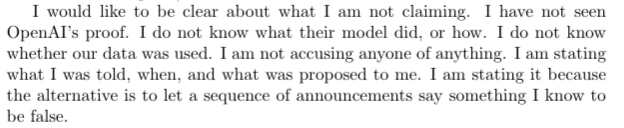
However, the same document accused OpenAI of floating “proposals” that included removing Levent’s name from an announcement that attributed the solution to OpenAI’s internal model.
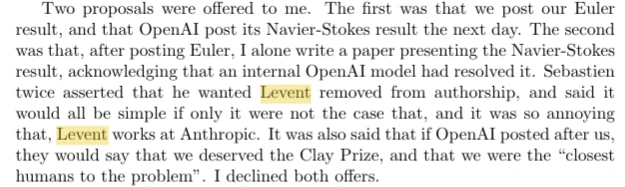
Bubeck has since refuted that claim, writing on X: “I never ever asked for Levent to be removed from authorship of his own work,” he wrote.
I would like to clarify a few things:
1) The screenshot is my reaching out to Levent to coordinate our releases. I hope it’s clear from the message that we came in with the best possible intentions.
2) I never ever asked for Levent to be removed from authorship of his own work… pic.twitter.com/yRli0hLNuM
— Sebastien Bubeck (@SebastienBubeck) September 8, 2026
Sam Altman also weighed in to back his team.
Unlikely but not impossible is not a strong enough denial for skeptics
OpenAI’s core defense is flat: neither its people nor its agents saw the pair’s prompts, drafts, or user data, and they only encountered the work once it went public.
Yet in its own blog post, the company added a line that Levent himself flagged: “While unlikely, we cannot rule out that de-identified data derived from their usage of our products helped improve our models.”
“i mean props to them for straight coming clean,” Levent posted.
Tristan’s account also complicates OpenAI’s framing. He says he was initially told “very little human input” went into the result, but that during calls, it emerged that an entire team had been involved, that easier problems were tackled first, and that even the prompt shown to him had itself been generated by prompting Codex.
He credited the underlying program not to any AI but to mathematicians Diego Córdoba and Luis Martínez-Zoroa, calling the moment a “Deep Blue-Kasparov” turning point for the field.
Tristan has not filed any lawsuit. OpenAI maintains that its proof differs substantially from the pair’s and that no user data was accessed to produce it.
As more research runs through AI systems owned by companies building rival research tools, the harder question is not who owns a finished idea but what a platform is allowed to do with what gets typed into it, and how anyone could ever prove influence after the fact.
If you're reading this, you’re already ahead. Stay there with our newsletter.
บทความแนะนำ


