


The US Dollar Index cannot rally with Washington on the offer
- DXY trades near 99.50, a session low just above 99.25 breaking August's range.
- Euro at a two-month high, the Pound near three-month peaks, Gold bid.
- Empire State manufacturing prints 20.6 against 11, a four-year high.
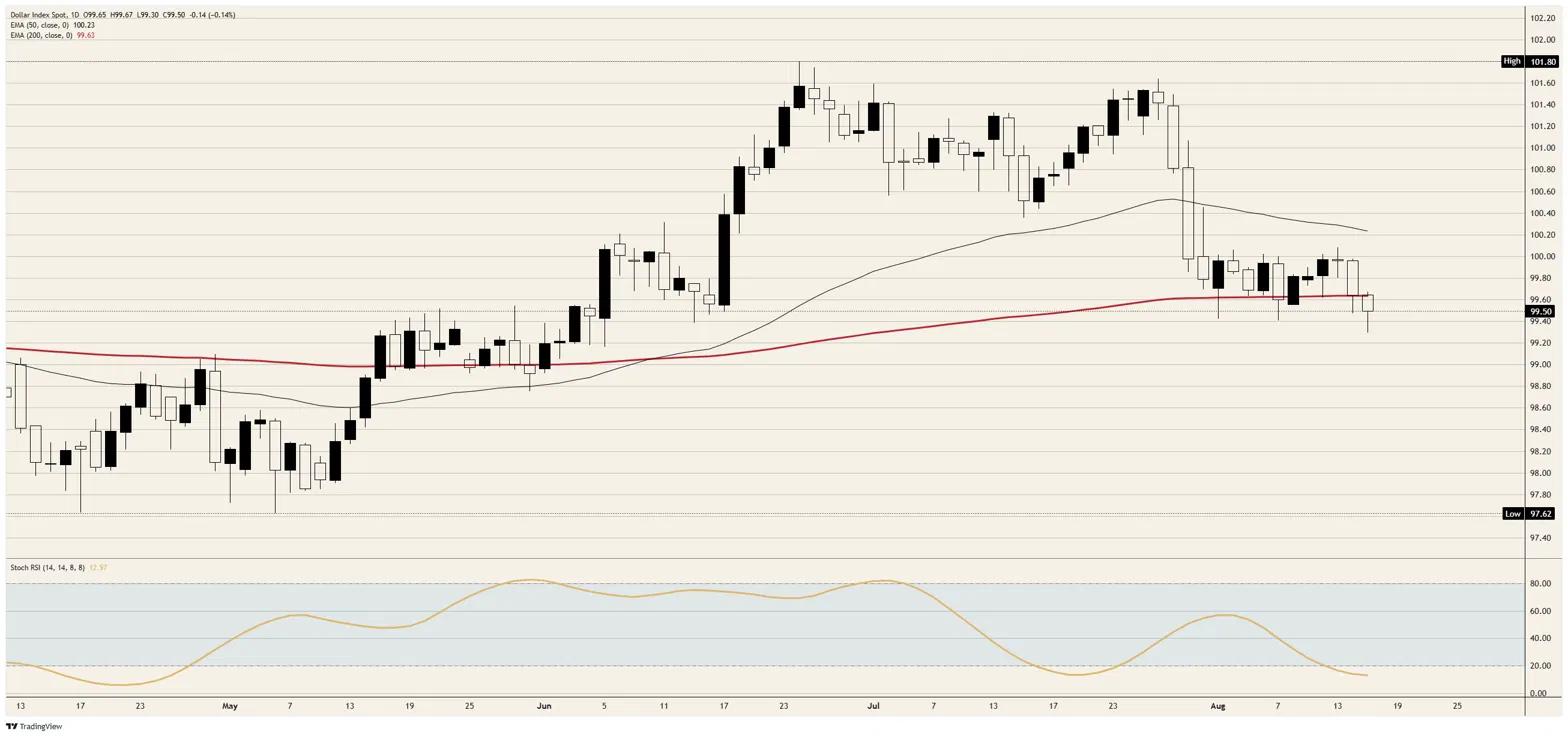
The Dollar Index trades near 99.50, roughly a tenth of a percent lower, having opened directly on its 200-day Exponential Moving Average (EMA) and failed there inside the first minutes, with a session low just above 99.25 taking out the August range. That is the tape on the day a 60-day framework meant to end the war over the Strait of Hormuz expires with nothing agreed to replace it, which is not how a haven currency is supposed to behave on a deadline.
The haven bid went somewhere else
A senior Iranian official told Reuters the country may move from a defensive policy to an offensive one should diplomacy fail, escalating both in the Strait and across the wider region, and three vessels crossed the waterway on Sunday against a five-day average of 12 and roughly 130 a day before the war. Crude Oil firmed on the headlines, with West Texas Intermediate (WTI) near the $83.00 handle and Brent above the $88.00 handle.
On paper this should pay the Dollar twice over. Haven flow is the obvious leg and the terms-of-trade leg is the stronger one, because the United States exports energy on net while the euro area imports the barrels that move through that chokepoint. Instead the Euro trades at a two-month high, the Pound sits near three-month peaks and Gold is bid, which is the signature of a market that has stopped buying safety and started selling one currency.
The rate premium left the price last week
The Dollar had carried a hike premium since the July 29 meeting, where three policymakers dissented in favour of a quarter point against a committee that held. A soft Consumer Price Index (CPI) print, a soft Producer Price Index (PPI) print and a 0.6% contraction in July retail sales took that premium apart inside four sessions, moving September hike odds from a coin flip on August 10 to roughly a third by Friday.
Monday's Empire State manufacturing survey argues the other way and is being ignored for it. The index printed 20.6 against an 11 consensus and 15.6 in July, the strongest reading in more than four years, with unfilled orders up ten points to 15.5 and prices paid rising while prices received fell. A regional survey does not rebuild a rate premium that three national prints dismantled, which leaves Wednesday as the first genuine test of the repricing.
The Dollar has an official seller now
The largest single move on this chart was not a data event at all. At the turn of the month Tokyo intervened alone and then ran a coordinated Yen-buying operation with the US Treasury, the first joint action of its kind since 1998, with the New York Federal Reserve reportedly selling Euros to fund it. The index travelled from above 101.50 to beneath the 100.00 handle inside that window and has not reclaimed a figure of it in the fortnight since.
The size of one operation is not the point of it. A currency whose own Treasury has bought the other side, called the Yen substantially undervalued and promised to act again trades beneath a declared ceiling. Positioning long the Dollar into a war headline now carries the risk of meeting an official seller at the top of the move, which is precisely why the escalation premium is being expressed in Gold and in European currencies instead.
The week the Dollar has to work with
The Federal Open Market Committee (FOMC) publishes minutes from the July 29 meeting on Wednesday at 18:00 GMT, the only scheduled event this week capable of rebuilding what the data removed. The useful detail is not the 9-3 vote, which is known, but how close the remainder of the committee sat to the three who wanted a quarter point, and the account predates the soft inflation prints and the retail sales miss entirely.
Friday carries preliminary August Purchasing Managers Index (PMI) readings at 13:45 GMT, US manufacturing seen at 53.8 from 53.9 and services at 54 from 54.6, alongside euro-area flash readings that are the first real test of whether the other side of the basket can supply a leg of its own. Beyond the week sits the Jackson Hole symposium on August 27-29, with the chair's keynote on the Friday, 19 days ahead of the September decision.
The domestic calendar in between is second tier and priced that way. Tuesday stacks housing starts at 1.35 million from 1.427 million and building permits little changed at 1.37 million from 12:30 GMT, industrial production 0.3% from 0.1% at 13:15 and pending home sales 0.2% from -5.4% at 14:00. Thursday brings initial claims at 212K against 209K and a Philadelphia Fed survey seen at 25 from 41.4, none of which moves September on its own.
Dollar Index technical levels
Resistance: The 200-day EMA near 99.65 caps immediately, having turned the opening print back, with the 100.00 handle above it and a declining 50-day EMA near 100.25 the line that would end this leg.
Support: Just above 99.25 is the session floor and the break of the August range, with the 99.00 handle beneath it and the 98.75 area behind that.
Bias: Bearish. A daily Stochastic Relative Strength Index (Stoch RSI) near 13 reads oversold, though oversold beneath a rolled-over 50-day EMA and a lost 200-day EMA describes a trend rather than a bounce, and rallies into the 100.00 handle are for selling. Invalidation on a daily close back above 100.00.
DXY daily chart
US Dollar FAQs
The US Dollar (USD) is the official currency of the United States of America, and the ‘de facto’ currency of a significant number of other countries where it is found in circulation alongside local notes. It is the most heavily traded currency in the world, accounting for over 88% of all global foreign exchange turnover, or an average of $6.6 trillion in transactions per day, according to data from 2022. Following the second world war, the USD took over from the British Pound as the world’s reserve currency. For most of its history, the US Dollar was backed by Gold, until the Bretton Woods Agreement in 1971 when the Gold Standard went away.
The most important single factor impacting on the value of the US Dollar is monetary policy, which is shaped by the Federal Reserve (Fed). The Fed has two mandates: to achieve price stability (control inflation) and foster full employment. Its primary tool to achieve these two goals is by adjusting interest rates. When prices are rising too quickly and inflation is above the Fed’s 2% target, the Fed will raise rates, which helps the USD value. When inflation falls below 2% or the Unemployment Rate is too high, the Fed may lower interest rates, which weighs on the Greenback.
In extreme situations, the Federal Reserve can also print more Dollars and enact quantitative easing (QE). QE is the process by which the Fed substantially increases the flow of credit in a stuck financial system. It is a non-standard policy measure used when credit has dried up because banks will not lend to each other (out of the fear of counterparty default). It is a last resort when simply lowering interest rates is unlikely to achieve the necessary result. It was the Fed’s weapon of choice to combat the credit crunch that occurred during the Great Financial Crisis in 2008. It involves the Fed printing more Dollars and using them to buy US government bonds predominantly from financial institutions. QE usually leads to a weaker US Dollar.
Quantitative tightening (QT) is the reverse process whereby the Federal Reserve stops buying bonds from financial institutions and does not reinvest the principal from the bonds it holds maturing in new purchases. It is usually positive for the US Dollar.
Artigos Recomendados


