


Gold struggles near $5,000 as Fed signals no rush to cut rates
- Gold trades sideways near $5,000 as traders reassess Fed monetary policy outlook.
- Safe-haven flows persist amid reports of potential US military action against Iran.
- Technical indicators point to a mild bullish bias within a narrowing range.
Gold (XAU/USD) trades flat on Thursday, struggling to extend the previous day’s gains as traders weigh hawkish Federal Reserve (Fed) meeting Minutes against persistent geopolitical tensions.
At the time of writing, XAU/USD trades around $4,993, consolidating after reaching an intraday high near $5,021.
Fed not in a hurry to lower borrowing costs
The Federal Open Market Committee’s (FOMC) January meeting Minutes, published on Wednesday, struck a cautiously hawkish tone, even as policymakers appeared divided on the monetary policy path.
Several participants suggested it would likely be appropriate to keep the interest rate steady for some time while assessing incoming data. At the same time, officials left the door open to future rate hikes if inflation remains above target.
However, some members noted that rate cuts could become appropriate later if inflation declines in line with their expectations.
The Minutes reinforced the view that near-term interest rate cuts remain unlikely. That keeps the US Dollar (USD) and Treasury yields supported, pressuring non-yielding metals. Still, markets continue to expect the Fed to resume monetary policy easing in the second half of the year.
US weighs military action against Iran
Meanwhile, geopolitical risks linked to ongoing US-Iran tensions remain elevated despite high-level talks earlier this week. CBS News reported early Thursday that the US military is preparing for possible strikes on Iran as soon as Saturday, citing sources familiar with the matter.
The report follows a significant US military build-up in the Middle East in recent days, with US President Donald Trump expected to make a final decision.
Against this backdrop, the broader outlook for Gold stays tilted to the upside. Any pullback is likely to attract dip-buying interest, while sustained institutional and investor demand continues to provide an underlying cushion.
Looking ahead, the US economic calendar is relatively light on Thursday, featuring the weekly Initial Jobless Claims and the Philadelphia Fed Manufacturing Survey.
Market attention, however, is firmly focused on Friday’s data, including the Core Personal Consumption Expenditures (PCE) Price Index and the advance estimate of fourth-quarter US Gross Domestic Product (GDP).
Technical analysis: XAU/USD consolidates within narrowing Bollinger Bands
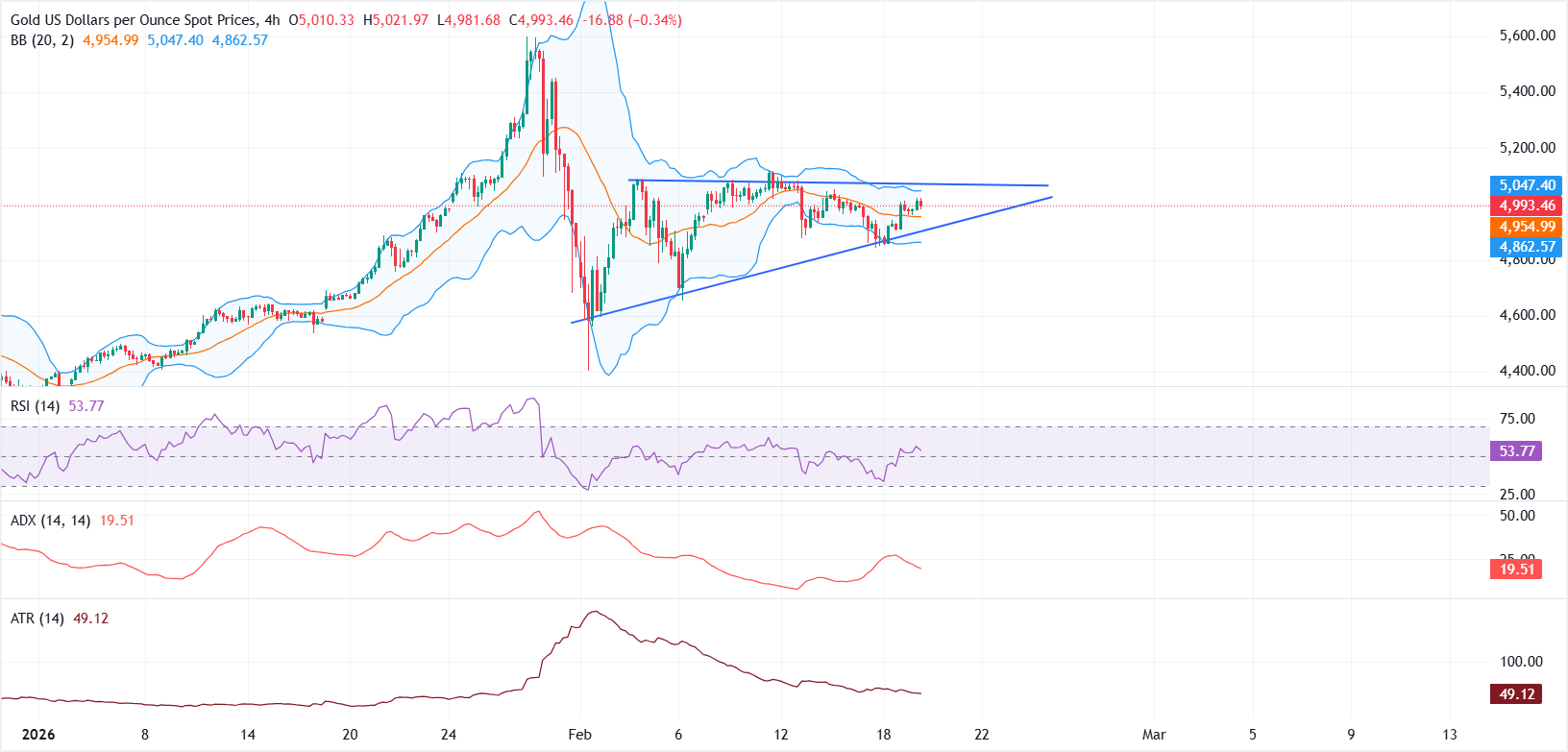
From a technical perspective, the 4-hour chart shows price holding above the 20-period Simple Moving Average (SMA), which also forms the middle Bollinger Band near $4,954, keeping the near-term bias mildly supportive.
Bollinger Bands have narrowed, signaling reduced volatility, while spot prices trade in the upper half of the envelope, bringing the upper band near $5,047 into focus.
The Relative Strength Index (RSI) stands at 53 on the same chart, suggesting neutral-to-bullish momentum, while the Average Directional Index (ADX) at 19.51 points to a relatively weak trend environment.
As long as the price remains above the 20-SMA, dips may find support near the $4,955-$4,900 region. A sustained break above $5,047 would strengthen short-term bullish momentum, while a move below the mid-band may shift momentum back toward the lower Bollinger Band near $4,862.
(The technical analysis of this story was written with the help of an AI tool.)
Gold FAQs
Gold has played a key role in human’s history as it has been widely used as a store of value and medium of exchange. Currently, apart from its shine and usage for jewelry, the precious metal is widely seen as a safe-haven asset, meaning that it is considered a good investment during turbulent times. Gold is also widely seen as a hedge against inflation and against depreciating currencies as it doesn’t rely on any specific issuer or government.
Central banks are the biggest Gold holders. In their aim to support their currencies in turbulent times, central banks tend to diversify their reserves and buy Gold to improve the perceived strength of the economy and the currency. High Gold reserves can be a source of trust for a country’s solvency. Central banks added 1,136 tonnes of Gold worth around $70 billion to their reserves in 2022, according to data from the World Gold Council. This is the highest yearly purchase since records began. Central banks from emerging economies such as China, India and Turkey are quickly increasing their Gold reserves.
Gold has an inverse correlation with the US Dollar and US Treasuries, which are both major reserve and safe-haven assets. When the Dollar depreciates, Gold tends to rise, enabling investors and central banks to diversify their assets in turbulent times. Gold is also inversely correlated with risk assets. A rally in the stock market tends to weaken Gold price, while sell-offs in riskier markets tend to favor the precious metal.
The price can move due to a wide range of factors. Geopolitical instability or fears of a deep recession can quickly make Gold price escalate due to its safe-haven status. As a yield-less asset, Gold tends to rise with lower interest rates, while higher cost of money usually weighs down on the yellow metal. Still, most moves depend on how the US Dollar (USD) behaves as the asset is priced in dollars (XAU/USD). A strong Dollar tends to keep the price of Gold controlled, whereas a weaker Dollar is likely to push Gold prices up.
Artigos Recomendados


