


Australian Dollar receives downward pressure from economic uncertainty in China
- The Australian Dollar depreciated as China's fiscal stimulus plan failed to boost the market sentiment.
- The ANZ-Roy Morgan Consumer Confidence index remained steady at 83.4 this week.
- The US Dollar receives support from the fading likelihood of further bumper rate cuts by the Fed.
The Australian Dollar (AUD) remains subdued against the US Dollar (USD) on Tuesday, weighed down by weak trade balance data from China, Australia's largest trading partner, released on Monday. Furthermore, China's fiscal stimulus plan, announced over the weekend, failed to boost the Aussie Dollar, as investors were left uncertain about the scale of the package.
The Australian weekly survey of Consumer Confidence showed little movement, with the ANZ-Roy Morgan Consumer Confidence index remaining steady at 83.4 this week. Despite the unchanged figure, the longer-term trend shows that Consumer Confidence has been below the 85.0 mark for a record 89 consecutive weeks. The current reading is 1.3 points higher than the 2024 weekly average of 82.1.
The US Dollar (USD) gains support from increasing expectations that the US Federal Reserve (Fed) will avoid aggressive interest rate cuts. According to the CME FedWatch Tool, markets are currently pricing in an 83.6% probability of a 25-basis-point rate cut in November, with no anticipation of a larger 50-basis-point reduction.
Daily Digest Market Movers: Australian Dollar remains subdued over economic woes in China
- Federal Reserve (Fed) Bank of Minneapolis President Neel Kashkari reassured markets late on Monday by reaffirming the Fed's data-dependent approach. Kashkari reiterated familiar Fed policymaker views on the strength of the US economy, noting continued easing of inflationary pressures and a robust labor market, despite a recent uptick in the overall unemployment rate, per Reuters.
- The AUD might have received downward pressure from a detailed note from the Commonwealth Bank of Australia indicating expectations that the Reserve Bank of Australia (RBA) will implement a 25 basis point rate cut by the end of 2024. The report suggested that a stronger disinflationary trend than the RBA anticipates is essential for the Board to consider easing policy within this calendar year.
- The risk-sensitive AUD/USD pair might have received downward pressure due to escalating tensions in the Middle East that have sparked concerns of a broader regional conflict. According to CNN, at least four Israeli soldiers were killed, and over 60 people were injured in a drone attack in north-central Israel on Sunday.
- China's military initiated drills in the Taiwan Strait and around Taiwan on Monday. A spokesperson for the US Department of State expressed serious concern regarding the People's Liberation Army's (PLA) military actions. In response, Taiwan's Defense Ministry stated, “We will not escalate conflict in our response.”
- The National Bureau of Statistics of China reported that the country's monthly Consumer Price Index (CPI) remained unchanged at 0% in September, down from August's 0.4% increase. The annual inflation rate rose by 0.4%, falling short of the anticipated 0.6%. Additionally, the Producer Price Index (PPI) decreased by 2.8% year-on-year, a larger drop than the previous decline of 1.8% and exceeding expectations of a 2.5% decrease.
- On Saturday, the National People’s Congress expressed an optimistic outlook following a briefing from China’s Ministry of Finance (MoF). The MoF emphasized key priorities focused on stabilizing the property market and tackling local government debt issues. The ministry indicated that special bonds would be issued to support both bank recapitalization and efforts to stabilize the real estate sector.
- Chicago Fed President Austan Goolsbee spoke to Bloomberg, commending the progress on inflation and the labor market. Goolsbee noted that despite the positive jobs report for September, there are no indications of overheating in the economy.
- Last week, the Reserve Bank of Australia released the Minutes from its September monetary policy meeting, suggesting that board members examined potential scenarios for both lowering and raising interest rates in the future. The discussion indicated that future financial conditions may need to be either tighter or looser than current levels to meet the Board's objectives.
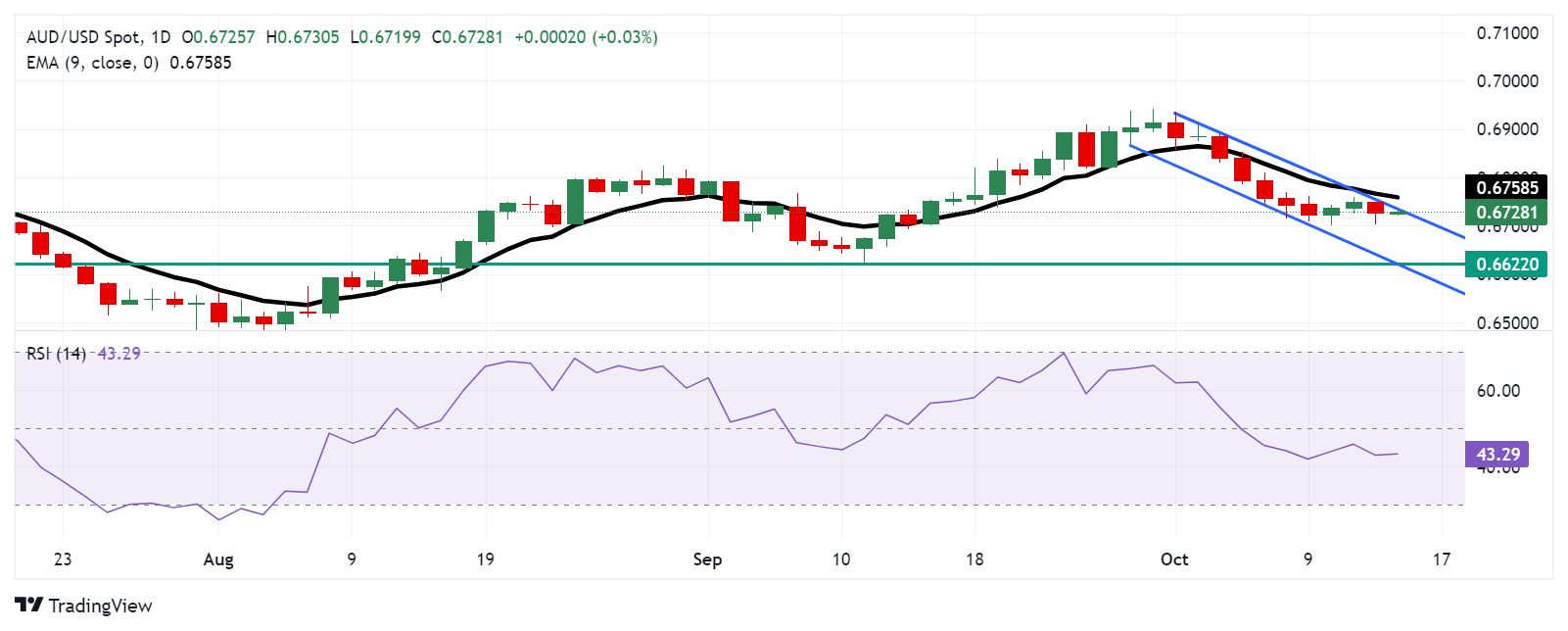
Technical Analysis: Australian Dollar remains below 0.6750 within the descending channel
The AUD/USD pair hovers around 0.6730 on Tuesday. Technical analysis of the daily chart shows the pair testing the upper boundary of a descending channel pattern. A successful breakout above this level could signal a shift in momentum from bearish to bullish. However, the 14-day Relative Strength Index (RSI) remains below the 50 mark, indicating that bearish momentum remains.
Suppose the AUD/USD pair breaks above the descending channel. In that case, it may encounter initial resistance at the nine-day Exponential Moving Average (EMA) around the 0.6758 level, followed by the key psychological resistance at 0.6800.
On the downside, the AUD/USD pair may target the lower boundary of the descending channel near the 0.6630 level, with further support at its eight-week low of 0.6622, last recorded on September 11.
AUD/USD: Daily Chart
Australian Dollar PRICE Today
The table below shows the percentage change of Australian Dollar (AUD) against listed major currencies today. Australian Dollar was the weakest against the Japanese Yen.
| USD | EUR | GBP | JPY | CAD | AUD | NZD | CHF | |
|---|---|---|---|---|---|---|---|---|
| USD | 0.00% | -0.05% | -0.21% | 0.01% | -0.05% | 0.12% | -0.17% | |
| EUR | -0.01% | -0.06% | -0.23% | -0.02% | -0.05% | 0.10% | -0.18% | |
| GBP | 0.05% | 0.06% | -0.16% | 0.05% | 0.00% | 0.16% | -0.06% | |
| JPY | 0.21% | 0.23% | 0.16% | 0.21% | 0.15% | 0.31% | 0.07% | |
| CAD | -0.01% | 0.02% | -0.05% | -0.21% | -0.06% | 0.11% | -0.12% | |
| AUD | 0.05% | 0.05% | -0.01% | -0.15% | 0.06% | 0.16% | -0.07% | |
| NZD | -0.12% | -0.10% | -0.16% | -0.31% | -0.11% | -0.16% | -0.23% | |
| CHF | 0.17% | 0.18% | 0.06% | -0.07% | 0.12% | 0.07% | 0.23% |
The heat map shows percentage changes of major currencies against each other. The base currency is picked from the left column, while the quote currency is picked from the top row. For example, if you pick the Australian Dollar from the left column and move along the horizontal line to the US Dollar, the percentage change displayed in the box will represent AUD (base)/USD (quote).
Australian Dollar FAQs
One of the most significant factors for the Australian Dollar (AUD) is the level of interest rates set by the Reserve Bank of Australia (RBA). Because Australia is a resource-rich country another key driver is the price of its biggest export, Iron Ore. The health of the Chinese economy, its largest trading partner, is a factor, as well as inflation in Australia, its growth rate and Trade Balance. Market sentiment – whether investors are taking on more risky assets (risk-on) or seeking safe-havens (risk-off) – is also a factor, with risk-on positive for AUD.
The Reserve Bank of Australia (RBA) influences the Australian Dollar (AUD) by setting the level of interest rates that Australian banks can lend to each other. This influences the level of interest rates in the economy as a whole. The main goal of the RBA is to maintain a stable inflation rate of 2-3% by adjusting interest rates up or down. Relatively high interest rates compared to other major central banks support the AUD, and the opposite for relatively low. The RBA can also use quantitative easing and tightening to influence credit conditions, with the former AUD-negative and the latter AUD-positive.
China is Australia’s largest trading partner so the health of the Chinese economy is a major influence on the value of the Australian Dollar (AUD). When the Chinese economy is doing well it purchases more raw materials, goods and services from Australia, lifting demand for the AUD, and pushing up its value. The opposite is the case when the Chinese economy is not growing as fast as expected. Positive or negative surprises in Chinese growth data, therefore, often have a direct impact on the Australian Dollar and its pairs.
Iron Ore is Australia’s largest export, accounting for $118 billion a year according to data from 2021, with China as its primary destination. The price of Iron Ore, therefore, can be a driver of the Australian Dollar. Generally, if the price of Iron Ore rises, AUD also goes up, as aggregate demand for the currency increases. The opposite is the case if the price of Iron Ore falls. Higher Iron Ore prices also tend to result in a greater likelihood of a positive Trade Balance for Australia, which is also positive of the AUD.
The Trade Balance, which is the difference between what a country earns from its exports versus what it pays for its imports, is another factor that can influence the value of the Australian Dollar. If Australia produces highly sought after exports, then its currency will gain in value purely from the surplus demand created from foreign buyers seeking to purchase its exports versus what it spends to purchase imports. Therefore, a positive net Trade Balance strengthens the AUD, with the opposite effect if the Trade Balance is negative.
Artigos Recomendados


