


Indian Rupee corrects from two-month high as oil prices extend rally
- The Indian Rupee comes under pressure again as energy prices rally further.
- The exchange of attacks between the US and Iran on oil tankers has lifted oil prices.
- Financial market experts hold a hawkish view on the Fed’s monetary policy outlook.
The Indian Rupee (INR) retreats from its two-month high against the US Dollar (USD) on Tuesday. The USD/INR pair recovers to near 94.68 from its two-month low of 94.29 posted last week as the impact of higher oil prices on the pair seems to be outweighing the lower US Dollar, which has come under pressure amid caution ahead of the United States (US) Consumer Price Index (CPI) scheduled for Friday.
As of writing, the US Dollar Index (DXY), which gauges the Greenback’s value against six major currencies, trades 0.1% lower to near 98.80.
In the opening session, the MCX Crude Oil contract expiring on September 21 is up 0.6% to near Rs. 8,818, the highest level since May 22.
Asia ex-Japan FX faces energy headwinds despite softer Dollar backdrop
According to OCBC, the renewed rise in oil prices and higher US Treasury yields “risks an unfavourable backdrop for much of Asia ex-Japan (AXJ) given the region’s dependence on energy imports” and could “restrain the extent of FX appreciation even if the broader USD stays contained.” The bank suggests that, while a softer Dollar tone may offer some relief, the terms-of-trade shock from elevated energy costs is likely to cap gains for many Asia ex-Japan currencies.
Financial markets expect oil prices to rise further amid continued clashes between the US and Iran. Strategists at Societe Generale said in a note that Brent has “crossed a multi-month descending trend line and is gradually advancing toward the July peak around $102.” They argue that “a move above $102 may extend the uptrend toward the next projections around $108/$110 and $117.” Such a scenario would put more strain on the Indian currency.
Oil risk premia build as Hormuz traffic remains fragile
Analysts at Commerzbank warn that the latest geopolitical flare-up has materially heightened supply risks, noting that "the latest escalation increases the risk that the recent improvement in oil flows through Hormuz is reversed." They point out that "observable traffic through the Strait remained sparse over the weekend," even as "some tankers continue to transit with tracking systems switched off or with military support," underscoring how fragile and opaque the current flow dynamics have become.
US CPI data to influence Fed’s interest rate expectations
This week, the major highlight will be the US CPI data for August, which is expected to reshape the Federal Reserve’s (Fed) interest rate expectations.
According to TD Securities, this week’s inflation data should be “subdued enough to keep the Fed on hold,” though they stress that “the PCE translation will be key” in shaping the policy outlook. The bank expects that “the Fed [will] remain on hold over our forecast horizon,” arguing that while “inflation should remain high for the rest of the year, and the labor market has stabilized,” these dynamics give the FOMC scope to “shift focus to its inflation mandate.” TD Securities cautions that, if policymakers do adjust rates, “if the Fed were to move this year, we believe that move is more likely to be a hike than a cut.”
Currently, the CME FedWatch tool shows that the odds of the Fed hiking interest rates at the policy meeting next month are 58.4%.
USD/INR Technical Analysis
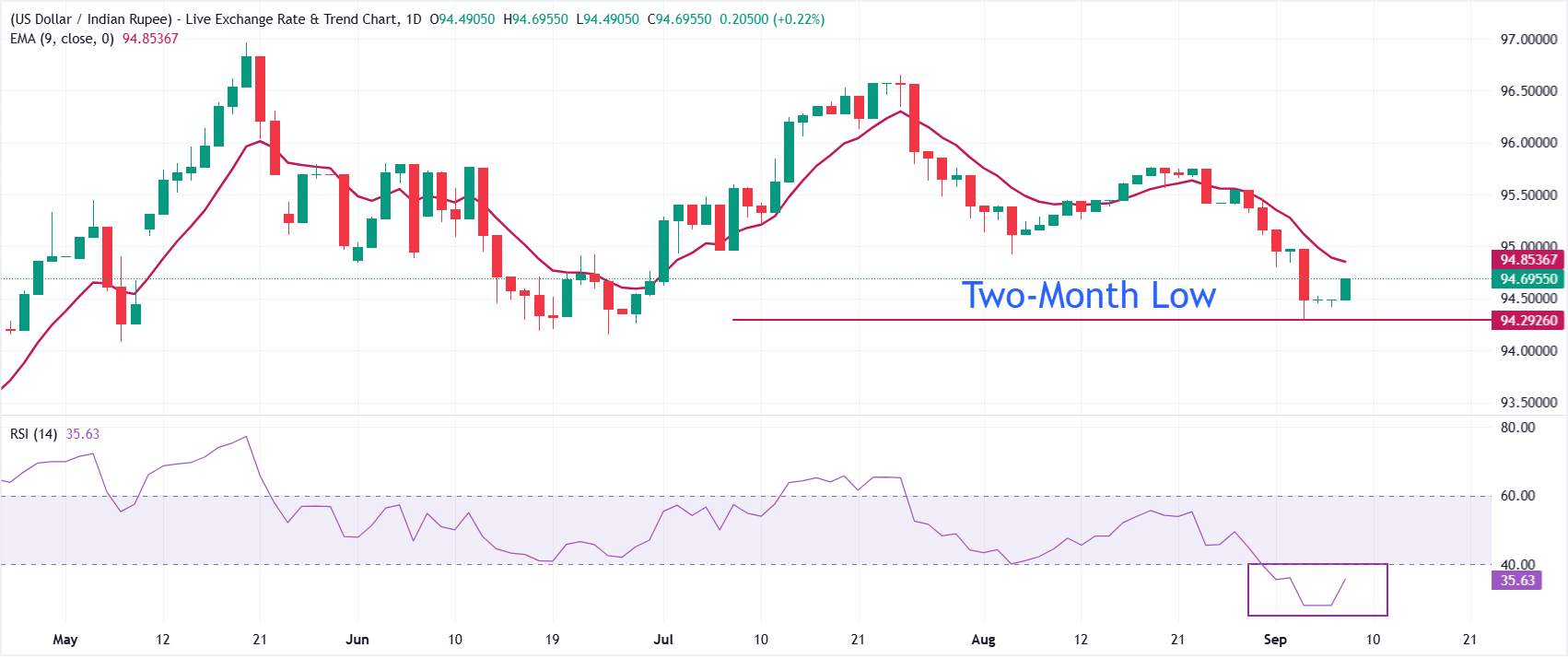
USD/INR trades at 94.69, keeping a bearish near-term tone as it holds below the nine-period exponential moving average (EMA) at 94.8537. The pair remains pressured by this nearby dynamic resistance, while the Relative Strength Index (RSI) around 35 suggests lingering downside bias but with conditions edging toward oversold rather than outright capitulation.
On the topside, the 9-period EMA at 94.8537 is the first resistance level that bulls would need to reclaim to ease immediate selling pressure and open the way for a corrective bounce. On the downside, the two-month low at 94.29 is the key support level.
(The technical analysis of this story was written with the help of an AI tool. Know more.)
Indian Rupee FAQs
The Indian Rupee (INR) is one of the most sensitive currencies to external factors. The price of Crude Oil (the country is highly dependent on imported Oil), the value of the US Dollar – most trade is conducted in USD – and the level of foreign investment, are all influential. Direct intervention by the Reserve Bank of India (RBI) in FX markets to keep the exchange rate stable, as well as the level of interest rates set by the RBI, are further major influencing factors on the Rupee.
The Reserve Bank of India (RBI) actively intervenes in forex markets to maintain a stable exchange rate, to help facilitate trade. In addition, the RBI tries to maintain the inflation rate at its 4% target by adjusting interest rates. Higher interest rates usually strengthen the Rupee. This is due to the role of the ‘carry trade’ in which investors borrow in countries with lower interest rates so as to place their money in countries’ offering relatively higher interest rates and profit from the difference.
Macroeconomic factors that influence the value of the Rupee include inflation, interest rates, the economic growth rate (GDP), the balance of trade, and inflows from foreign investment. A higher growth rate can lead to more overseas investment, pushing up demand for the Rupee. A less negative balance of trade will eventually lead to a stronger Rupee. Higher interest rates, especially real rates (interest rates less inflation) are also positive for the Rupee. A risk-on environment can lead to greater inflows of Foreign Direct and Indirect Investment (FDI and FII), which also benefit the Rupee.
Higher inflation, particularly, if it is comparatively higher than India’s peers, is generally negative for the currency as it reflects devaluation through oversupply. Inflation also increases the cost of exports, leading to more Rupees being sold to purchase foreign imports, which is Rupee-negative. At the same time, higher inflation usually leads to the Reserve Bank of India (RBI) raising interest rates and this can be positive for the Rupee, due to increased demand from international investors. The opposite effect is true of lower inflation.
Artigos Recomendados


