


Indian Rupee opens marginally lower as US Dollar trades firmly
- The Indian Rupee ticks lower against the US Dollar as the latter holds on to Wednesday’s gains.
- The US Dollar gains despite an expected slowdown in the US CPI data for July.
- Oil prices recover opening gains amid prolonged Hormuz closure.
The Indian Rupee (INR) opens on a cautious note against the US Dollar (USD) on Thursday due to overnight gains in the latter. The USD/INR pair edges up to near 95.35 after a corrective move the previous day, as fears of a prolonged global energy supply disruption have strengthened the US Dollar.
As of writing, the US Dollar Index (DXY), which gauges the Greenback’s value against six major currencies, trades firmly near Wednesday’s high at 100.00.
Investors doubt sustainability of US Dollar’s recovery
Though the US Dollar is outperforming its peers as continued Middle East tensions have increased its safe-haven demand, easing fears of a near-term Federal Reserve (Fed) interest rate hike due to an expected slowdown in the United States (US) Consumer Price Index (CPI) growth in July have raised concerns over its strength.
According to TD Securities, the July US CPI report "should continue to bring relief to the Fed regarding the need for tighter policy, at least in the near horizon." The bank points to "signs of normalization in services prices along with tariff pass-through that remains under control" as factors that "bode well for concerns around sticky core inflation." On that basis, TD Securities reiterates that "we remain of the view that the Fed will keep its policy stance unchanged this year."
In terms of market reaction, TD Securities notes that "markets remain relatively unchanged in the wake of the July report, with the pricing for a hike in the September meeting still sitting just under 50%.
Oil prices bounce back
The absence of progress in US-Iran negotiations on the reopening of the Strait of Hormuz, a critical chokepoint for almost 20% of global energy supply, has staged a strong recovery in oil prices.
In the opening trade, the MCX Crude Oil contract expiring on August 19 trades almost flat at around Rs. 7,920 after a weak opening, tracking losses in global oil prices.
Currencies from economies, such as India, which rely heavily on oil imports to meet their energy needs, tend to underperform in a high-oil-price environment.
On Wednesday, oil prices faced sharp selling pressure as OPEC revised its global oil demand growth forecast for the current year to 580,000 barrels per day (bpd) from the previous forecast of 780,000 bpd.
India’s retail CPI accelerates in July
Inflation in India at the retail level accelerated to 4.45% Year-on-Year (YoY) in July from 4.38% in June, almost in line with estimates of 4.50%. The retail CPI remains within the Reserve Bank of India’s (RBI) tolerance band of 2%-6%.
Technical Analysis: USD/INR holds advancing trendline
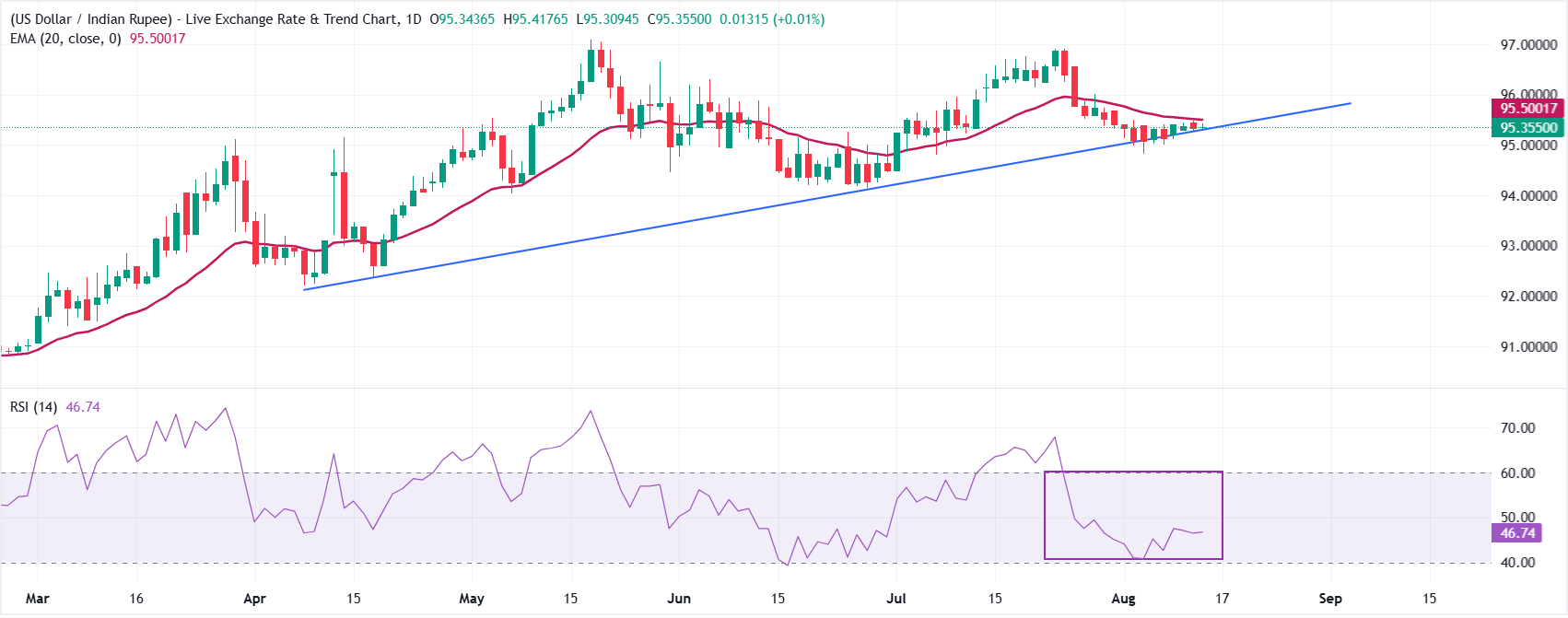
USD/INR trades at around 95.35, keeping a mild bearish near-term bias as it holds below the 20-period Exponential Moving Average (EMA) at 95.50. Price action remains under this short-term trend proxy, suggesting rallies are capped for now, while the Relative Strength Index (14) at 46.74 stays in neutral-to-soft territory, hinting at lacklustre bullish momentum rather than a decisive selloff.
On the downside, initial support is aligned with the former break point of the rising trend line at 95.30, which now acts as an underlying floor for the pair; below that, the August 5 low at 94.83 is the critical support level. On the topside, a recovery would first need to clear the 20-period EMA at 95.50 to ease bearish pressure, with a sustained move above this level required to shift the bias towards a more constructive stance. Looking up, the 96.00 level would be the next hurdle for the pair.
(The technical analysis of this story was written with the help of an AI tool. Know more.)
Indian Rupee FAQs
The Indian Rupee (INR) is one of the most sensitive currencies to external factors. The price of Crude Oil (the country is highly dependent on imported Oil), the value of the US Dollar – most trade is conducted in USD – and the level of foreign investment, are all influential. Direct intervention by the Reserve Bank of India (RBI) in FX markets to keep the exchange rate stable, as well as the level of interest rates set by the RBI, are further major influencing factors on the Rupee.
The Reserve Bank of India (RBI) actively intervenes in forex markets to maintain a stable exchange rate, to help facilitate trade. In addition, the RBI tries to maintain the inflation rate at its 4% target by adjusting interest rates. Higher interest rates usually strengthen the Rupee. This is due to the role of the ‘carry trade’ in which investors borrow in countries with lower interest rates so as to place their money in countries’ offering relatively higher interest rates and profit from the difference.
Macroeconomic factors that influence the value of the Rupee include inflation, interest rates, the economic growth rate (GDP), the balance of trade, and inflows from foreign investment. A higher growth rate can lead to more overseas investment, pushing up demand for the Rupee. A less negative balance of trade will eventually lead to a stronger Rupee. Higher interest rates, especially real rates (interest rates less inflation) are also positive for the Rupee. A risk-on environment can lead to greater inflows of Foreign Direct and Indirect Investment (FDI and FII), which also benefit the Rupee.
Higher inflation, particularly, if it is comparatively higher than India’s peers, is generally negative for the currency as it reflects devaluation through oversupply. Inflation also increases the cost of exports, leading to more Rupees being sold to purchase foreign imports, which is Rupee-negative. At the same time, higher inflation usually leads to the Reserve Bank of India (RBI) raising interest rates and this can be positive for the Rupee, due to increased demand from international investors. The opposite effect is true of lower inflation.
Artigos Recomendados


