


Indian Rupee edges up against US Dollar, ignores rising oil prices
- The Indian Rupee trades marginally higher against the US Dollar despite a significant recovery in oil prices.
- Renewed Middle East risks have lifted oil prices.
- Investors await FOMC Minutes for fresh cues over the US interest rate outlook.
The Indian Rupee (INR) ticks higher against the US Dollar (USD) in the opening session on Wednesday. The USD/INR pair edges down to near 95.00 despite renewed geopolitical risks, following United States (US) attacks on Iran, which have lifted oil prices.
In the opening session, the MCX Crude Oil contract expiring on July 20 is up 2.62% to near 6,882. The contract also gained almost 2.35% on Tuesday.
Currencies from economies, such as India, which rely heavily on oil imports to meet their energy needs, tend to underperform when oil prices surge.
US strikes in retaliation for attacks on commercial ships
The US Central Command has reported, through a post on X, that it launched powerful attacks on Iranian military infrastructure for attacking commercial ships transiting through the Strait of Hormuz, a critical chokepoint for almost 20% of global energy supply. In response, Tehran clarified that it attacked those ships for crossing the chokepoint without its approval. However, the US, Qatar, and Saudi Arabia have blamed Iran for the attacks on the vessels.
Meanwhile, Iran's top negotiator Mohammad Bagher Ghalibaf has accused the US of violating the Memorandum of Understanding (MoU) signed to end the war, and warned that Tehran won’t step back. “The era of bullying and extortion is over. It leads nowhere. We don’t fold,” Ghalibaf wrote on X.
US Dollar ticks down ahead of FOMC Minutes
In the late Asian trade, the US Dollar Index (DXY), which tracks the Greenback’s value against six major currencies, trades subduedly near 101.10. The US Dollar is expected to trade broadly sideways ahead of the Federal Open Market Committee (FOMC) minutes of the June policy meeting, which will be published at 18:00 GMT.
Investors will gauge what possible reasons were behind policymakers’ decision to avoid delivering remarks on the monetary policy outlook. In the policy press conference, Fed Chair Kevin Warsh said that forward-looking remarks are not well-suited in the current policy juncture.
FIIs remain net buyers for three straight trading days
Foreign Institutional Investors (FIIs) continue to increase their stake in the Indian stock market, extending the buying streak for three trading days on Tuesday. In the past three trading days, overseas investors have poured investment worth Rs. 1,991.55 crore. An improvement in sentiment of foreign investors towards Indian equities ahead of the start of the Q1FY27 earnings season underscores their optimism over quarterly earnings growth.
Technical Analysis: USD/INR falls to near 95.00
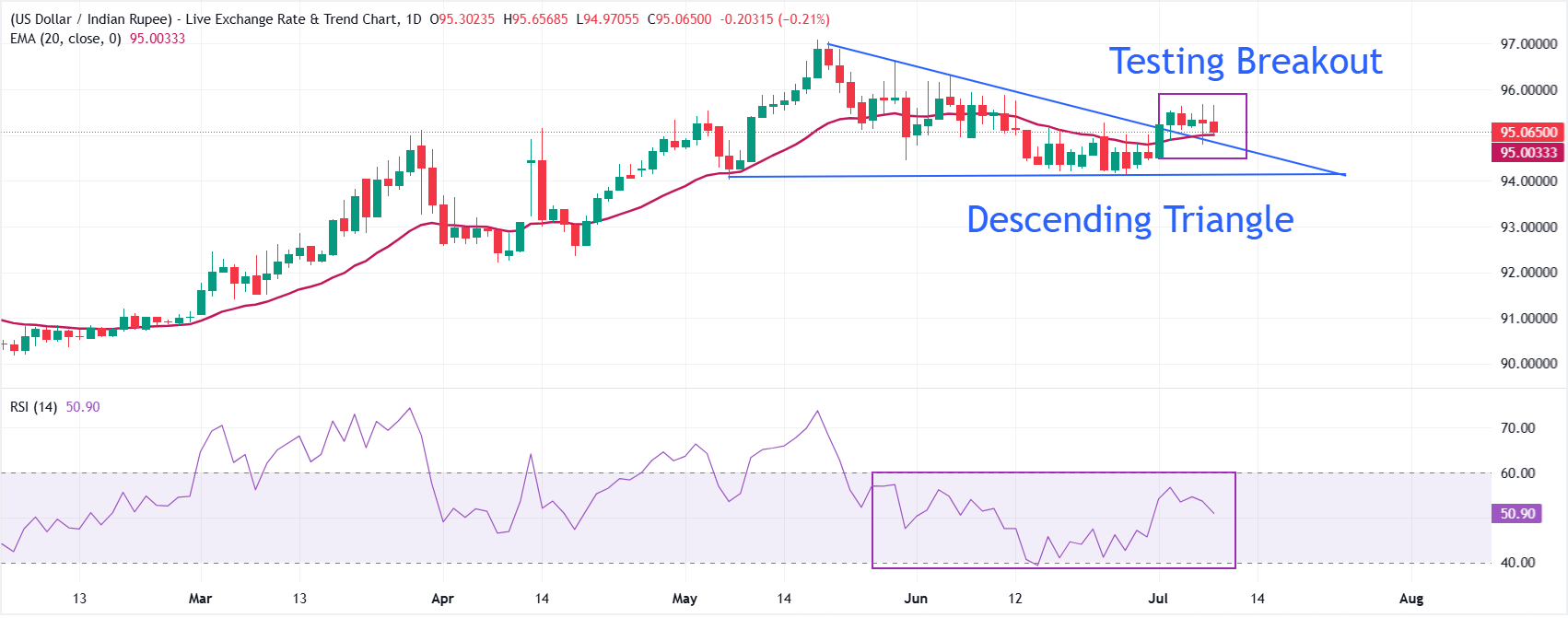
USD/INR trades lower at around 95.00, holding a neutral bias as spot has corrected to near the 20-day Exponential Moving Average (EMA), which is at 95.00. The pair is testing the breakout region of the Descending Triangle formation.
The Relative Strength Index (14) around 51 points to neutral momentum that neither signals overbought conditions nor strong downside pressure.
On the downside, immediate support is defined by the 20-day EMA at 95.00; a break below it would expose the pair to the May 7 low at 94.03. On the topside, a more meaningful resistance level is seen near the original descending trendline start point around 97, where a sustained break would open the way for a stronger bullish extension.
(The technical analysis of this story was written with the help of an AI tool. Know more.)
Indian Rupee FAQs
The Indian Rupee (INR) is one of the most sensitive currencies to external factors. The price of Crude Oil (the country is highly dependent on imported Oil), the value of the US Dollar – most trade is conducted in USD – and the level of foreign investment, are all influential. Direct intervention by the Reserve Bank of India (RBI) in FX markets to keep the exchange rate stable, as well as the level of interest rates set by the RBI, are further major influencing factors on the Rupee.
The Reserve Bank of India (RBI) actively intervenes in forex markets to maintain a stable exchange rate, to help facilitate trade. In addition, the RBI tries to maintain the inflation rate at its 4% target by adjusting interest rates. Higher interest rates usually strengthen the Rupee. This is due to the role of the ‘carry trade’ in which investors borrow in countries with lower interest rates so as to place their money in countries’ offering relatively higher interest rates and profit from the difference.
Macroeconomic factors that influence the value of the Rupee include inflation, interest rates, the economic growth rate (GDP), the balance of trade, and inflows from foreign investment. A higher growth rate can lead to more overseas investment, pushing up demand for the Rupee. A less negative balance of trade will eventually lead to a stronger Rupee. Higher interest rates, especially real rates (interest rates less inflation) are also positive for the Rupee. A risk-on environment can lead to greater inflows of Foreign Direct and Indirect Investment (FDI and FII), which also benefit the Rupee.
Higher inflation, particularly, if it is comparatively higher than India’s peers, is generally negative for the currency as it reflects devaluation through oversupply. Inflation also increases the cost of exports, leading to more Rupees being sold to purchase foreign imports, which is Rupee-negative. At the same time, higher inflation usually leads to the Reserve Bank of India (RBI) raising interest rates and this can be positive for the Rupee, due to increased demand from international investors. The opposite effect is true of lower inflation.
Artigos Recomendados


