


Australian Dollar folds to a hawkish Fed with no data to lean on
- AUD/USD fell sharply to its lowest level of the session after the June Federal Reserve decision.
- New projections flipped the 2026 rate path from a cut to a hike.
- Rate traders now price a first Fed hike as soon as September.
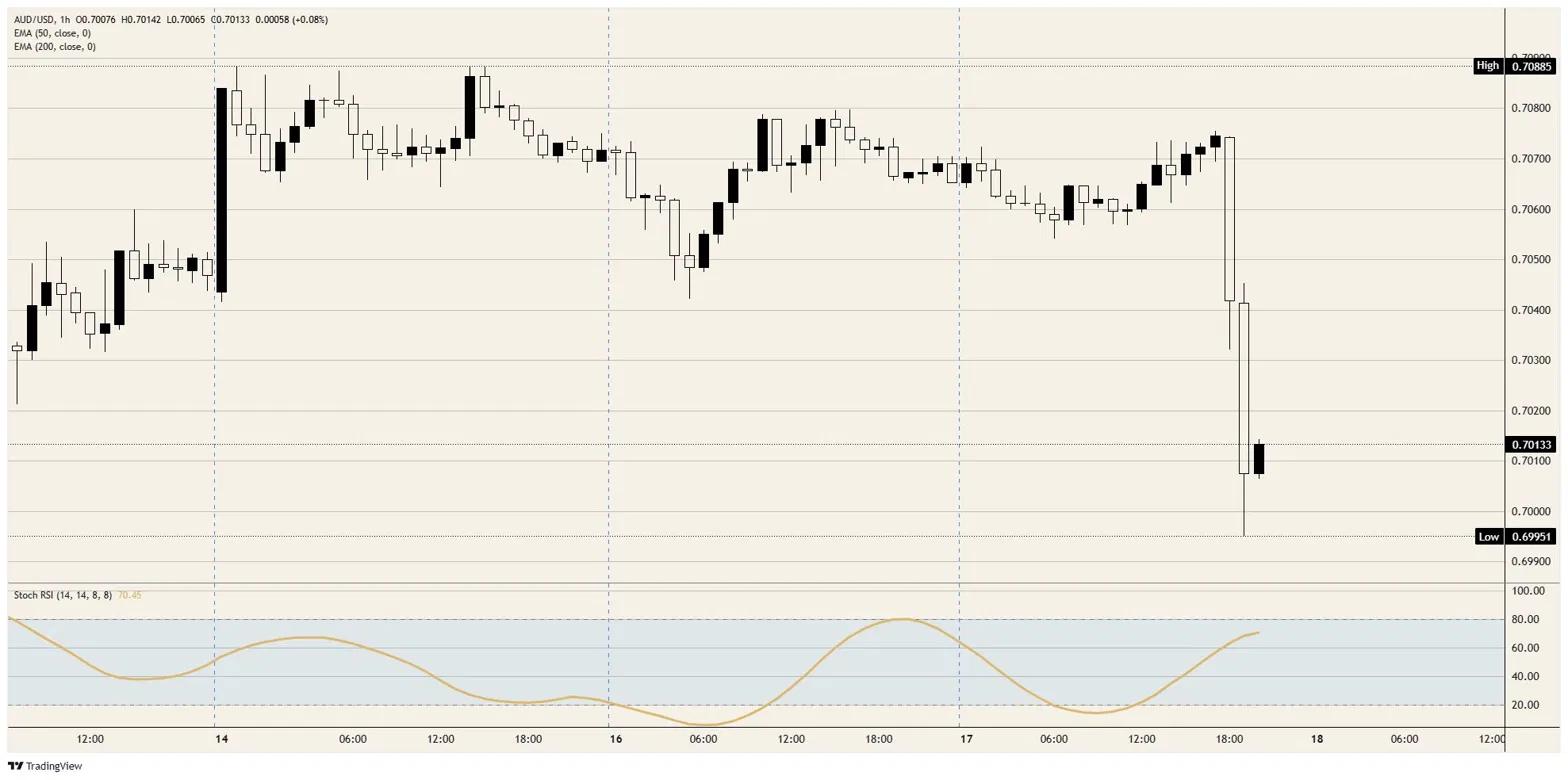
The Australian Dollar went into Kevin Warsh's first Federal Reserve (Fed) decision as a high-beta currency with no domestic shield, and it paid for it. AUD/USD had been holding above 0.7050 ahead of the announcement and fell close to 80 pips in the reaction, slicing through 0.7050 and briefly breaking the 0.7000 handle to a session low just beneath it before clawing back above the figure.
A hold that read like a warning
The Federal Open Market Committee (FOMC) kept the target range at 3.50% to 3.75% on a unanimous 12 to 0 vote, a sharp shift from April's four-way 8 to 4 split, and stripped the easing bias out of the statement. The Summary of Economic Projections (SEP) then did the damage, lifting the median 2026 federal funds projection to roughly 3.8% from 3.4% in March and flipping the next move from a cut to a hike, driven by a 2026 Personal Consumption Expenditures (PCE) inflation forecast that jumped to 3.6% from 2.7%.
Warsh rewrites the rulebook
Warsh used his debut press conference to signal a broad communications overhaul rather than to reassure. He suggested the Fed may hold press conferences only when it actually has something to say, told markets to expect changes to the SEP and the central bank's reporting by year-end, and appears to have withheld his own dot, all of it pointing to a Chair who wants to end forward guidance. The irony was not lost on traders, since the dot plot that just sank the Aussie may be among the tools he reworks.
September, then January
The rate market heard the message and moved. According to the CME FedWatch tool, a first hike is now priced for September, where a 25 basis point increase is the single most likely outcome, and the curve builds toward a second hike by January, where two hikes has become the most probable result. With the nearest meetings near-certain holds, the debate is no longer about cuts at all but about how fast the Fed tightens, a brutal backdrop for a risk-sensitive currency like the Aussie.
Nothing on the calendar to help
There is little relief coming from the data side. The US docket is largely spent for the week after the decision and the press conference, and the Australian calendar is just as thin, leaving the Aussie without a domestic catalyst to lean on. That hands the initiative to broad Dollar momentum and risk appetite, both of which now lean against it.
Resistance: The 0.7050 level the pair lost now caps rebounds, with the 0.7100 handle the next barrier should risk sentiment stabilize.
Support: The 0.7000 handle is the immediate battleground after the brief break beneath it, and a decisive failure there opens the way toward 0.6950.
Bias: Bearish. A hawkish Fed, a widening Dollar yield advantage and an empty calendar leave rallies toward 0.7050 looking like selling opportunities unless global risk appetite turns sharply higher.
AUD/USD 1-hour chart
Australian Dollar FAQs
One of the most significant factors for the Australian Dollar (AUD) is the level of interest rates set by the Reserve Bank of Australia (RBA). Because Australia is a resource-rich country another key driver is the price of its biggest export, Iron Ore. The health of the Chinese economy, its largest trading partner, is a factor, as well as inflation in Australia, its growth rate and Trade Balance. Market sentiment – whether investors are taking on more risky assets (risk-on) or seeking safe-havens (risk-off) – is also a factor, with risk-on positive for AUD.
The Reserve Bank of Australia (RBA) influences the Australian Dollar (AUD) by setting the level of interest rates that Australian banks can lend to each other. This influences the level of interest rates in the economy as a whole. The main goal of the RBA is to maintain a stable inflation rate of 2-3% by adjusting interest rates up or down. Relatively high interest rates compared to other major central banks support the AUD, and the opposite for relatively low. The RBA can also use quantitative easing and tightening to influence credit conditions, with the former AUD-negative and the latter AUD-positive.
China is Australia’s largest trading partner so the health of the Chinese economy is a major influence on the value of the Australian Dollar (AUD). When the Chinese economy is doing well it purchases more raw materials, goods and services from Australia, lifting demand for the AUD, and pushing up its value. The opposite is the case when the Chinese economy is not growing as fast as expected. Positive or negative surprises in Chinese growth data, therefore, often have a direct impact on the Australian Dollar and its pairs.
Iron Ore is Australia’s largest export, accounting for $118 billion a year according to data from 2021, with China as its primary destination. The price of Iron Ore, therefore, can be a driver of the Australian Dollar. Generally, if the price of Iron Ore rises, AUD also goes up, as aggregate demand for the currency increases. The opposite is the case if the price of Iron Ore falls. Higher Iron Ore prices also tend to result in a greater likelihood of a positive Trade Balance for Australia, which is also positive of the AUD.
The Trade Balance, which is the difference between what a country earns from its exports versus what it pays for its imports, is another factor that can influence the value of the Australian Dollar. If Australia produces highly sought after exports, then its currency will gain in value purely from the surplus demand created from foreign buyers seeking to purchase its exports versus what it spends to purchase imports. Therefore, a positive net Trade Balance strengthens the AUD, with the opposite effect if the Trade Balance is negative.
Artigos Recomendados


