




USD/INR revisits all-time high on sustained US Dollar’s demand by Indian importers
- The Indian Rupee falls further against the US Dollar due to robust USD demand by Indian importers.
- FIIs continue to pare their stake in the Indian equity market.
- US-EU disputes over Greenland’s future have weakened demand for US assets.
The Indian Rupee (INR) extends its losing streak for the fourth trading day against the US Dollar (USD) on Tuesday. The USD/INR pair trades close to its all-time high of 91.55, even as the US Dollar is broadly under pressure due to escalating disputes between the United States (US) and the Eurozone over Greenland’s future.
USD/INR continues to extend its advance due to sustained US Dollar demand by Indian importers. According to a report from Reuters, strong dollar demand by Indian importers has been a major driving force for the USD/INR pair.
The demand for US Dollars by Indian importers remains firm due to the absence of a trade deal announcement between the US and India. Negotiators from both nations have been expressing confidence that they are close to reaching a deal for over six months, but have not reached a consensus yet.
The US-India trade stalemate has remained a key dent in the interest of foreign investors toward the Indian stock market. Foreign Institutional Investors (FIIs) have been offloading their stake consistently for over six months. So far in January, FIIs have sold shares worth Rs. 29,315.22 crore.
Daily Digest Market Movers: EU members criticized Trump for using tariff tactic to acquire Greenland
- The US Dollar continues to gain against a weakened Indian Rupee despite escalating US-EU disputes. At the time of writing, the US Dollar Index (DXY), which tracks the Greenback’s value against six major currencies, trades 0.1% lower to near 98.90.
- The appeal of US assets has come under pressure as the dispute over Greenland’s future between both sides of the Atlantic has turned into a trade war.
- Over the weekend, US President Donald Trump levied 10% tariffs on several European Union (EU) members and the United Kingdom (UK), which will become effective from February 1, and warned that import duty could be increased to 25% if the continent continues to oppose Washington’s plans to purchase and control Greenland.
- In response, EU members and UK Prime Minister (PM) Keir Starmer have criticized US President Trump for invoking the tariff tool to coerce the continent to fulfill his intentions.
- Though the outcome of the US-EU tussle has resulted in the US Dollar’s weakness, and the Euro (EUR) has capitalized on the Greenback’s alternative demand, the scenario is unlikely to continue as the size of Europe’s exports to the US is higher than what it imports from the nation, analysts at Societe Generale said.
- On the domestic front, traders remain confident that the Federal Reserve (Fed) will not cut interest rates in the policy meeting later this month.
- Meanwhile, Fed Vice Chair for Supervision Michelle Bowman stated in a speech on Friday that the central bank needs to bring interest rates to their neutral level sooner to contain elevated job risks.
Technical Analysis: USD/INR reclaims all-time high near 91.55
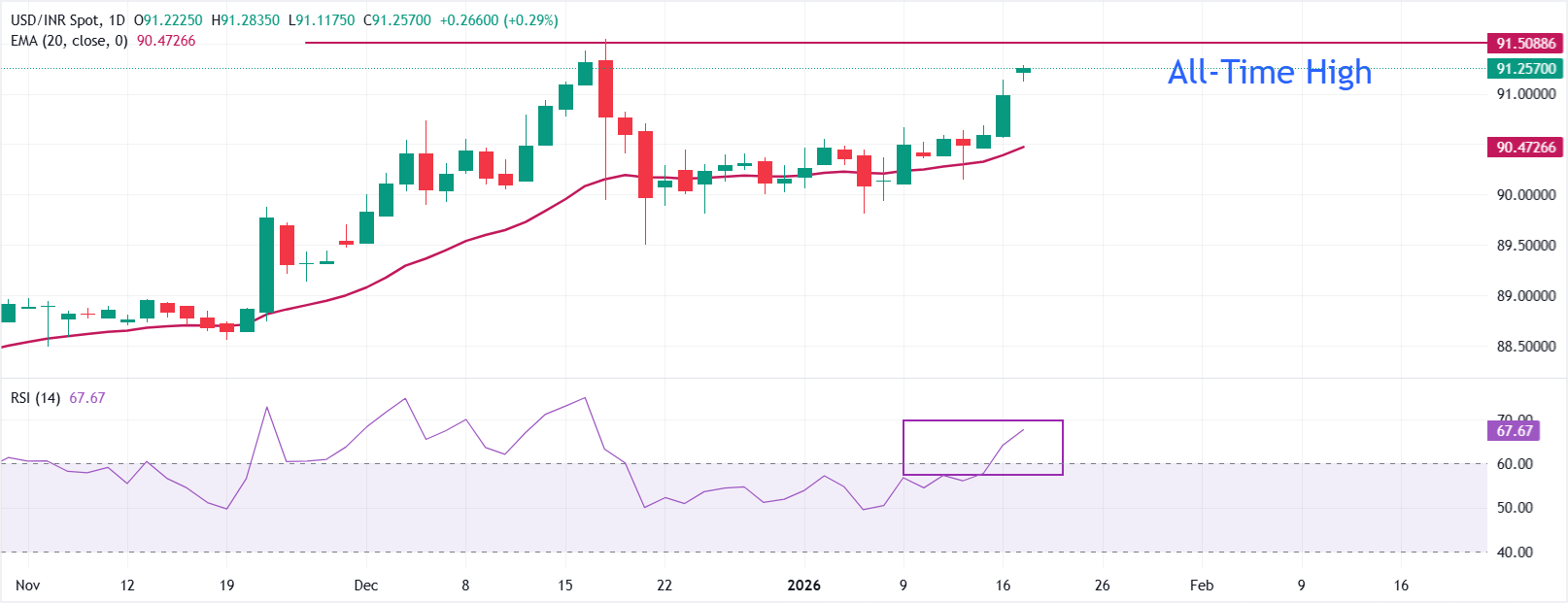
In the daily chart, USD/INR trades at 91.2570. The 20-Exponential Moving Average (EMA) slopes higher and lies below the price at 90.4727, underpinning the advance.
The 14-day Relative Strength Index (RSI) at 67.67 signals firm bullish momentum, nearing the overbought threshold.
Trend extension would follow as long as the spot remains above the 20-EMA, with dips expected to find support in the 90.4727–90.3268 band. A move into overbought on RSI would validate continuation, while a retreat from the current reading could shift the pair into consolidation.
(The technical analysis of this story was written with the help of an AI tool.)
Indian Rupee FAQs
The Indian Rupee (INR) is one of the most sensitive currencies to external factors. The price of Crude Oil (the country is highly dependent on imported Oil), the value of the US Dollar – most trade is conducted in USD – and the level of foreign investment, are all influential. Direct intervention by the Reserve Bank of India (RBI) in FX markets to keep the exchange rate stable, as well as the level of interest rates set by the RBI, are further major influencing factors on the Rupee.
The Reserve Bank of India (RBI) actively intervenes in forex markets to maintain a stable exchange rate, to help facilitate trade. In addition, the RBI tries to maintain the inflation rate at its 4% target by adjusting interest rates. Higher interest rates usually strengthen the Rupee. This is due to the role of the ‘carry trade’ in which investors borrow in countries with lower interest rates so as to place their money in countries’ offering relatively higher interest rates and profit from the difference.
Macroeconomic factors that influence the value of the Rupee include inflation, interest rates, the economic growth rate (GDP), the balance of trade, and inflows from foreign investment. A higher growth rate can lead to more overseas investment, pushing up demand for the Rupee. A less negative balance of trade will eventually lead to a stronger Rupee. Higher interest rates, especially real rates (interest rates less inflation) are also positive for the Rupee. A risk-on environment can lead to greater inflows of Foreign Direct and Indirect Investment (FDI and FII), which also benefit the Rupee.
Higher inflation, particularly, if it is comparatively higher than India’s peers, is generally negative for the currency as it reflects devaluation through oversupply. Inflation also increases the cost of exports, leading to more Rupees being sold to purchase foreign imports, which is Rupee-negative. At the same time, higher inflation usually leads to the Reserve Bank of India (RBI) raising interest rates and this can be positive for the Rupee, due to increased demand from international investors. The opposite effect is true of lower inflation.
Artigos Recomendados


