


Pound Sterling holds Fed-related gains ahead of UK monthly GDP data
- The Pound Sterling trades mildly lower against its major peers ahead of the UK GDP data for October to be released on Friday.
- Investors expect the BoE to cut interest rates by 25 bps to 3.75% next week.
- The US Dollar holds onto recent losses after the Fed’s interest-rate cut.
The Pound Sterling (GBP) trades cautiously against its major peers on Thursday, broadly holding the gains after the Fed rate cut, as investors prepare for the release of key United Kingdom (UK) economic data before the Bank of England (BoE) decision next week.
From Friday and until the BoE decides next Thursday, the UK's Office for National Statistics (ONS) will release monthly Gross Domestic Product (GDP) data for October, labour market data for the three months ending October, and the Consumer Price Index (CPI) data for November.
On Friday, investors will pay close attention to the UK GDP report, which is expected to show that the economy expanded by 0.1% after contracting at a similar pace a month earlier. A good performance of the economy at the start of the fourth quarter would fuel optimism on the growth outlook at a time when the UK’s fiscal watchdog has raised the country's GDP projections for the current year to 1.5% from the 1.0% estimated in March.
Within the GDP data, investors will also focus on the Manufacturing and Industrial Production data. On a monthly basis, both economic indicators are expected to come in higher due to the low base effect.
On the monetary front, traders are increasingly confident that the Bank of England (BoE) will cut interest rates by 25 basis points (bps) to 3.75% next week amid weak job market conditions.
Daily digest market movers: Fed rate cut hurts the Dollar, supporting Pound Sterling
- The Pound Sterling trades close to a fresh seven-week high around 1.3400 against the US Dollar (USD) on Thursday. The GBP/USD pair trades firmly as the US Dollar struggles to gain ground following the Federal Reserve’s (Fed) rate cut on Wednesday.
- The US Dollar Index (DXY), which gauges the Greenback’s value against six major currencies, trades vulnerably near a seven-week low of 98.54 posted earlier in the day.
- On Wednesday, the Fed lowered the Federal Fund Rate by 25 basis points (bps) to 3.50%-3.75%, as expected, and the dot plot signaled that there will be one interest rate cut in 2026.
- The US Dollar has come under pressure as the cautious guidance from the Fed was also accompanied by several dovish elements, notably a lower revision in inflation expectations and a note in the statement about the recent uptick in unemployment. Regarding price rises, the Fed projected that “goods inflation would peak in Q1, if there were no new tariff announcements”.
- Before the policy outcome, investors anticipated that the Fed would announce a halt in the monetary expansion cycle after a 25-bps interest rate reduction, as inflation had remained well above the 2% target for a long period.
- However, Fed Chair Jerome Powell also gave some hawkish-leaning comments, stating that “the bar for further interest rate cuts is very high,” and the central bank is “well positioned to wait to see how the economy evolves”.
- In Thursday’s session, investors will focus on the US Initial Jobless Claims data for the week ending December 5, to be released at 13:30 GMT. The number of individuals claiming jobless benefits for the first time is expected to come in at 220K, higher than the prior reading of 191K.
Technical Analysis: GBP/USD posts fresh seven-week high near 1.3400
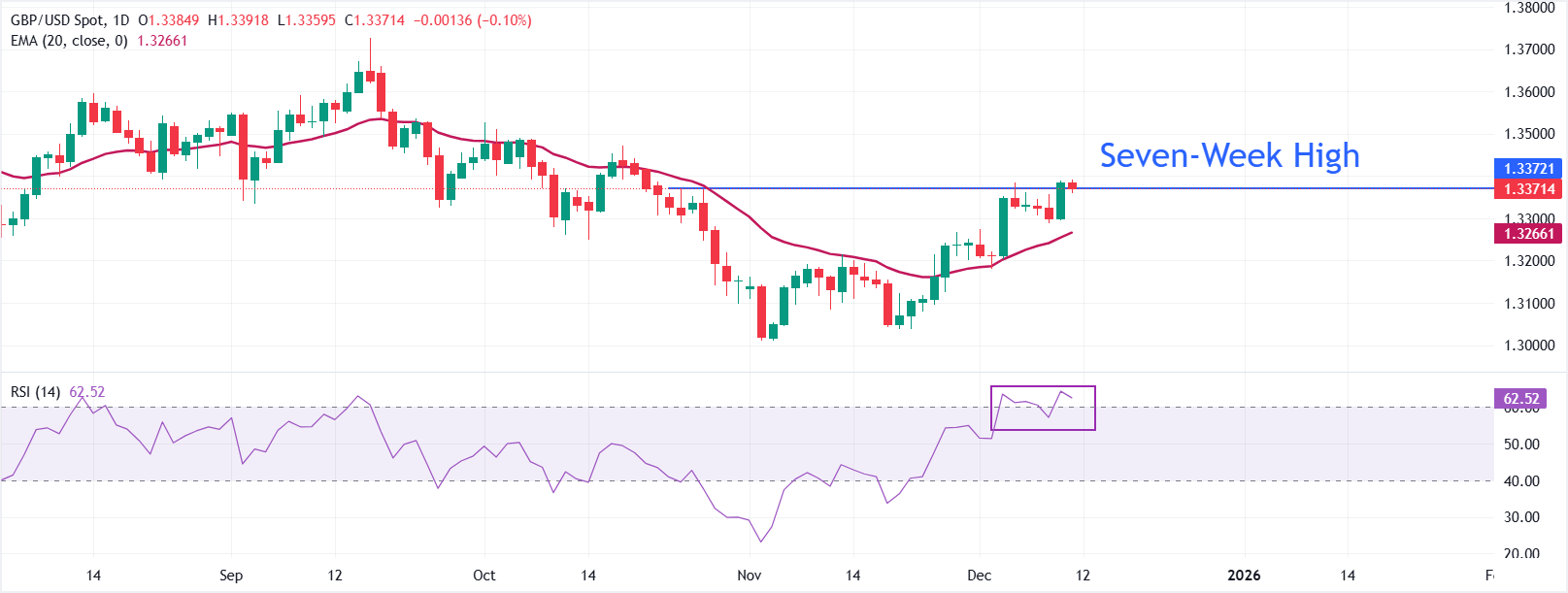
The Pound Sterling trades firmly at 1.3370 against the US Dollar on Thursday. The GBP/USD pair holds above the rising 20-day Exponential Moving Average (EMA) at 1.3266, which has turned higher and supports the uptrend. Pullbacks would be expected to find demand near this key level.
The 14-day Relative Strength Index (RSI) at 63 (bullish) eases slightly from recent highs but keeps momentum positive.
As long as the pair remains above the 20-day EMA at 1.3266, bulls could extend the advance towards the October 17 high of 1.3471, while a daily close below that EMA would shift the bias to neutral and might push the pair lower to the November 25 low around 1.3100.
(The technical analysis of this story was written with the help of an AI tool)
Pound Sterling FAQs
The Pound Sterling (GBP) is the oldest currency in the world (886 AD) and the official currency of the United Kingdom. It is the fourth most traded unit for foreign exchange (FX) in the world, accounting for 12% of all transactions, averaging $630 billion a day, according to 2022 data. Its key trading pairs are GBP/USD, also known as ‘Cable’, which accounts for 11% of FX, GBP/JPY, or the ‘Dragon’ as it is known by traders (3%), and EUR/GBP (2%). The Pound Sterling is issued by the Bank of England (BoE).
The single most important factor influencing the value of the Pound Sterling is monetary policy decided by the Bank of England. The BoE bases its decisions on whether it has achieved its primary goal of “price stability” – a steady inflation rate of around 2%. Its primary tool for achieving this is the adjustment of interest rates. When inflation is too high, the BoE will try to rein it in by raising interest rates, making it more expensive for people and businesses to access credit. This is generally positive for GBP, as higher interest rates make the UK a more attractive place for global investors to park their money. When inflation falls too low it is a sign economic growth is slowing. In this scenario, the BoE will consider lowering interest rates to cheapen credit so businesses will borrow more to invest in growth-generating projects.
Data releases gauge the health of the economy and can impact the value of the Pound Sterling. Indicators such as GDP, Manufacturing and Services PMIs, and employment can all influence the direction of the GBP. A strong economy is good for Sterling. Not only does it attract more foreign investment but it may encourage the BoE to put up interest rates, which will directly strengthen GBP. Otherwise, if economic data is weak, the Pound Sterling is likely to fall.
Another significant data release for the Pound Sterling is the Trade Balance. This indicator measures the difference between what a country earns from its exports and what it spends on imports over a given period. If a country produces highly sought-after exports, its currency will benefit purely from the extra demand created from foreign buyers seeking to purchase these goods. Therefore, a positive net Trade Balance strengthens a currency and vice versa for a negative balance.
Artigos Recomendados


