


UoM Consumer Sentiment Index set to ease as inflation, labour market worries loom
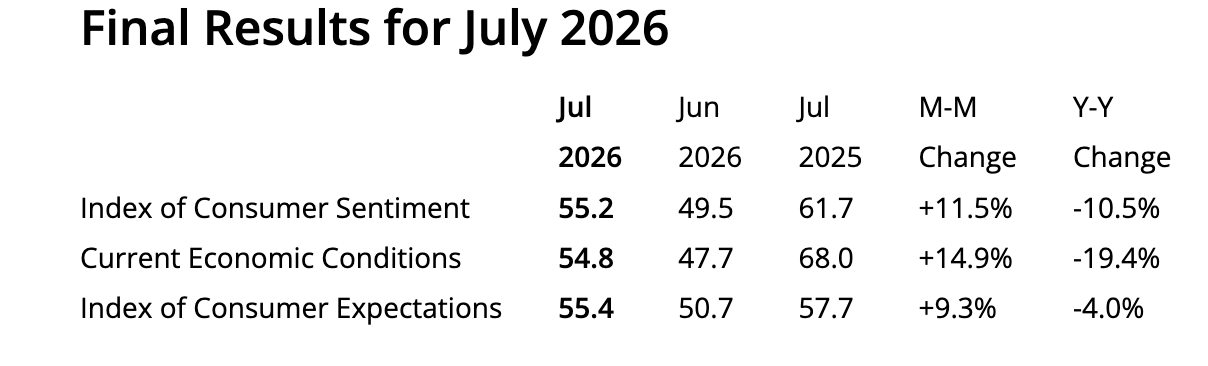
- The Preliminary Michigan Consumer Sentiment Index is expected to ease to 54.5 from 55.2 in July
- US consumers’ optimism has improved to levels close to those seen before the US-Iran war began.
- August’s UoM Consumer Sentiment is unlikely to change the view on the Fed’s monetary policy, which is the main USD driver.
The University of Michigan (UoM) will release the preliminary estimate of August’s Consumer Sentiment Index on Friday. The UoM report, which analyses US consumers’ feelings about their personal finances, business conditions, and purchasing plans, is expected to show a moderate decline, yet remain relatively close to levels in January and February, when concerns about Iran’s war and the economic impact of the energy shock were absent.
US consumers’ confidence is expected to have ticked down to 54.5 in August from 55.2 in July, as measured by the UoM Consumer Sentiment Index. These numbers would highlight fairly resilient sentiment in the face of uncertainty surrounding the Middle East conflict, a deteriorating labour market, and stubbornly high price pressures.
The risk on the US Dollar (USD), thus, is skewed to the downside. A positive surprise on August’s Michigan Consumer Sentiment Index is unlikely to change the prevailing view that the Federal Reserve (Fed) will stand pat on rates in September, while a weak sentiment report might heighten doubts about the momentum of the US economy, pushing Fed rate hikes further back and adding pressure on the Greenback
What to expect from August’s UoM Consumer Sentiment Index report?
Investors will be attentive to Friday’s data to see how US consumers are responding to the Middle East deadlock and the persistently high prices.
US macroeconomic data released earlier this week revealed some moderation in inflation, yet with the headline Consumer Price Index (CPI) growing at a 3.4% year-over-year rate in July, a whole percentage point above the levels seen in January and February, before the Middle East conflict sent Oil prices surging.
If this was not enough, the Nonfarm Payrolls (NFP) report showed that net employment contracted unexpectedly in July, highlighting a sharp deterioration of the labour market, which, sooner or later, is highly likely to dent consumers’ confidence.
July’s University of Michigan report highlighted a broad-based improvement, although, looking from a wider perspective, the overall sentiment remains well below its historical average. The Director of the Survey of Consumers, Johanne Hsu, noted that “sentiment is 11% below a year ago, reflecting a generally somber view of the economy amid five years of elevated inflation and persistently high prices.”
Bearing this in mind, the landscape has not given reasons to contemplate a positive surprise on Friday. Quite the contrary. West Texas Intermediate (WTI) Oil prices are more than 15% above the levels in early July, when the interviews for last month’s report took place, and the situation in the Middle East remains stalled, pushing energy prices and overall inflation higher.
Inflation expectations for the year ahead eased in July to 4.2% from 4.6% in June, but recent developments might have prompted some recovery in August, adding pressure on the overall sentiment.
When will the UoM Consumer Sentiment Index be released, and how could it affect the US Dollar?
The University of Michigan will release its Consumer Sentiment Index, together with the Consumer Inflation Expectations survey, on Friday at 14:00 GMT. The market consensus hints at a moderate pullback from July’s reading, although showing levels not far from the 2026 peak.
The US Dollar remains weighed by dwindling hopes of Fed rate hikes, although the cautious market mood, amid growing uncertainty about the fate of the US-Iran peace process, has kept the safe-haven Greenback buoyed this week.
The USD Index (DXY), which measures the value of the US Dollar against a basket of six major currency peers, has been showing a mild upside bias over the last few days, after finding some support at the 99.45 area. Bulls, however, have been unable to find acceptance above the 100.00 psychological level at the time of writing.
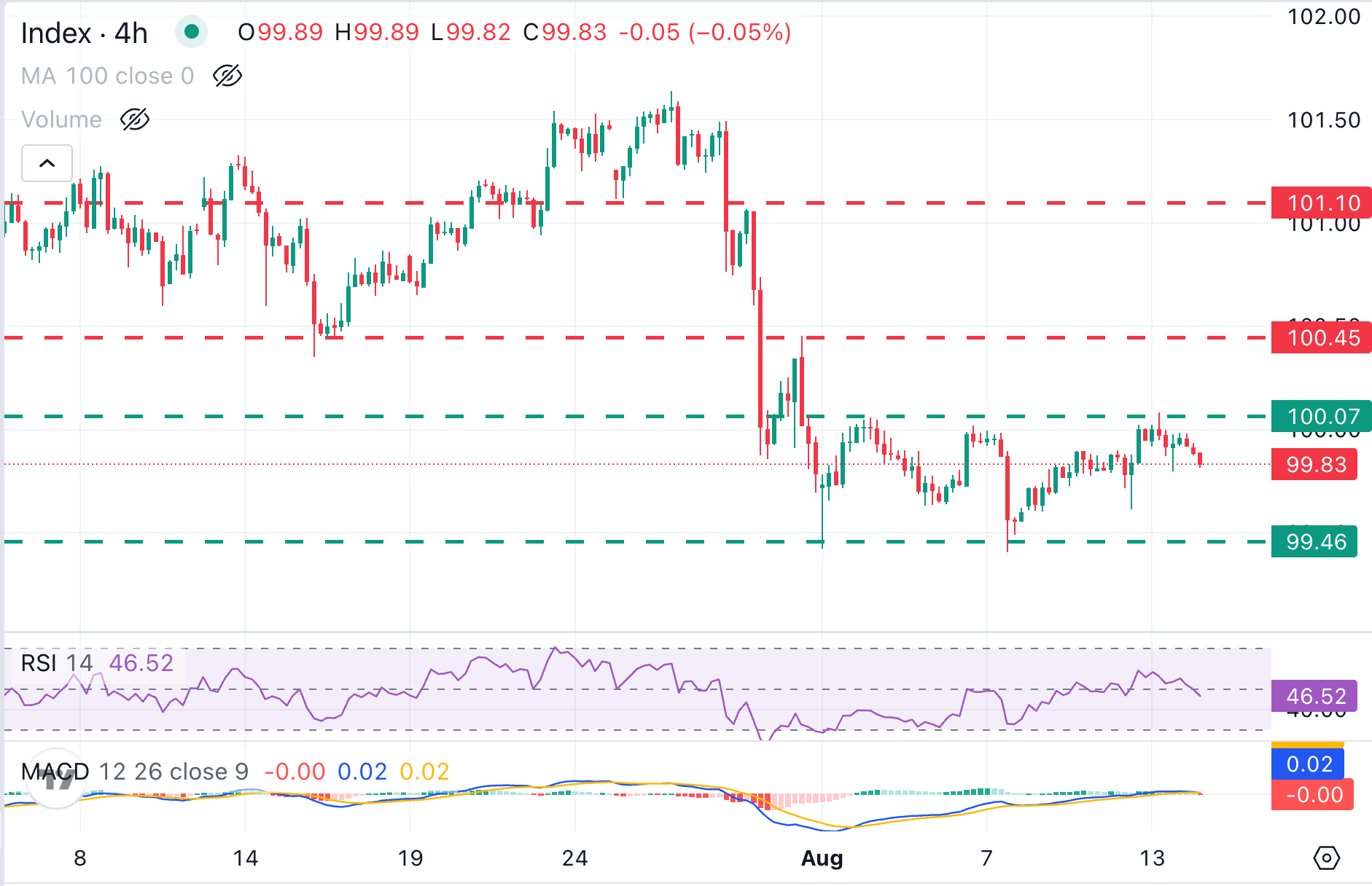
The 4-hour chart highlights a neutral-to-bearish near-term bias, with the Relative Strength Index (14) drifting below the 50 midline and the Moving Average Convergence Divergence (MACD) histogram marginally in negative territory. This hints at a fading bullish undertone rather than a bearish reversal.
Bulls would need a clear break of the 100.00 resistance zone to shift the focus towards a previous support area near 100.45, which capped bulls on July 31, ahead of the July 30 high, a few pips above 101.00. On the downside, Wednesday’s low in the 99.60 region is likely to test bears’ confidence, although the key support area is the mentioned 99.40, the bottom of the last two months’ trading range.
US Dollar FAQs
The US Dollar (USD) is the official currency of the United States of America, and the ‘de facto’ currency of a significant number of other countries where it is found in circulation alongside local notes. It is the most heavily traded currency in the world, accounting for over 88% of all global foreign exchange turnover, or an average of $6.6 trillion in transactions per day, according to data from 2022. Following the second world war, the USD took over from the British Pound as the world’s reserve currency. For most of its history, the US Dollar was backed by Gold, until the Bretton Woods Agreement in 1971 when the Gold Standard went away.
The most important single factor impacting on the value of the US Dollar is monetary policy, which is shaped by the Federal Reserve (Fed). The Fed has two mandates: to achieve price stability (control inflation) and foster full employment. Its primary tool to achieve these two goals is by adjusting interest rates. When prices are rising too quickly and inflation is above the Fed’s 2% target, the Fed will raise rates, which helps the USD value. When inflation falls below 2% or the Unemployment Rate is too high, the Fed may lower interest rates, which weighs on the Greenback.
In extreme situations, the Federal Reserve can also print more Dollars and enact quantitative easing (QE). QE is the process by which the Fed substantially increases the flow of credit in a stuck financial system. It is a non-standard policy measure used when credit has dried up because banks will not lend to each other (out of the fear of counterparty default). It is a last resort when simply lowering interest rates is unlikely to achieve the necessary result. It was the Fed’s weapon of choice to combat the credit crunch that occurred during the Great Financial Crisis in 2008. It involves the Fed printing more Dollars and using them to buy US government bonds predominantly from financial institutions. QE usually leads to a weaker US Dollar.
Quantitative tightening (QT) is the reverse process whereby the Federal Reserve stops buying bonds from financial institutions and does not reinvest the principal from the bonds it holds maturing in new purchases. It is usually positive for the US Dollar.
Inflation FAQs
Inflation measures the rise in the price of a representative basket of goods and services. Headline inflation is usually expressed as a percentage change on a month-on-month (MoM) and year-on-year (YoY) basis. Core inflation excludes more volatile elements such as food and fuel which can fluctuate because of geopolitical and seasonal factors. Core inflation is the figure economists focus on and is the level targeted by central banks, which are mandated to keep inflation at a manageable level, usually around 2%.
The Consumer Price Index (CPI) measures the change in prices of a basket of goods and services over a period of time. It is usually expressed as a percentage change on a month-on-month (MoM) and year-on-year (YoY) basis. Core CPI is the figure targeted by central banks as it excludes volatile food and fuel inputs. When Core CPI rises above 2% it usually results in higher interest rates and vice versa when it falls below 2%. Since higher interest rates are positive for a currency, higher inflation usually results in a stronger currency. The opposite is true when inflation falls.
Although it may seem counter-intuitive, high inflation in a country pushes up the value of its currency and vice versa for lower inflation. This is because the central bank will normally raise interest rates to combat the higher inflation, which attract more global capital inflows from investors looking for a lucrative place to park their money.
Formerly, Gold was the asset investors turned to in times of high inflation because it preserved its value, and whilst investors will often still buy Gold for its safe-haven properties in times of extreme market turmoil, this is not the case most of the time. This is because when inflation is high, central banks will put up interest rates to combat it. Higher interest rates are negative for Gold because they increase the opportunity-cost of holding Gold vis-a-vis an interest-bearing asset or placing the money in a cash deposit account. On the flipside, lower inflation tends to be positive for Gold as it brings interest rates down, making the bright metal a more viable investment alternative.
추천 기사


