


Dow Jones Industrial Average edges lower as Goldman drags, Crude Oil climbs back over $100
- The Dow Jones Industrial Average dipped on Monday, weighed down by Goldman Sachs after disappointing fixed income results, even as the S&P 500 and Nasdaq Composite pushed into positive territory.
- Oil prices surged back above $100 per barrel after President Trump ordered a US naval blockade of the Strait of Hormuz following the collapse of weekend peace talks with Iran.
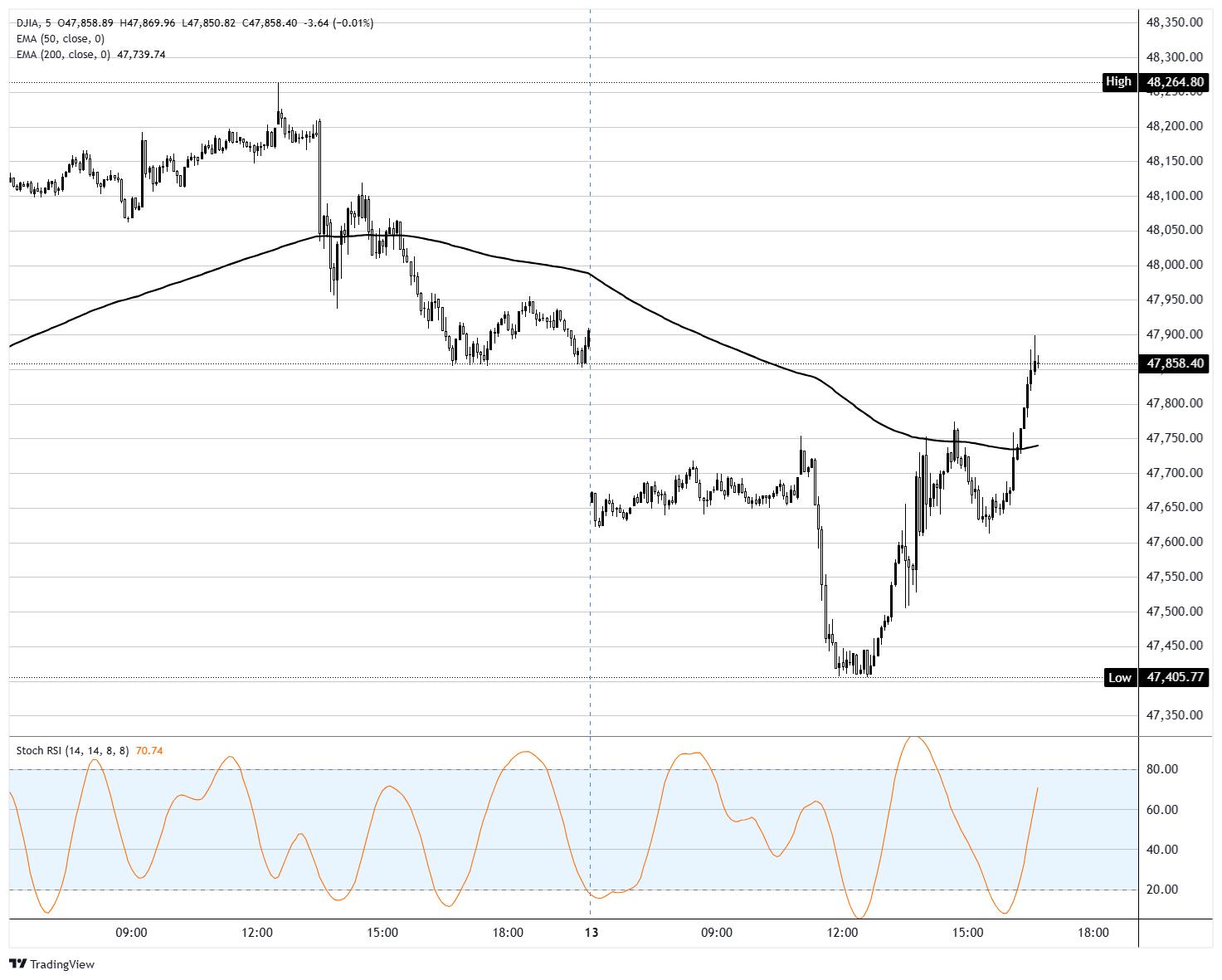
- Dow Jones Industrial Average futures dropped more than 500 points overnight before a sharp recovery through the session, with markets showing increasing resilience to geopolitical headlines.
- Software stocks led the rally, with Oracle jumping 8% and Palantir gaining more than 3%, while Goldman Sachs fell 2.5% despite beating earnings estimates after a large miss in its fixed income unit.
The Dow Jones Industrial Average (DJIA) edged lower on Monday, slipping around 50 points to trade near 47,900 after recovering from a much steeper drop at the open. The S&P 500 rose 0.2% to trade above 6,800, while the Nasdaq Composite gained 0.6% to push above 23,000. Dow Jones Industrial Average futures had plunged more than 500 points in the overnight session after President Trump announced a US blockade of the Strait of Hormuz, but equities staged a notable intraday recovery as investors appeared to bet on an eventual resolution to the US-Iran standoff.
Hormuz blockade sends Oil back above $100
West Texas Intermediate (WTI) Crude Oil surged more than 5% to top $101 per barrel after Trump declared that the US Navy would blockade all vessels entering or leaving Iranian ports in the Strait of Hormuz. US Central Command (CENTCOM) clarified that the blockade would not impede vessels transiting the strait to non-Iranian ports. The announcement came after weekend negotiations in Islamabad collapsed, with Vice President JD Vance departing without a deal, citing Iran's unwillingness to halt its nuclear weapons program. The two sides appear far apart, with Iran also demanding control of the strait, war reparations, and the release of frozen assets. Mediators from Pakistan, Egypt, and Turkey will continue talks with both nations in the coming days, according to Axios. Meanwhile, the Wall Street Journal reported that Trump is weighing a resumption of military strikes. Brent Crude jumped as much as 9% to trade near $102. The move reverses much of the relief rally that followed the April 7 ceasefire agreement, which had briefly pushed Oil prices back below $100. "Investors are now back to the drawing board trying to reassess the fair value of stocks now that it's clear that there is no end in sight to the conflict in the Middle East," said Clark Bellin, president and chief investment officer at Bellwether Wealth.
Goldman Sachs weighs on the Dow
Goldman Sachs (GS) was the biggest drag on the Dow Jones Industrial Average on Monday, falling 2.5% despite reporting first-quarter results that topped estimates on both the top and bottom line. Earnings per share came in at $17.55 versus the $16.49 consensus estimate, while revenue hit $17.23 billion against expectations of $16.97 billion. The standout was equities trading, which posted a record quarter at $5.33 billion in revenue, up 27% YoY. However, the bank's fixed income, currencies and commodities (FICC) division was a sore spot, with revenue dropping 10% YoY to $4.01 billion, missing StreetAccount estimates by roughly $900 million. The miss was attributed to weakness in interest rate products, mortgages, and credit. Bank of America called the overall results "solid" but "clouded by the FICC miss," while Wolfe Research described the quarter as "disappointing" despite lofty expectations, noting that higher commodities and foreign exchange trading were more than offset by weakness in rates, mortgages, and credit. Wells Fargo added that the FICC shortfall was "a little surprising relative to peer guidance and balance sheet growth." The result kicked off what is expected to be a busy week for bank earnings, with JPMorgan Chase, Citigroup, Wells Fargo, Morgan Stanley, and Bank of America all set to report.
Software stocks lead the recovery
While financials dragged, technology and enterprise software names pushed the Nasdaq Composite higher. Oracle (ORCL) surged 8% to lead S&P 500 gainers after announcing new AI-powered utilities industry suite offerings. Palantir Technologies (PLTR) gained more than 3%, while ServiceNow (NOW) and Workday (WDAY) both rose more than 5%. Within the Dow, Salesforce (CRM) rose more than 3% on optimism around its artificial intelligence integration pipeline, Microsoft (MSFT) added around 1.6%, and IBM (IBM) gained roughly 1%. The sector rotation out of financials and into software was a defining feature of the session, helping the Nasdaq outperform despite the heavy geopolitical overhang. Semiconductor stocks broadly held gains from last week's rally, which had been fueled by strong results from TSMC and renewed AI capex commitments from major tech firms.
Existing home sales hit nine-month low
Existing home sales fell to a seasonally adjusted annual rate of 3.98 million in March, the National Association of Realtors (NAR) reported Monday. The figure marked a 3.6% monthly decline and missed the Dow Jones consensus estimate of 4.05 million, coming in at the lowest level since June 2025. Mortgage rates climbed sharply through March, peaking at 6.64% for a 30-year loan before easing by roughly a quarter percentage point during the US-Iran ceasefire. The median home sales price rose 1.4% YoY to near $409K. The housing data adds to a growing pile of evidence that elevated borrowing costs are weighing on rate-sensitive parts of the economy, keeping pressure on the Federal Reserve (Fed) as it navigates between persistent inflation risks and softening demand.
Bond yields rise as inflation fears return
Treasury yields climbed on Monday as the resurgence in Oil prices reignited inflation concerns. The 10-year Treasury yield rose 3 basis points to 4.34%, while the 30-year yield added 2 basis points to reach 4.93%. The moves come on the back of Friday's Consumer Price Index (CPI) data, which had already revived higher inflation expectations. With Oil back above $100, traders are increasingly pricing in the possibility that the Fed may need to delay rate cuts further. The bond selloff adds another layer of pressure for equity valuations, particularly in rate-sensitive sectors. Last week had been the strongest for all three major indexes since November, with the S&P 500 gaining 3.6%, the Nasdaq jumping 4.7%, and the Dow advancing 3%, so Monday's relatively contained pullback was viewed as a healthy pause given the escalation in geopolitical risk.
Looking ahead
The key data release this week is the March Producer Price Index (PPI) inflation update due on Tuesday, with consensus expecting a jump to 4.6% YoY from 3.4% previously, and 1.2% MoM versus 0.7% prior. Core PPI excluding food and energy is also expected to accelerate to 4.2% YoY from 3.9%. A hot PPI print, particularly on the heels of Friday's CPI data and the renewed surge in Oil prices, could further dampen rate cut expectations and weigh on risk sentiment. Thursday brings weekly Initial Jobless Claims (consensus 215K), the Philadelphia Fed Manufacturing Survey, and March Industrial Production data. The week also features a heavy lineup of Fed speakers, including Goolsbee, Barr, Barkin, Collins, and Williams, along with the release of the Fed's Beige Book on Wednesday.
Dow Jones 5-minute chart
Dow Jones FAQs
The Dow Jones Industrial Average, one of the oldest stock market indices in the world, is compiled of the 30 most traded stocks in the US. The index is price-weighted rather than weighted by capitalization. It is calculated by summing the prices of the constituent stocks and dividing them by a factor, currently 0.152. The index was founded by Charles Dow, who also founded the Wall Street Journal. In later years it has been criticized for not being broadly representative enough because it only tracks 30 conglomerates, unlike broader indices such as the S&P 500.
Many different factors drive the Dow Jones Industrial Average (DJIA). The aggregate performance of the component companies revealed in quarterly company earnings reports is the main one. US and global macroeconomic data also contributes as it impacts on investor sentiment. The level of interest rates, set by the Federal Reserve (Fed), also influences the DJIA as it affects the cost of credit, on which many corporations are heavily reliant. Therefore, inflation can be a major driver as well as other metrics which impact the Fed decisions.
Dow Theory is a method for identifying the primary trend of the stock market developed by Charles Dow. A key step is to compare the direction of the Dow Jones Industrial Average (DJIA) and the Dow Jones Transportation Average (DJTA) and only follow trends where both are moving in the same direction. Volume is a confirmatory criteria. The theory uses elements of peak and trough analysis. Dow’s theory posits three trend phases: accumulation, when smart money starts buying or selling; public participation, when the wider public joins in; and distribution, when the smart money exits.
There are a number of ways to trade the DJIA. One is to use ETFs which allow investors to trade the DJIA as a single security, rather than having to buy shares in all 30 constituent companies. A leading example is the SPDR Dow Jones Industrial Average ETF (DIA). DJIA futures contracts enable traders to speculate on the future value of the index and Options provide the right, but not the obligation, to buy or sell the index at a predetermined price in the future. Mutual funds enable investors to buy a share of a diversified portfolio of DJIA stocks thus providing exposure to the overall index.
추천 기사


