


Indian Rupee corrects further as renewed Hormuz risk lifts oil prices
- The Indian Rupee falls further against the US Dollar due to rising oil prices.
- FIIs continuous buying in Indian stock market will likely limit the INR’s downside.
- The RBI is almost certain to hike the Repo Rate next week.
The Indian Rupee (INR) extends correction further against the US Dollar (USD) on Friday. The USD/INR pair recovers further to near 92.75 as a sharp recovery in oil prices weighs on the Indian currency.
On Friday, the MCX Crude Oil contract expiring on December 18 extends its winning streak for the fourth trading day, rising 1.5% to near Rs. 8,000.
Currencies from economies, such as India, which rely heavily on oil imports to meet their energy needs, tend to underperform in a high-oil-price environment.
Oil gains deepen as Strait of Hormuz risks intensify
Strategists at Scotiabank stress that the latest advance in crude is more than a routine bounce, arguing that “the gains are important, notable, and reflect the renewed barrage of worrisome headlines suggesting an intensification of Iranian strikes on oil tankers transiting the Strait of Hormuz.” They point to this escalation in geopolitical tension as a key driver of the move, reinforcing the market’s sensitivity to any disruption risks along this critical shipping corridor.
Continued FII buying likely limit INR’s downside
The continuous inflow of overseas funds into the Indian stock market will likely keep the downside in the Indian Rupee limited. So far in November, Foreign Institutional Investors (FIIs) have remained net buyers in all complete trading days and raised their stake worth Rs. 1,27,944.79 crore.
The interest of FIIs into the Indian stock market as financial markets started looking beyond the global Artificial Intelligence (AI) trade, following the victory of Democrats in United States (US) midterm elections and corporate governance issues in giant chipmaker Nvidia.
RBI is almost certain to hike rates next week
Analysts at Deutsche Bank said, “With Consumer Price Index (CPI) now above tolerance band, underlying inflation broadening and real GDP growth likely to remain above 7% despite West Asia crisis, the bank expects Reserve Bank of India (RBI) to continue tightening.” Reuters reported. The bank added that there are also risks of a bigger RBI Repo Rate hike on December 4.
Technical Analysis: USD/INR finds cushion near 92.20
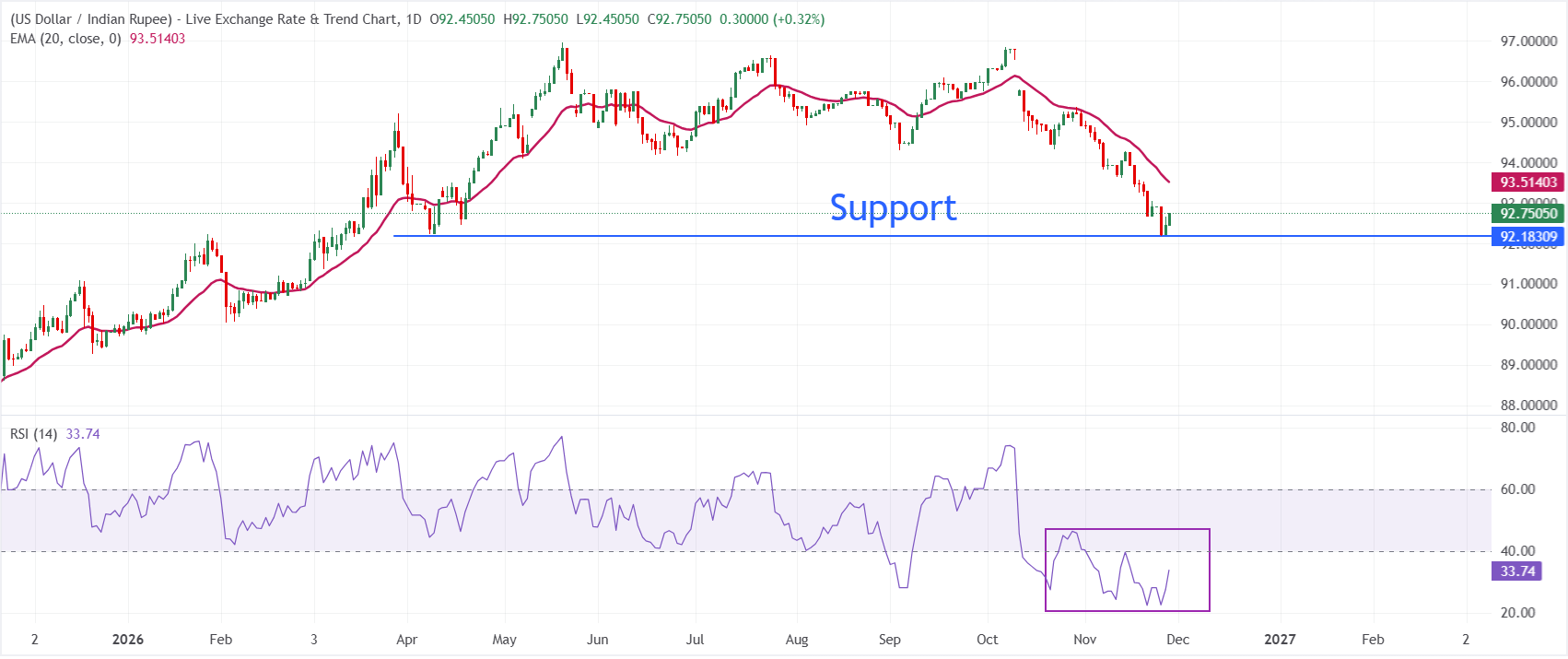
In the daily chart, USD/INR trades at 92.75, keeping a bearish near-term tone as it remains under the 20-day Exponential Moving Average (EMA) at 93.51. The pair’s inability to reclaim this overhead EMA suggests rallies are still being capped by short-term trend resistance, while the Relative Strength Index (RSI) at 33.74 has bounced from oversold territory but stays below the mid-50s area, hinting at only modest stabilization rather than a decisive reversal.
On the topside, immediate resistance is located at the 20-day EMA near 93.51, and a sustained break above this level would be needed to ease current downside pressure and open the door for a broader corrective rebound. Looking down, the November 25 low at 92.18 is the key support level.
(The technical analysis of this story was written with the help of an AI tool. Know more.)
Indian Rupee FAQs
The Indian Rupee (INR) is one of the most sensitive currencies to external factors. The price of Crude Oil (the country is highly dependent on imported Oil), the value of the US Dollar – most trade is conducted in USD – and the level of foreign investment, are all influential. Direct intervention by the Reserve Bank of India (RBI) in FX markets to keep the exchange rate stable, as well as the level of interest rates set by the RBI, are further major influencing factors on the Rupee.
The Reserve Bank of India (RBI) actively intervenes in forex markets to maintain a stable exchange rate, to help facilitate trade. In addition, the RBI tries to maintain the inflation rate at its 4% target by adjusting interest rates. Higher interest rates usually strengthen the Rupee. This is due to the role of the ‘carry trade’ in which investors borrow in countries with lower interest rates so as to place their money in countries’ offering relatively higher interest rates and profit from the difference.
Macroeconomic factors that influence the value of the Rupee include inflation, interest rates, the economic growth rate (GDP), the balance of trade, and inflows from foreign investment. A higher growth rate can lead to more overseas investment, pushing up demand for the Rupee. A less negative balance of trade will eventually lead to a stronger Rupee. Higher interest rates, especially real rates (interest rates less inflation) are also positive for the Rupee. A risk-on environment can lead to greater inflows of Foreign Direct and Indirect Investment (FDI and FII), which also benefit the Rupee.
Higher inflation, particularly, if it is comparatively higher than India’s peers, is generally negative for the currency as it reflects devaluation through oversupply. Inflation also increases the cost of exports, leading to more Rupees being sold to purchase foreign imports, which is Rupee-negative. At the same time, higher inflation usually leads to the Reserve Bank of India (RBI) raising interest rates and this can be positive for the Rupee, due to increased demand from international investors. The opposite effect is true of lower inflation.
추천 기사


