


New Zealand Dollar rebounds from 2009 low ahead of confidence data
- NZD/USD is up for a second session after ten straight falls to a 17-year low.
- The RBNZ's rate is 2.75%, at least a full point below the Fed's rate, which is set to hike.
- ANZ-Roy Morgan consumer confidence is due Thursday, with US markets on holiday.
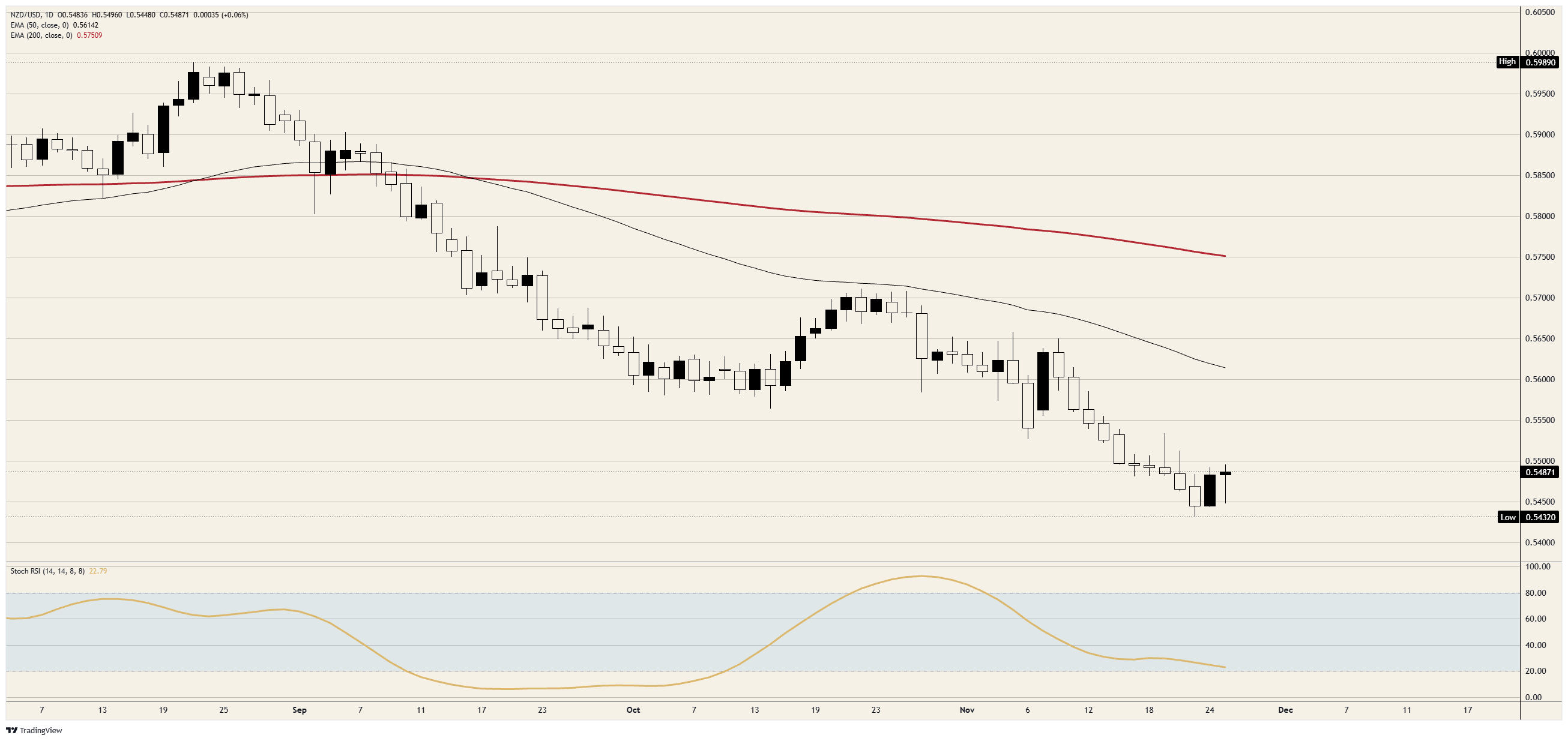
Ten falling sessions in a row took NZD/USD to its lowest since March 2009 on Monday, and the two sessions since have recovered about a quarter of that run. It fell to near 0.5450 on Wednesday without reaching Monday's low and is trading just under 0.5500. The run had a rate gap behind it that Wednesday's US data did nothing to narrow.
The Reserve Bank of New Zealand (RBNZ) left its rate at 2.75% on October 28 in a 4-3 vote, when a hike was almost fully priced. The Fed's rate is 3.75%-4.00% and a December hike is priced near 94%, which would stretch a gap of 1.00-1.25 points by another quarter-point. US third-quarter growth of 4.3%, against a 3.4% forecast, gave traders no reason to doubt it.
NZD/USD fell on Wednesday as selling in artificial intelligence (AI) stocks ran from Asia to New York, with South Korea's Kospi down 6.2% and Japan's Nikkei 225 down 2.8%. The US also proposed new tariffs on China, New Zealand's biggest export market, and 13 other economies. NZD/USD recovered when US stocks did, as the Dow Jones Industrial Average erased a more than 2% drop.
On the calendar
ANZ-Roy Morgan consumer confidence for November comes out at 21:00 GMT on Thursday, after 96.2 in October, with US markets off for Thanksgiving and Fed speeches stopping from Saturday. The RBNZ's next decision is on December 9, the same day as the Fed's, so both sides of NZD/USD's rate gap are set on one day.
On the charts
The run to Monday's low started from the November 10 high near 0.5650, and it all took place below the 50-day Exponential Moving Average (EMA), now just above 0.5600. The 200-day EMA is near 0.5750, and NZD/USD last traded above it in early September. Daily momentum has been falling since late October and is close to oversold.
NZD/USD daily chart
New Zealand Dollar FAQs
The New Zealand Dollar (NZD), also known as the Kiwi, is a well-known traded currency among investors. Its value is broadly determined by the health of the New Zealand economy and the country’s central bank policy. Still, there are some unique particularities that also can make NZD move. The performance of the Chinese economy tends to move the Kiwi because China is New Zealand’s biggest trading partner. Bad news for the Chinese economy likely means less New Zealand exports to the country, hitting the economy and thus its currency. Another factor moving NZD is dairy prices as the dairy industry is New Zealand’s main export. High dairy prices boost export income, contributing positively to the economy and thus to the NZD.
The Reserve Bank of New Zealand (RBNZ) aims to achieve and maintain an inflation rate between 1% and 3% over the medium term, with a focus to keep it near the 2% mid-point. To this end, the bank sets an appropriate level of interest rates. When inflation is too high, the RBNZ will increase interest rates to cool the economy, but the move will also make bond yields higher, increasing investors’ appeal to invest in the country and thus boosting NZD. On the contrary, lower interest rates tend to weaken NZD. The so-called rate differential, or how rates in New Zealand are or are expected to be compared to the ones set by the US Federal Reserve, can also play a key role in moving the NZD/USD pair.
Macroeconomic data releases in New Zealand are key to assess the state of the economy and can impact the New Zealand Dollar’s (NZD) valuation. A strong economy, based on high economic growth, low unemployment and high confidence is good for NZD. High economic growth attracts foreign investment and may encourage the Reserve Bank of New Zealand to increase interest rates, if this economic strength comes together with elevated inflation. Conversely, if economic data is weak, NZD is likely to depreciate.
The New Zealand Dollar (NZD) tends to strengthen during risk-on periods, or when investors perceive that broader market risks are low and are optimistic about growth. This tends to lead to a more favorable outlook for commodities and so-called ‘commodity currencies’ such as the Kiwi. Conversely, NZD tends to weaken at times of market turbulence or economic uncertainty as investors tend to sell higher-risk assets and flee to the more-stable safe havens.
추천 기사


