


Yen holds under 160.00 with Tokyo CPI due on a US holiday
- USD/JPY is just above 159.00 with no daily close above 160.00 since September 1.
- BoJ signals a December hike while a Fed hike the week before is priced in.
- Tokyo CPI for November is due Thursday, with US markets shut for Thanksgiving.
Intervention warnings at 160.00 and a Fed that is still hiking have kept USD/JPY in a band of less than 200 pips since November 11. The pair fell for one session on Friday after Japan's inflation figures and has risen in both sessions since. It's trading just above 159.00, and every daily close since September 1 has been below 160.00.
Japan's inflation rose to 2.3% in October from 2.1%, and core inflation of 2.2% was above the Bank of Japan's (BoJ) 2% goal for a second month. BoJ Governor Ueda told parliament on November 19 that the bank expects to keep raising rates, and markets are pricing in a move from 1.25% to 1.50% at the December 17-18 meeting. That expectation is why USD/JPY fell on Friday.
The Fed meets first, on December 8-9, and a quarter-point hike from 3.75%-4.00% is priced above 95%, so a BoJ hike a week later would leave the gap between the two rates unchanged. Finance Minister Katayama said on November 13 that she saw one-sided, rapid moves and would coordinate with the US Treasury, which joined Japan in buying Yen on July 31. USD/JPY hasn't traded above 160.50 since.
On the calendar
Tokyo's Consumer Price Index (CPI) for November is due at 23:30 GMT on Thursday, the first November price figure the BoJ gets before its December decision. It comes out while US markets are on their Thanksgiving break.
October's US Personal Consumption Expenditures Price Index (PCE) is out at 13:30 GMT on Wednesday, and the Fed's pre-meeting quiet period starts on November 28. Both central banks then decide within nine days of each other, and USD/JPY has followed the gap between their rates.
On the charts
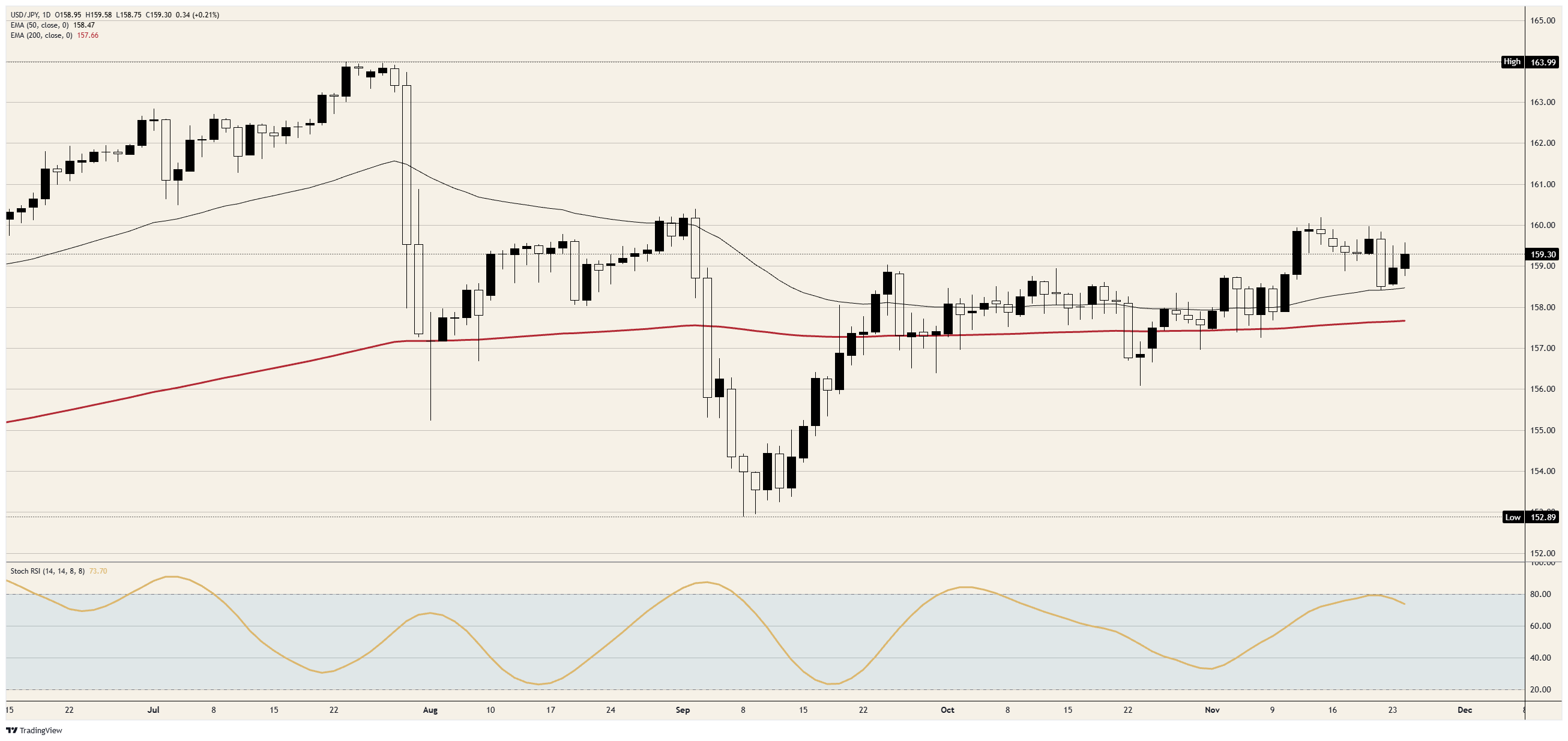
Friday's fall stopped at the 50-day Exponential Moving Average (EMA) near 158.50, with the 200-day just under 158.00. USD/JPY fell from just above 160.00 to 153.00 in a week in early September and didn't trade at 160.00 again until November 12. Daily momentum has turned down from just short of overbought.
USD/JPY daily chart
Japanese Yen FAQs
The Japanese Yen (JPY) is one of the world’s most traded currencies. Its value is broadly determined by the performance of the Japanese economy, but more specifically by the Bank of Japan’s policy, the differential between Japanese and US bond yields, or risk sentiment among traders, among other factors.
One of the Bank of Japan’s mandates is currency control, so its moves are key for the Yen. The BoJ has directly intervened in currency markets sometimes, generally to lower the value of the Yen, although it refrains from doing it often due to political concerns of its main trading partners. The BoJ ultra-loose monetary policy between 2013 and 2024 caused the Yen to depreciate against its main currency peers due to an increasing policy divergence between the Bank of Japan and other main central banks. More recently, the gradually unwinding of this ultra-loose policy has given some support to the Yen.
Over the last decade, the BoJ’s stance of sticking to ultra-loose monetary policy has led to a widening policy divergence with other central banks, particularly with the US Federal Reserve. This supported a widening of the differential between the 10-year US and Japanese bonds, which favored the US Dollar against the Japanese Yen. The BoJ decision in 2024 to gradually abandon the ultra-loose policy, coupled with interest-rate cuts in other major central banks, is narrowing this differential.
The Japanese Yen is often seen as a safe-haven investment. This means that in times of market stress, investors are more likely to put their money in the Japanese currency due to its supposed reliability and stability. Turbulent times are likely to strengthen the Yen’s value against other currencies seen as more risky to invest in.
추천 기사


