


The Japanese Yen gives back more of its rally as the Fed raises rates
- USD/JPY is up three sessions running and has recovered half of its September drop.
- Bank of Japan decides Friday, with a hike to 1.25% priced at 100%.
- Japan's national inflation figures for August are out Thursday at 23:30 GMT.
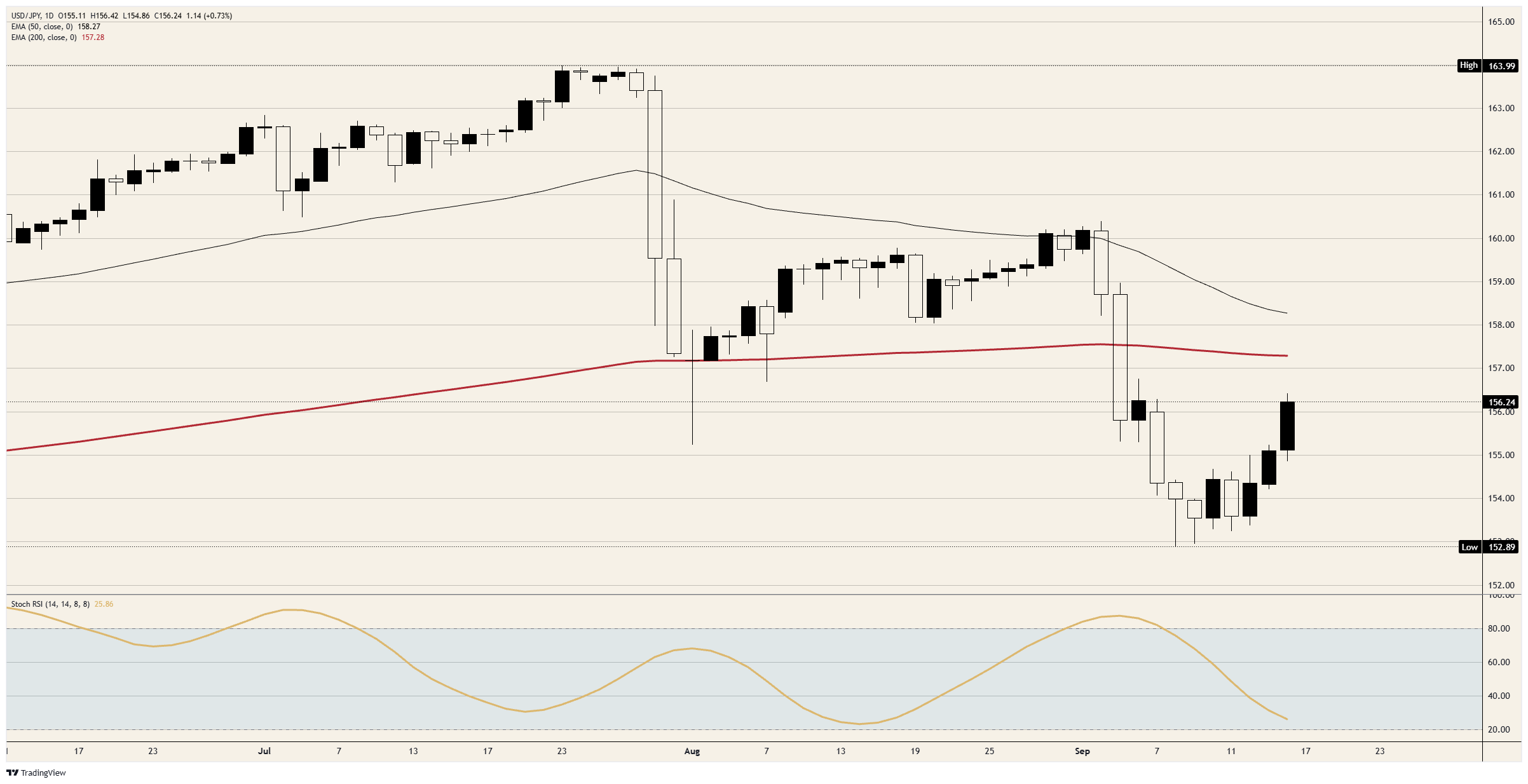
The Bank of Japan meets on Friday, and the market has a quarter-point hike to 1.25% priced at 100%. The Yen has been falling anyway. USD/JPY is up three sessions in a row, Wednesday's gain was the biggest of the three, and the pair is trading just under 156.50 after the Fed's hike to 3.75-4.00%. That puts it roughly halfway back from the September low near 153.00 to where it started the month near 160.00.
Both central banks are raising and the gap barely moves
Japan's policy rate is 1%, the highest since 1995, and Friday's expected move takes it to 1.25%. The Fed's midpoint is now 3.875%. So after both moves the gap between the two is about two and five-eighths points, and it was about two and five-eighths points before either of them did anything. The market has the BoJ at 1.48% by December and 1.85% by the middle of 2027, while the Fed's forecasts have its rate at 4.1% at the end of 2027 with no cuts before then. Two quarter-point hikes in the same week do nothing to a gap that size, which is why a Yen that rallied about 4% in the first half of September on hike expectations has given more than half of it back since.
Thursday's inflation figures set up Friday's press conference
Japan's national consumer prices for August are due on Thursday at 23:30 GMT, with the measure excluding fresh food forecast at 1.8%, the same as July. That's below the BoJ's 2% target and it's the number BoJ Governor Ueda will be asked about on Friday, since a bank raising rates with inflation under target has some explaining to do. The BoJ decision has no fixed time on Friday and the press conference is at 06:30 GMT. Wholesale prices rose 7.6% in the year to August, which is the BoJ's argument that consumer inflation is coming. Momentum on the daily chart has turned up from its September low but is still in the lower third of its range, so the rebound is early rather than stretched. The Fed's part is done. From here the pair moves on what the BoJ says about December.
Levels and bias
Resistance: 156.50, just above Wednesday's high, then the 200-day Exponential Moving Average (EMA) just under 157.50, then 158.00, the bottom of the range the pair was in through late August.
Support: 155.00, near Wednesday's low, then 154.00, then the September low near 153.00.
Bias: Bullish above 155.00. The first objective is the 200-day EMA just under 157.50 and the second is 158.00. The daily Stochastic Relative Strength Index (Stoch RSI), a momentum gauge, is at 26 and rising, so the rebound has room. If the pair has a daily close below 154.00, the bullish case is over.
USD/JPY daily chart
Japanese Yen FAQs
The Japanese Yen (JPY) is one of the world’s most traded currencies. Its value is broadly determined by the performance of the Japanese economy, but more specifically by the Bank of Japan’s policy, the differential between Japanese and US bond yields, or risk sentiment among traders, among other factors.
One of the Bank of Japan’s mandates is currency control, so its moves are key for the Yen. The BoJ has directly intervened in currency markets sometimes, generally to lower the value of the Yen, although it refrains from doing it often due to political concerns of its main trading partners. The BoJ ultra-loose monetary policy between 2013 and 2024 caused the Yen to depreciate against its main currency peers due to an increasing policy divergence between the Bank of Japan and other main central banks. More recently, the gradually unwinding of this ultra-loose policy has given some support to the Yen.
Over the last decade, the BoJ’s stance of sticking to ultra-loose monetary policy has led to a widening policy divergence with other central banks, particularly with the US Federal Reserve. This supported a widening of the differential between the 10-year US and Japanese bonds, which favored the US Dollar against the Japanese Yen. The BoJ decision in 2024 to gradually abandon the ultra-loose policy, coupled with interest-rate cuts in other major central banks, is narrowing this differential.
The Japanese Yen is often seen as a safe-haven investment. This means that in times of market stress, investors are more likely to put their money in the Japanese currency due to its supposed reliability and stability. Turbulent times are likely to strengthen the Yen’s value against other currencies seen as more risky to invest in.
추천 기사


