


The Euro waits for the sentence after the rate hike
- EUR/USD holds above 1.1600 after a 28-pip session range, up 0.10%.
- All 65 economists in the Reuters poll expect an ECB hike on Thursday.
- Futures price a third hike to 2.75% and the surveyed economists do not.
EUR/USD holds above 1.1600 after a Monday that covered 28 pips. The Eurozone revised second-quarter growth up to 0.6% against a 0.4% consensus, the Sentix investor survey jumped to 5.1 from 0.9, and the pair added a tenth of a percent. Both central banks are priced to raise rates this month for the same energy shock, and a rate gap that is not moving does not move a currency.
Neither side's best number lasted the session
Monday's Eurozone releases landed at 08:30 GMT and 09:00 GMT, and EUR/USD spiked to a high short of 1.1650 within the half hour. It was back where it started inside the following hour. The revision was built on trade, which added 0.9 percentage points to the quarter while inventories subtracted half a point. A currency rallying on an export-led beat is bidding up the thing that would undo it.
Friday ran the same experiment for the Dollar. Nonfarm payrolls printed 162K against a 53K consensus and EUR/USD fell roughly 40 pips to just beneath 1.1600 on the 12:30 GMT release. The move was gone by the New York afternoon. The Dollar Index sits at two-week lows on Monday, and the weakness has gone to the Yen rather than to the Euro.
Sixty-five out of sixty-five
The European Central Bank (ECB) announces at 12:15 GMT on Thursday and is expected to lift the deposit rate to 2.5% and the main refinancing rate to 2.65%. Every one of the 65 economists in the Reuters survey taken between August 31 and September 3 expects it, up from 83% of them in August. Consensus that complete is a description rather than a forecast.
Which is why the decision cannot move the pair far. A 2.5% deposit rate is the top of the range most estimates put at neutral, between 1.75% and 2.5%, so Thursday finishes the journey to neutral and goes no further. Everything past it is a deliberate choice to restrict demand rather than to contain a price shock. The Federal Reserve is being repriced for the same barrel of Crude Oil, which is why the pair has gone nowhere for three weeks while both curves moved.
Frankfurt is arguing with the market and with itself
Neither side is arguing about Thursday. The argument is whether the 2% deposit rate the ECB left behind in June was the floor of a short defensive move or the base of a cycle. Interest rate futures price a third increase to 2.75%. The economists in that same survey do not, which leaves the curve and the forecasting community holding opposite views on the only question Thursday can answer. The July minutes record some Governing Council members favouring a move into mildly restrictive territory.
The bank's own research has been arguing the other way. An ECB blog post this month made the case that the energy shock has not fed into non-energy inflation the way it did in 2022, which is the argument for stopping at neutral. Headline inflation is 3.3%, new staff projections arrive with the decision, and desks expect them broadly unchanged. The institution is publishing the case against the path the market has priced for it.
Thursday lunchtime, then Friday lunchtime
The two events that matter land 24 hours apart. Rates and the statement come at 12:15 GMT Thursday and the press conference at 12:45 GMT, with the United States Producer Price Index (PPI) printing in between at 12:30 GMT, seen at 0.4% on the month after a flat July and 5.3% YoY after 4.7%. The ECB President then speaks again at 14:00 GMT Friday and on Saturday morning. Everything the pair has refused to do for three weeks is scheduled for two consecutive lunchtimes.
Friday belongs to the Dollar leg. The Consumer Price Index (CPI) at 12:30 GMT is seen at 0.4% on the month after 0.1%, with the annual rate steady at 3.4% and the core measure easing to 2.4%, and it is the last inflation print before the Federal Reserve meets September 15-16 with a hike priced near 58%. A soft American number and a hint from Frankfurt that neutral is not the destination is the combination that takes EUR/USD through 1.1700. A hot number and no guidance sends it back to the moving averages.
Levels and bias
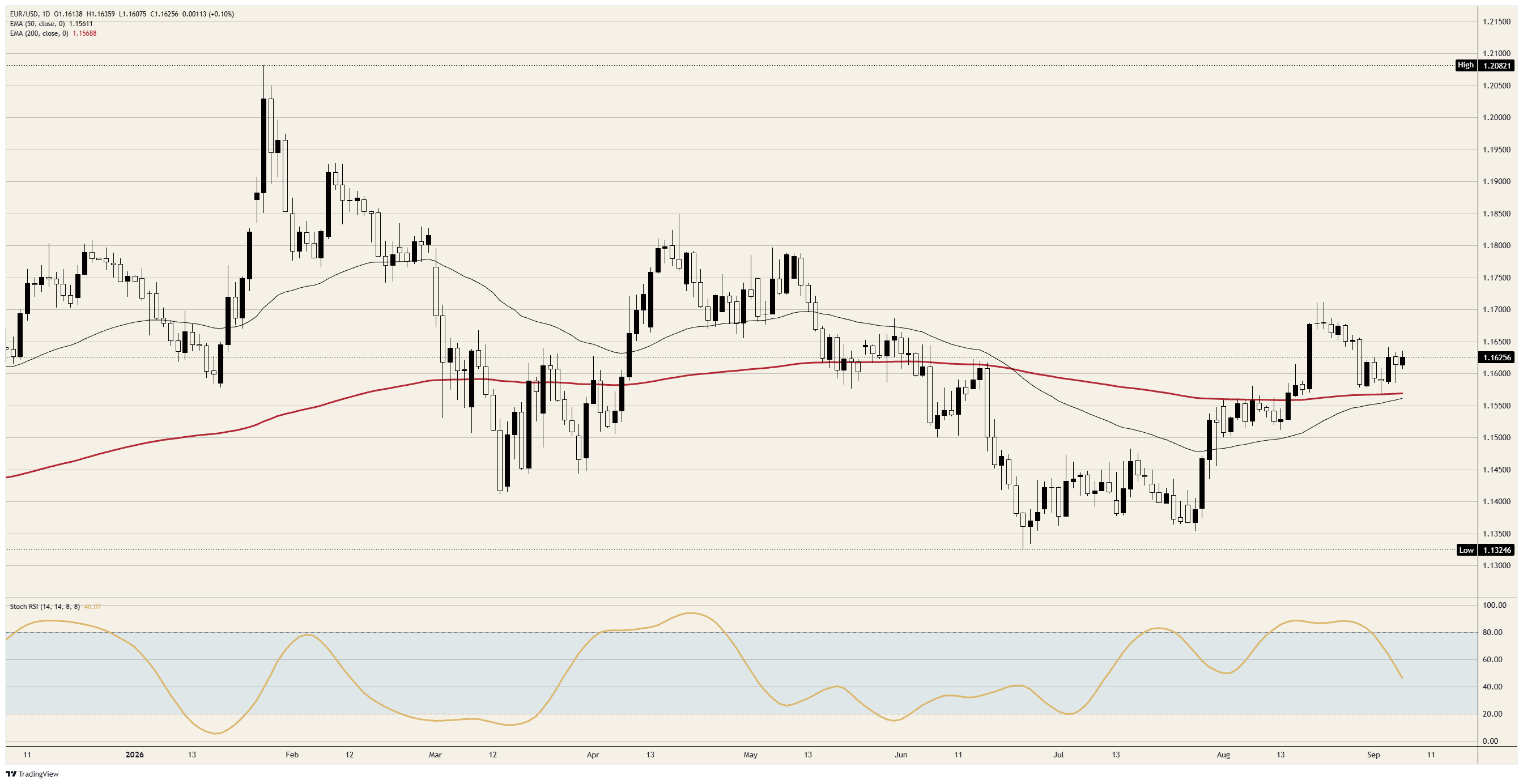
Resistance: The 1.1650 area caps the range and Monday's high stopped short of it again. Above that, the late-August peak just under 1.1700 is what defines the whole three-week range, and a daily close through it opens 1.1750 and then the May highs in the 1.1800 area.
Support: The 1.1600 handle held through Monday, and Friday's payrolls low sat just beneath it without closing there. Under it the 50-day and 200-day Exponential Moving Averages (EMA) sit within eight pips of each other just above 1.1550, which puts the entire downside case in one place. Beneath them 1.1500 is the next round figure, with the early-August base below that.
Bias: Bearish while 1.1650 caps, with the EMA cluster just above 1.1550 the objective. The daily Stochastic Relative Strength Index (Stoch RSI) has fallen from above 85 to 46 in four sessions while price held its range, which is momentum leaving without price following it yet, and the intraday reading near 43 gives a bounce nothing to work with. The scheduled risk points the same way: the curve is priced for more tightening than any surveyed economist expects, and Friday's inflation consensus is hot enough to restore the Fed hike. A daily close above 1.1650 invalidates the call and puts 1.1700 back in play.
EUR/USD daily chart
Euro FAQs
The Euro is the currency for the 20 European Union countries that belong to the Eurozone. It is the second most heavily traded currency in the world behind the US Dollar. In 2022, it accounted for 31% of all foreign exchange transactions, with an average daily turnover of over $2.2 trillion a day. EUR/USD is the most heavily traded currency pair in the world, accounting for an estimated 30% off all transactions, followed by EUR/JPY (4%), EUR/GBP (3%) and EUR/AUD (2%).
The European Central Bank (ECB) in Frankfurt, Germany, is the reserve bank for the Eurozone. The ECB sets interest rates and manages monetary policy. The ECB’s primary mandate is to maintain price stability, which means either controlling inflation or stimulating growth. Its primary tool is the raising or lowering of interest rates. Relatively high interest rates – or the expectation of higher rates – will usually benefit the Euro and vice versa. The ECB Governing Council makes monetary policy decisions at meetings held eight times a year. Decisions are made by heads of the Eurozone national banks and six permanent members, including the President of the ECB, Christine Lagarde.
Eurozone inflation data, measured by the Harmonized Index of Consumer Prices (HICP), is an important econometric for the Euro. If inflation rises more than expected, especially if above the ECB’s 2% target, it obliges the ECB to raise interest rates to bring it back under control. Relatively high interest rates compared to its counterparts will usually benefit the Euro, as it makes the region more attractive as a place for global investors to park their money.
Data releases gauge the health of the economy and can impact on the Euro. Indicators such as GDP, Manufacturing and Services PMIs, employment, and consumer sentiment surveys can all influence the direction of the single currency. A strong economy is good for the Euro. Not only does it attract more foreign investment but it may encourage the ECB to put up interest rates, which will directly strengthen the Euro. Otherwise, if economic data is weak, the Euro is likely to fall. Economic data for the four largest economies in the euro area (Germany, France, Italy and Spain) are especially significant, as they account for 75% of the Eurozone’s economy.
Another significant data release for the Euro is the Trade Balance. This indicator measures the difference between what a country earns from its exports and what it spends on imports over a given period. If a country produces highly sought after exports then its currency will gain in value purely from the extra demand created from foreign buyers seeking to purchase these goods. Therefore, a positive net Trade Balance strengthens a currency and vice versa for a negative balance.
추천 기사


