


Tokyo reaching 2% is not enough for the Japanese Yen
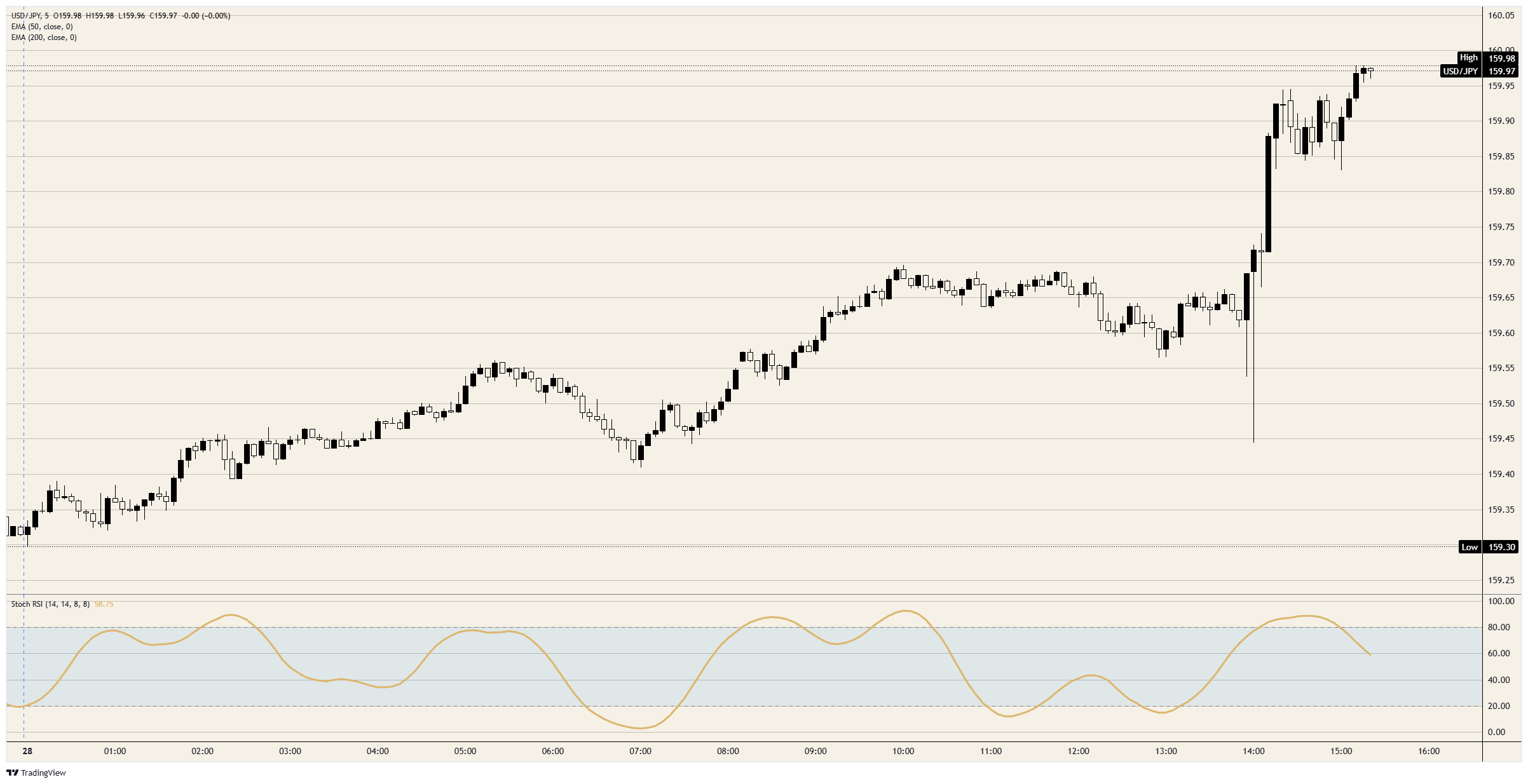
- USD/JPY presses the 160.00 handle at the session high, a fifth straight gain.
- Tokyo inflation excluding food and energy reached 2% in August, from 1.8%.
- A September Fed increase prices above 55%, its first outright majority.
Japan delivered the inflation and labour data the Bank of Japan needs to move next month and the Japanese Yen is weaker for a fifth consecutive session. Tokyo Consumer Price Index (CPI) inflation excluding food and energy reached 2% in August, the headline rate rose to 1.9%, and unemployment fell to 2.4% against a 2.5% forecast. USD/JPY presses the 160.00 handle regardless, at the high of the day.
The print the Bank of Japan needed
The measure policy actually follows, Tokyo prices excluding fresh food, rose 1.8% against a 1.7% consensus and a 1.7% prior, a third consecutive month of acceleration. Government electricity and gas subsidies, reinstated as the Gulf supply disruption pushed fuel costs higher, will suppress the headline rate through the October data, which makes the 2% reading on the ex-energy measure the honest one. Unemployment at 2.4% is the lowest in a year.
Wire reporting through the month has the policy board weighing an increase on September 18 and considering a faster pace than the roughly twice-yearly cadence it has kept since 2024, when it began unwinding a decade of stimulus. Five-year Japanese government bond yields have printed a record high on that speculation, and the June move took the policy rate to a 31-year high. None of it has bought the currency a single session.
Two increases leave one gap
The Federal Reserve chair used his first Jackson Hole keynote to warn that the committee still has work ahead of it while it lacks confidence that underlying inflation is returning to 2%, and futures moved on it. A quarter-point increase on September 16 now prices above 55%, the first outright majority of the cycle, with at least one increase near 85% by October 28 and a second running close to 38% by December 9. The same 14:00 GMT block carried year-ahead consumer inflation expectations falling to 4% against a 4.3% consensus, which the tape ignored entirely, and USD/JPY added roughly 50 pips inside twenty minutes.
The Bank of Japan decides two days after that, and the arithmetic is the problem. A move to 1.25% against a Federal Reserve range of 3.75% to 4.00% leaves the same gap of roughly 250 basis points that exists today. Two central banks tightening on consecutive days changes the level of rates in both countries and changes nothing about the reason to borrow one currency and hold the other.
The only outcome that pays the Japanese Yen is a Japanese increase against an American hold, and futures put that hold at 44% on its own. Every other branch either widens the gap or leaves it where it is, which is a poor return profile for anyone selling the carry trade on the strength of Japanese data.
The defence has a bond problem
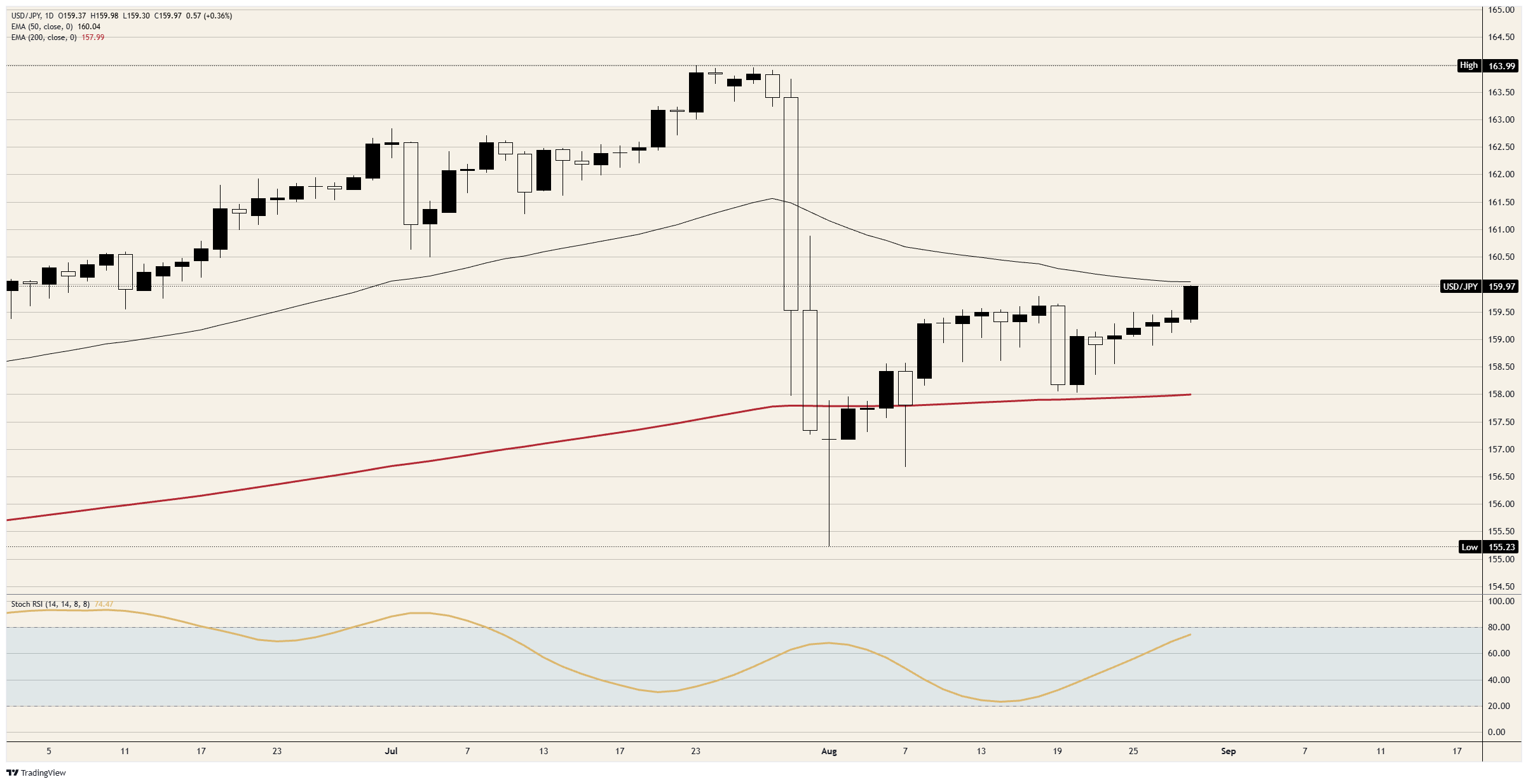
Behind the price sits the July 31 operation, a joint Japanese and American Yen purchase and the first coordinated intervention between the two since 2011. Tokyo has said it will not hesitate to repeat it. The scale was the largest single session on record at 8.45 trillion Yen, with roughly 5.3 trillion more following in coordination, and it dragged the pair from just short of 164.00 into the 155.00 area.
Washington's interest in that operation is not friendship. A solo Japanese defence is funded by selling American government bonds, and June holdings data already showed Japan cutting 26.4 billion Dollars of Treasuries while the currency was being defended, inside a total foreign reduction of 72.1 billion Dollars. With thirty-year yields near their highest since 2007, the cheapest way to stop Tokyo selling duration is to lend it Dollars instead. The Yen defence and the long-end problem are the same trade.
What resolves it
The symposium runs through August 29 and Bank of Japan officials speak into the run-up to their decision, including a briefing after a Group of Twenty meeting in the United States next week. American payrolls land September 4, and the two policy decisions arrive two days apart in the middle of the month. Until then the Japanese Yen is a bet on the Federal Reserve stopping, not on Tokyo delivering.
Levels to watch
Resistance: The 160.00 handle and the 50-day Exponential Moving Average (EMA) sit on the same line, and the session high stops just underneath both. Above there 161.00 is the first shelf, with the 162.00 to 163.00 zone that drew the July operation and the cycle high just short of 164.00 beyond it.
Support: The session floor lies just under 159.50, with 158.50 the base of last week's range beneath it. The 200-day EMA near 158.00 is rising and marks the floor the August recovery was built on.
Bias: Bullish while 159.50 holds, with the daily Stochastic Relative Strength Index (Stoch RSI) near 74 climbing through the upper band. A daily close above 160.00 opens 161.00. Invalidation on a daily close beneath 158.50, and above 162.00 the cap is policy rather than price.
USD/JPY 5-minute chart
USD/JPY daily chart
Japanese Yen FAQs
The Japanese Yen (JPY) is one of the world’s most traded currencies. Its value is broadly determined by the performance of the Japanese economy, but more specifically by the Bank of Japan’s policy, the differential between Japanese and US bond yields, or risk sentiment among traders, among other factors.
One of the Bank of Japan’s mandates is currency control, so its moves are key for the Yen. The BoJ has directly intervened in currency markets sometimes, generally to lower the value of the Yen, although it refrains from doing it often due to political concerns of its main trading partners. The BoJ ultra-loose monetary policy between 2013 and 2024 caused the Yen to depreciate against its main currency peers due to an increasing policy divergence between the Bank of Japan and other main central banks. More recently, the gradually unwinding of this ultra-loose policy has given some support to the Yen.
Over the last decade, the BoJ’s stance of sticking to ultra-loose monetary policy has led to a widening policy divergence with other central banks, particularly with the US Federal Reserve. This supported a widening of the differential between the 10-year US and Japanese bonds, which favored the US Dollar against the Japanese Yen. The BoJ decision in 2024 to gradually abandon the ultra-loose policy, coupled with interest-rate cuts in other major central banks, is narrowing this differential.
The Japanese Yen is often seen as a safe-haven investment. This means that in times of market stress, investors are more likely to put their money in the Japanese currency due to its supposed reliability and stability. Turbulent times are likely to strengthen the Yen’s value against other currencies seen as more risky to invest in.
추천 기사


