


The Japanese Yen gives back half of a record intervention
- USD/JPY trades just beneath 159.50, four Yen off the intervention low.
- Tokyo sold a record 8.45 trillion Yen in a single session on July 30.
- The Bank of Japan sits at 1.00% against a Fed upper bound of 3.75%.
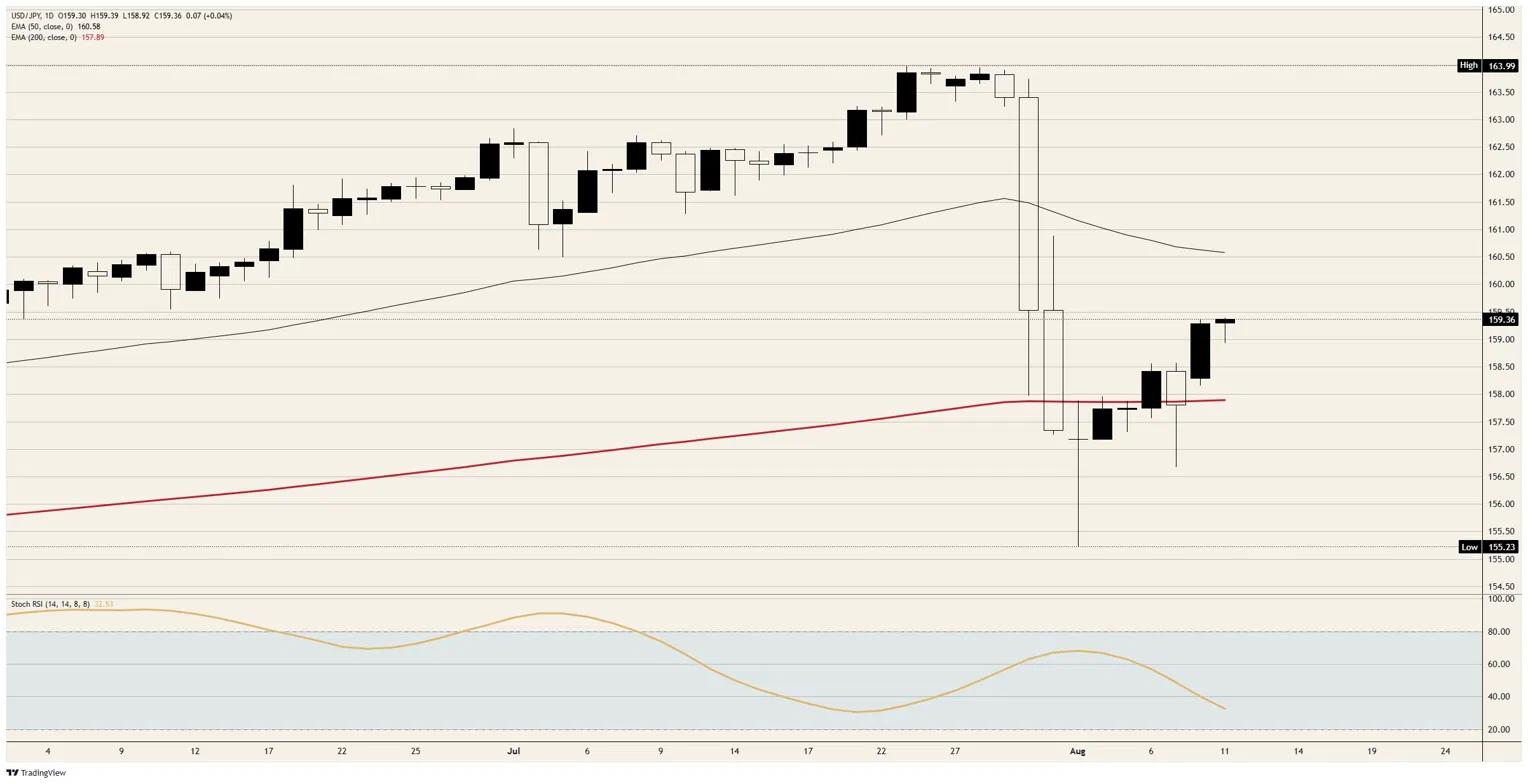
USD/JPY trades just beneath 159.50 on Tuesday August 11, effectively unchanged inside a 47-pip range, wedged between a reclaimed 200-day moving average near 158.00 and a declining 50-day near 160.50. The operation that put it down here was the largest on record, run across July 30 and July 31, and a little over half of what it delivered has already been handed back.
That giveback, rather than the intervention itself, is what the next month turns on. The market has taken back better than four Yen of a nine-Yen move, the 160.00 handle sits within a session's reach, and the American inflation print capable of reopening the whole distance arrives on Wednesday.
The arithmetic of the giveback
The pre-intervention peak came just short of 164.00, a level the Dollar had not commanded against the Yen since December 1986. The low that followed printed near 155.00. That is close to nine Yen of engineered move, bought with a record 8.45 trillion Yen in one session and roughly 5.3 trillion more the following day in coordination with the American Treasury.
Seven trading sessions have returned better than four of those nine Yen, putting the pair back above its 200-day moving average and inside striking distance of the handle it lost on the announcement. Interventions are judged on whether the level holds rather than on the headline size of the cheque, and by that standard this one is already halfway to a failure.
What the operation did not buy
Intervention changes the price of the Yen without changing the reason to sell it, and the reason is a policy rate at 1.00% against an American upper bound of 3.75%. The Bank of Japan left settings alone in the same week as the operation, and futures put the odds of its next increase a shade over even. That leaves 275 basis points of differential to narrow a quarter at a time under a committee in no hurry.
The domestic case for closing it is not obviously strengthening either. Japanese household spending fell 3.3% in June against expectations of a 1% gain, and the tightening path is complicated further by political pressure on the central bank to keep supporting the government bond market. A currency weak enough to be a political problem is not the same thing as a currency the central bank has a mandate to defend.
Silence was the old doctrine
The posture that governed this rate for years was verbal warning followed by silent ambush, with the ministry declining to confirm anything until the official record forced the issue. This operation inverted the lot. Both finance ministries confirmed it publicly, invoked a joint statement agreed last year, and committed in terms to doing it again.
The detail that matters for the next month sits in the plumbing rather than the rhetoric, because Tokyo has signalled it intends to draw Dollars through the Federal Reserve's repo facility for foreign monetary authorities, borrowing against its Treasury holdings instead of selling them. Reporting suggests Washington funded its own leg by selling Euros rather than Dollars, sparing Japan the same problem from the other side. Both choices are built for a campaign rather than a gesture, and a level defended in public is a level the market is entitled to test.
The print that reopens the gap
American Consumer Price Index (CPI) lands Wednesday August 12 at 12:30 GMT, headline seen at 0.1% MoM against a -0.4% prior and 3.4% YoY from 3.5%, core at 0.2% MoM from zero and 2.5% YoY from 2.6%. A core reading at three tenths or better revives the September increase, widens the very differential the operation was fighting, and hands the ministry the same problem with less room to work in.
Producer Price Index (PPI) follows Thursday August 13 at 12:30 GMT, seen at 0.2% MoM from -0.3% with core at 0.3%, ahead of retail sales and preliminary Michigan sentiment on Friday August 14. The Jackson Hole symposium runs August 27-29 and the Fed decides September 16, so the question is not whether 160.00 gets retested but whether Tokyo defends it before the American calendar has had its say.
Technical outlook
Resistance: The 160.00 handle is the first line, with the declining 50-day Exponential Moving Average (EMA) near 160.50 just above it and the pre-intervention peak just short of 164.00 the longer objective.
Support: 158.50 is the first floor, then the 200-day EMA near 158.00, with the intervention low near 155.00 beneath that.
Bias: Bullish while the 200-day EMA near 158.00 holds, with the 160.00 handle the objective and a daily Stochastic Relative Strength Index (Stoch RSI) near 33 leaving the grind higher plenty of room. A daily close beneath 158.00 invalidates the call and re-arms the 155.00 area.
USD/JPY daily chart
Japanese Yen FAQs
The Japanese Yen (JPY) is one of the world’s most traded currencies. Its value is broadly determined by the performance of the Japanese economy, but more specifically by the Bank of Japan’s policy, the differential between Japanese and US bond yields, or risk sentiment among traders, among other factors.
One of the Bank of Japan’s mandates is currency control, so its moves are key for the Yen. The BoJ has directly intervened in currency markets sometimes, generally to lower the value of the Yen, although it refrains from doing it often due to political concerns of its main trading partners. The BoJ ultra-loose monetary policy between 2013 and 2024 caused the Yen to depreciate against its main currency peers due to an increasing policy divergence between the Bank of Japan and other main central banks. More recently, the gradually unwinding of this ultra-loose policy has given some support to the Yen.
Over the last decade, the BoJ’s stance of sticking to ultra-loose monetary policy has led to a widening policy divergence with other central banks, particularly with the US Federal Reserve. This supported a widening of the differential between the 10-year US and Japanese bonds, which favored the US Dollar against the Japanese Yen. The BoJ decision in 2024 to gradually abandon the ultra-loose policy, coupled with interest-rate cuts in other major central banks, is narrowing this differential.
The Japanese Yen is often seen as a safe-haven investment. This means that in times of market stress, investors are more likely to put their money in the Japanese currency due to its supposed reliability and stability. Turbulent times are likely to strengthen the Yen’s value against other currencies seen as more risky to invest in.
추천 기사


