


British Pound Sterling slides for a sixth session on a Dollar story Britain had no part in
- GBP/USD trades near 1.3300 after a sixth consecutive daily decline, the weakest level since June.
- Thursday's slide carries no British catalyst, with the day's high printed before London opened and the low arriving after a US jobless claims release.
- Retail sales and flash surveys land Friday, ahead of a Federal Reserve decision on Wednesday and a Bank of England decision on Thursday.
Sterling's sixth consecutive losing session arrives without a single domestic headline behind it, and that absence is the more useful fact about Thursday than the 0.45% loss itself. GBP/USD trades near 1.3300 after setting a high just short of 1.3400 in the small hours and grinding lower through everything that followed.
The move belongs entirely to the Dollar, which is being bought for reasons that have nothing to do with Britain. A currency does not lose six sessions running on coincidence, but it can lose them without ever being the subject of the story.
A one-way session with nothing British in it
The intraday sequence rules out a domestic trigger with unusual clarity. GBP/USD posted its high just short of 1.3400 around 04:30 GMT, hours before London had anything to react to, then declined through the entire European morning against an empty UK calendar. No data, no fiscal announcement, and no policy remark landed to explain it.
Selling accelerated into the New York morning and ran until the tape printed just under 1.3300 around 15:10 GMT. The bounce that followed recovered barely 25 pips and has gone nowhere since, leaving spot pinned to the 1.3300 handle for the last six hours of the session. A currency that cannot lift off its low is not being sold on a story of its own making.
Three engines under the Dollar, all of them American
The Gulf war supplies the first engine, with reports of a threatened attack on Iran larger than anything already delivered pushing Brent above $101 and lifting the US Dollar Index by roughly 0.3% toward 101.50. An equity market repricing the cost of the artificial intelligence build-out layered on a second round of risk aversion. Sterling carries no war premium of its own to offset either.
The labour market is the second engine and the sharper one. Initial jobless claims fell to 187K against a 212K consensus and a 209K prior, the lowest weekly reading since 1969, and GBP/USD gave up roughly 50 pips in the two and a half hours following the 12:30 GMT release. A tight American labour market inside an energy shock is the combination that arms a hike.
Both central banks are being priced for tightening, and only one of them collects
Rate pricing now puts a hold at next Wednesday's Federal Reserve meeting at 66.9% and a hike at 33.1%, with the odds of at least one increase reaching 80.6% by mid-September, 86.6% by late October, and 92.2% by December. Two hikes carry a 60.0% probability by the December meeting, where the 4.00% to 4.25% band is the single most likely destination. Not one meeting on the visible curve prices a cut.
The awkward part for Sterling is that the Bank of England is being repriced in the same direction, with traders positioned for two quarter-point increases by March after the oil rebound revived the hawkish case that Wednesday's cooler inflation print had softened. Symmetric hawkishness cancels out. What remains is the war bid, and only the Dollar collects it.
Friday hands the Pound its first domestic test in two days
Retail sales for June arrive at 06:00 GMT with consensus at -0.3% MoM against a 1.2% gain previously, and the ex-fuel measure is expected at -0.4% after 1.2%. The GfK consumer confidence gauge lands first, at 23:01 GMT Thursday, improving to -17 from -23 against a -21 consensus. Households report feeling better about an economy that economists expect them to have stopped spending in.
Flash surveys follow at 08:30 GMT, and the services line is the one that matters. The UK composite Purchasing Managers Index sat at 49.3 last month with services at 48.8 and manufacturing at 52.5, an inversion that leaves the dominant share of the economy contracting while factories expand. Services inflation at 3.6% against a shrinking services sector is precisely the combination the Monetary Policy Committee has spent the summer talking around. US flash surveys at 13:45 GMT complete the comparison, manufacturing seen at 54.5 and services at 51.
The double bill lands next week
The Federal Reserve decides on Wednesday at 18:00 GMT with a press conference half an hour later, and the Bank of England follows on Thursday at 11:00 GMT with minutes, a fresh Monetary Policy Report, and a governor's speech at 11:30 GMT. Both are expected to hold at 3.75%. Both are being priced for hikes that arrive later.
The June vote split 7-2 with two members preferring 4.00%, and that same dissent bloc walks into a meeting convened after the oil shock restarted. American core personal consumption expenditure and second-quarter growth print the same Thursday, so the week carries live rate risk on both legs of the pair. Sterling walks in six sessions lower with nothing built up to absorb it.
Resistance, support, and bias
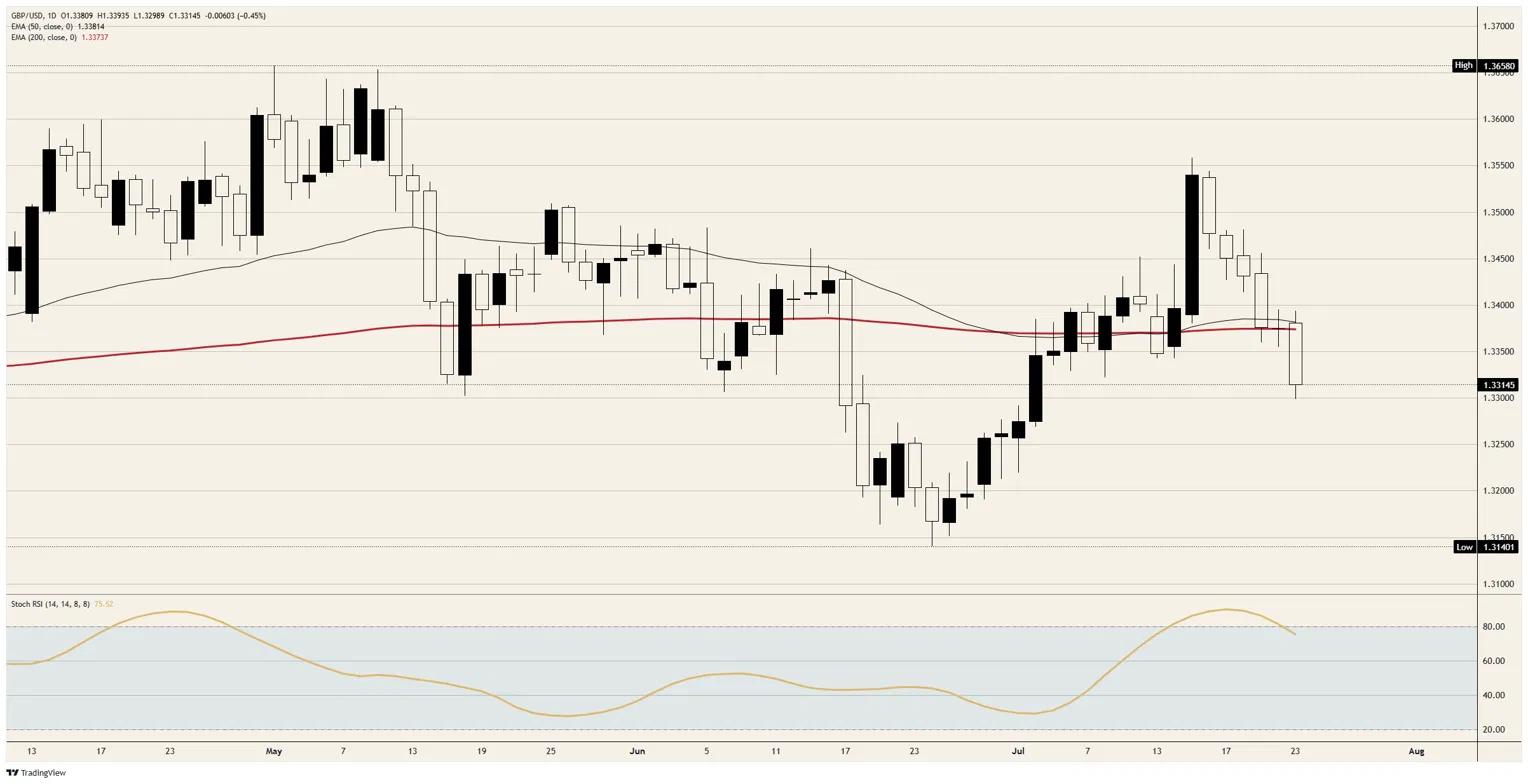
Resistance: The 50-day and 200-day Exponential Moving Averages have converged just below 1.3400, and price sits beneath both. That band was the floor through early July and now caps every attempt higher. Above it, 1.3450 comes into view, then the mid-July peak near 1.3550.
Support: The 1.3300 handle broke intraday and has not been reclaimed with any conviction. Beneath it, 1.3250 is the next shelf, then the summer base in the 1.3150 area that has held since late June.
Bias: Bearish. The daily Stochastic Relative Strength Index is rolling over from above 90 toward the mid-70s with room left to fall, and the 50-day average is on the verge of crossing beneath the 200-day. Sell strength into the 1.3400 band and target 1.3250, with a daily close back above 1.3400 the invalidation.
GBP/USD daily chart
Pound Sterling FAQs
The Pound Sterling (GBP) is the oldest currency in the world (886 AD) and the official currency of the United Kingdom. It is the fourth most traded unit for foreign exchange (FX) in the world, accounting for 12% of all transactions, averaging $630 billion a day, according to 2022 data. Its key trading pairs are GBP/USD, also known as ‘Cable’, which accounts for 11% of FX, GBP/JPY, or the ‘Dragon’ as it is known by traders (3%), and EUR/GBP (2%). The Pound Sterling is issued by the Bank of England (BoE).
The single most important factor influencing the value of the Pound Sterling is monetary policy decided by the Bank of England. The BoE bases its decisions on whether it has achieved its primary goal of “price stability” – a steady inflation rate of around 2%. Its primary tool for achieving this is the adjustment of interest rates. When inflation is too high, the BoE will try to rein it in by raising interest rates, making it more expensive for people and businesses to access credit. This is generally positive for GBP, as higher interest rates make the UK a more attractive place for global investors to park their money. When inflation falls too low it is a sign economic growth is slowing. In this scenario, the BoE will consider lowering interest rates to cheapen credit so businesses will borrow more to invest in growth-generating projects.
Data releases gauge the health of the economy and can impact the value of the Pound Sterling. Indicators such as GDP, Manufacturing and Services PMIs, and employment can all influence the direction of the GBP. A strong economy is good for Sterling. Not only does it attract more foreign investment but it may encourage the BoE to put up interest rates, which will directly strengthen GBP. Otherwise, if economic data is weak, the Pound Sterling is likely to fall.
Another significant data release for the Pound Sterling is the Trade Balance. This indicator measures the difference between what a country earns from its exports and what it spends on imports over a given period. If a country produces highly sought-after exports, its currency will benefit purely from the extra demand created from foreign buyers seeking to purchase these goods. Therefore, a positive net Trade Balance strengthens a currency and vice versa for a negative balance.
추천 기사


