


Japanese Yen finds the line in the sand is mostly sand
- USD/JPY erased last week's intervention scare and is back within reach of its cycle high.
- Tokyo has stopped drawing lines and gone quiet, which is itself the new intervention strategy.
- Wage data tonight and FOMC Minutes on Wednesday are the week's two tests.
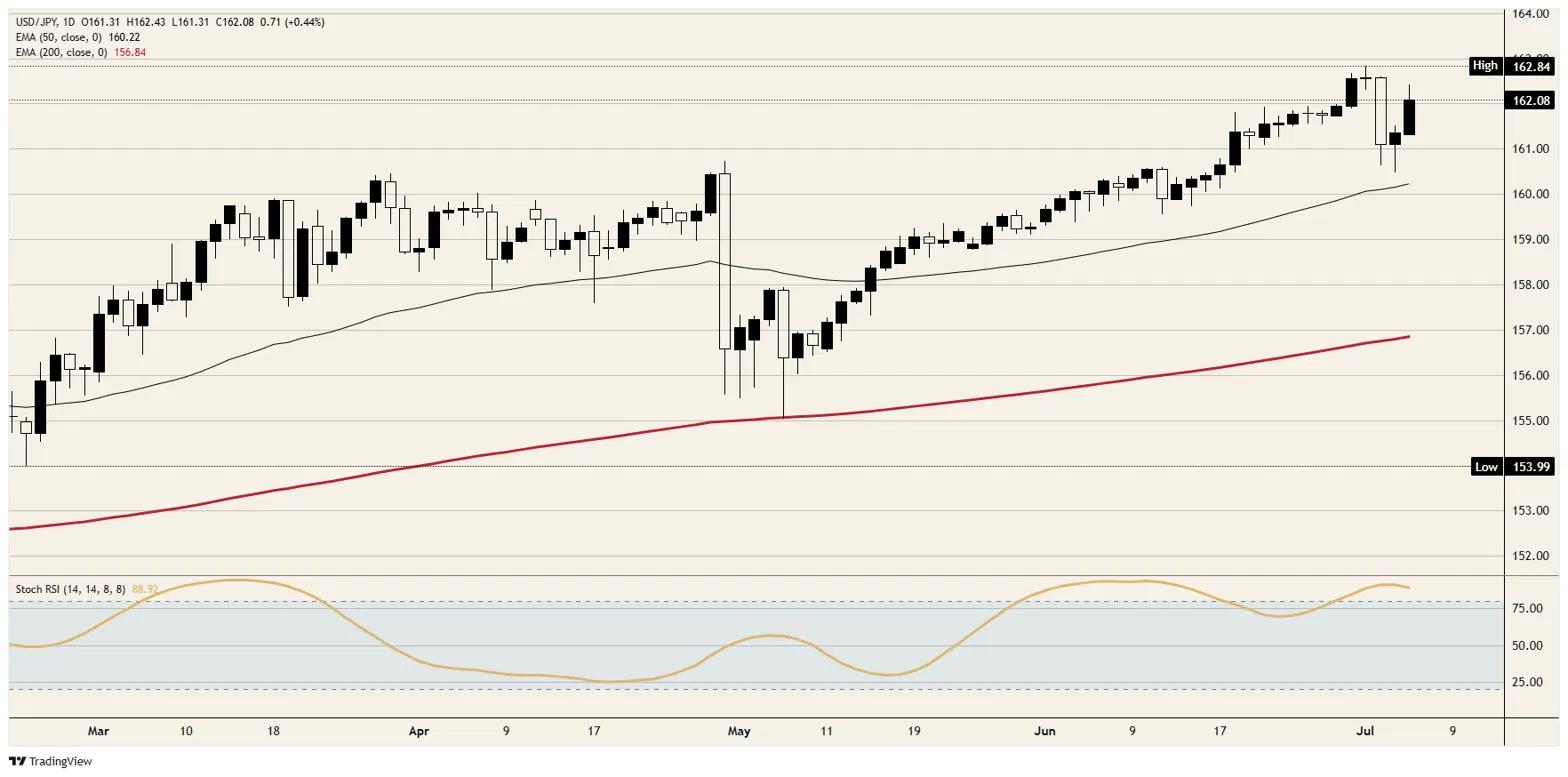
USD/JPY spent Monday doing what it has done for most of the year, grinding higher while officialdom watched. The pair climbed from near 161.50 in early Asian trading to just shy of 162.50 by the London afternoon, faded through New York, and settled a touch above the 162.00 mark, within one big figure of the cycle high printed last week.
The notable part is that the Dollar itself was not doing much. Sterling rallied through the same New York afternoon and the greenback's broader tape was soft, yet the Yen still lost 71 pips on the day, which makes Monday a Yen story rather than a Dollar one. The currency is being sold on its own merits, at levels last seen roughly 40 years ago.
The ministry has stopped talking, on purpose
The Yentervention watch produced last week's wobble, when the pair tagged its cycle peak and traders briefly remembered that Japan spent close to ¥12 trillion, around $73 billion, buying its own currency through April and May. The recovery came when they noticed what followed: nothing. The Finance Ministry has withdrawn its verbal warnings entirely, refuses to name any threshold, and reportedly now favours ambush tactics triggered by the build-up of speculative short positions rather than by a particular level. The 162.00 handle is the market's own line in the sand; Tokyo declines to co-sign it, on the logic that a confirmed trigger is just a level speculators can lean on with confidence.
A hike bought an afternoon
The Bank of Japan (BoJ) raised its policy rate to 1.00% on June 16, the first time above that threshold in three decades, with a lone dissent and a hawkish supporting cast talking about a march toward a 2% neutral rate. The Yen strengthened for roughly a session. Policy remains accommodative by the Bank's own description, real rates are still negative with inflation forecast back above 2% as subsidies roll off and war-era energy costs pass through, and the next hike is not expected until the fourth quarter. Against a Federal Reserve (Fed) holding at 3.75% and openly debating whether its next move is up, a 25-point instalment plan does not change the carry arithmetic; analysts have likened intervening while policy stays this loose to braking with the other foot still on the accelerator.
Tonight's wages, Wednesday's Minutes
Labor Cash Earnings for May land at 23:30 GMT tonight with consensus at 3.4% YoY against 3.5% prior; wages are the variable the BoJ actually watches, and a hot print revives the case for moving before the fourth quarter. Japan's current account follows Tuesday at 23:50 GMT, expected north of ¥4 trillion, a reminder that a country running surpluses that size with a currency at 40-year lows is exporting its own savings. Minutes from the June Federal Open Market Committee (FOMC) meeting arrive Wednesday at 18:00 GMT, and a hawkish read that revives the US hike debate would put the cycle high straight back in play.
Levels to watch
Resistance: The first ceiling is 162.50, Monday's stalling point, with the cycle high just under 163.00 behind it. Beyond that the chart offers nothing but round numbers nobody has traded in four decades, which is precisely why the market keeps probing.
Support: The 162.00 mark is first support and the session's psychological pivot, with Monday's launch point near 161.50 below it and last week's scare low around 161.00 beneath that. The 50-day Exponential Moving Average (EMA) just above the 160.00 handle is the rail the entire trend has ridden since mid-May.
Bias: Bullish, with an asterisk the size of Japan's Finance Ministry. The trend, the carry, and the momentum all point higher, and dips toward 161.50 keep getting bought inside a session. The one seller with the firepower to reverse this has chosen silence over signalling, so the honest read is bullish until Tokyo's next surprise, with tight risk below 161.00 because that surprise is designed to arrive unannounced.
USD/JPY daily chart
Japanese Yen FAQs
The Japanese Yen (JPY) is one of the world’s most traded currencies. Its value is broadly determined by the performance of the Japanese economy, but more specifically by the Bank of Japan’s policy, the differential between Japanese and US bond yields, or risk sentiment among traders, among other factors.
One of the Bank of Japan’s mandates is currency control, so its moves are key for the Yen. The BoJ has directly intervened in currency markets sometimes, generally to lower the value of the Yen, although it refrains from doing it often due to political concerns of its main trading partners. The BoJ ultra-loose monetary policy between 2013 and 2024 caused the Yen to depreciate against its main currency peers due to an increasing policy divergence between the Bank of Japan and other main central banks. More recently, the gradually unwinding of this ultra-loose policy has given some support to the Yen.
Over the last decade, the BoJ’s stance of sticking to ultra-loose monetary policy has led to a widening policy divergence with other central banks, particularly with the US Federal Reserve. This supported a widening of the differential between the 10-year US and Japanese bonds, which favored the US Dollar against the Japanese Yen. The BoJ decision in 2024 to gradually abandon the ultra-loose policy, coupled with interest-rate cuts in other major central banks, is narrowing this differential.
The Japanese Yen is often seen as a safe-haven investment. This means that in times of market stress, investors are more likely to put their money in the Japanese currency due to its supposed reliability and stability. Turbulent times are likely to strengthen the Yen’s value against other currencies seen as more risky to invest in.
추천 기사


